Cinema Advertising Returns as Premium Placement Digital Can't Replicate
Independent agencies are rediscovering theatrical advertising's singular advantage: guaranteed viewability, zero skip rate, and audiences that chose to be captive.

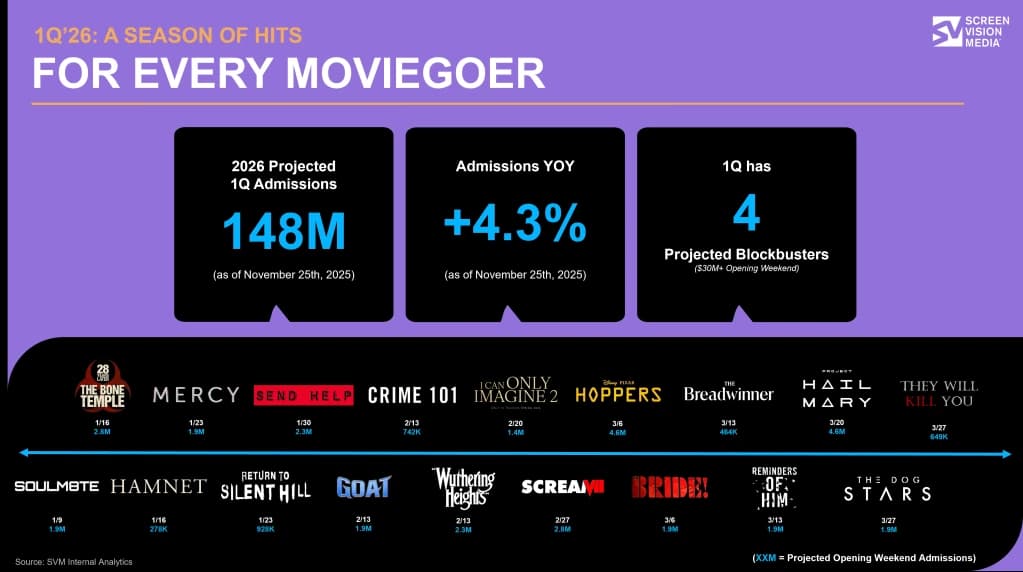
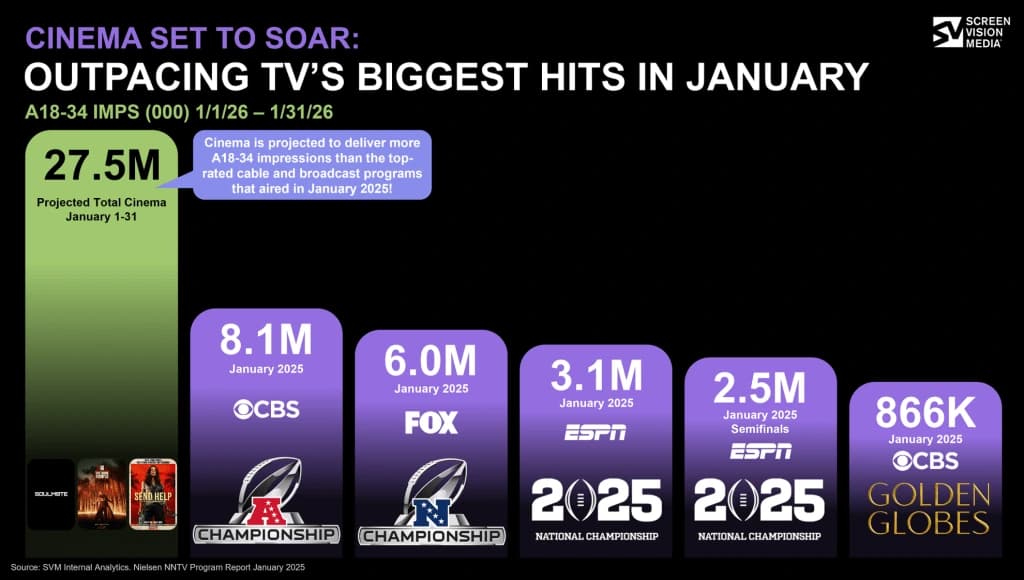
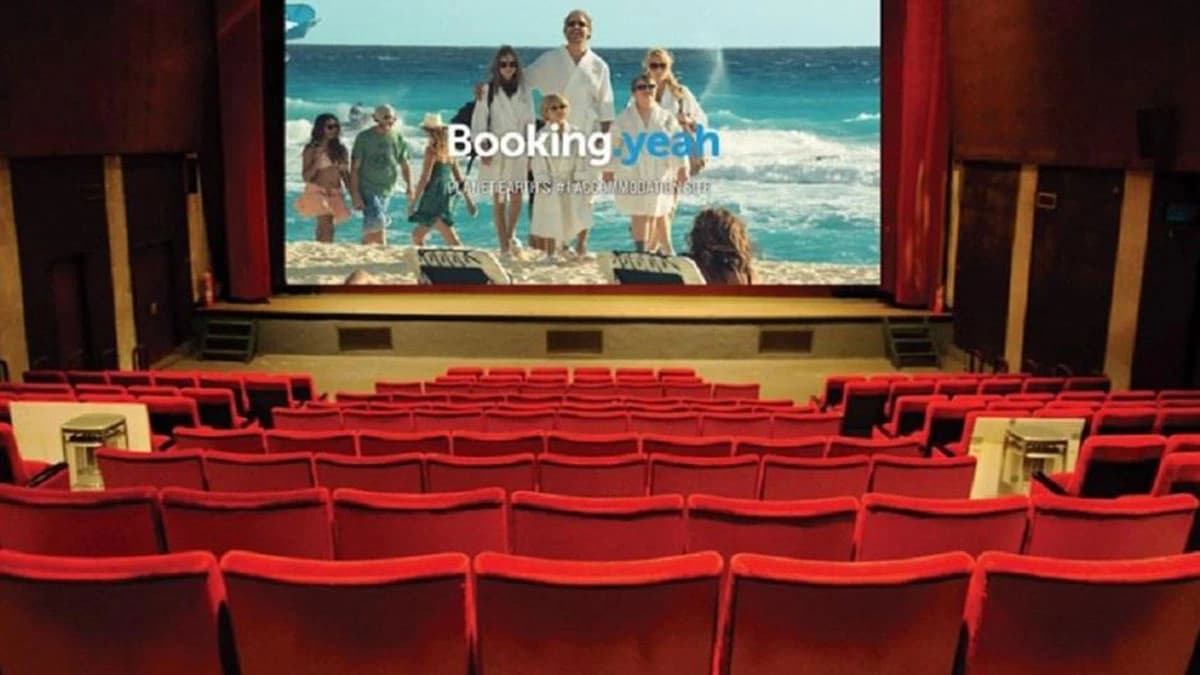
The lights dim and phones go dark. 300 people who paid $15 each sit captive for the next two hours. And right before the Marvel logo drops, your client's 60-second spot plays on a screen 40 feet wide with Dolby Atmos sound that makes a Super Bowl ad feel like an Instagram Story.
Cinema advertising died in 2020. Theaters shuttered. Streaming won. The 30-second pre-roll became the default unit of video advertising. By 2023, agencies had moved on.
By 2026, they're moving back.
12,100 monthly searches for "digital cinema media" and related terms. That's 340% higher than pre-pandemic levels. Not from consumers looking for showtimes. From agencies looking for theatrical ad specs, DCM relationships, and proof points to sell clients on a medium most CMOs wrote off as legacy infrastructure. The search volume tells the story before the box office numbers do: cinema advertising isn't recovering. It's being rediscovered as a premium placement with advantages digital can't replicate.
The pitch is straightforward. Where else can you guarantee 100% viewability, zero skip rate, and an audience that chose to be there? Not on YouTube. Not on Hulu. Not anywhere screens compete with notifications. Theaters offer the last truly captive environment in media. And independent agencies are building entire theatrical practices around that singular advantage.
The Client Objection Playbook: Streaming vs. Screens
Every cinema pitch starts with the same CMO question: "Why would we spend theatrical budget when our target demos stream everything?"
Smart agencies don't argue. They reframe.
The objection assumes theaters and streaming compete for the same attention. They don't. Theatrical targets intentionality. Someone who drives to a cinema, pays $15-20, and commits two hours isn't passively scrolling. They're locked in. That behavioral difference: recall rates 76% higher than television and 4x higher than pre-roll video, according to UK data agencies are citing in pitch decks. The medium selects for engagement before the ad even runs.
Demographic concentration is the second counter. Streaming fragments audiences across 10,000 title choices. Theaters concentrate them into predictable cohorts. A Friday night Marvel premiere pulls 18-34 males. Sunday matinee family films deliver parents with household income above $75K. Horror releases skew female 18-24. Agencies positioning cinema aren't selling reach. They're selling precision at scale. One theatrical buy can deliver more concentrated exposure to a target demo than 50 programmatic placements scattered across CTV inventory.
The third reframe: streaming ads interrupt content people already chose. Theatrical ads ARE the pre-content ritual. Audiences expect them. The lights-down moment has commercial space baked into the experience. That's not interruption. That's context. Agencies winning these budgets frame theatrical as premium anticipation, not forced viewing. The positioning matters: your brand gets the big-screen treatment reserved for $200 million tentpoles, not the skippable slot before a binge session.
Cost per engaged viewer closes the argument. Theatrical CPMs run higher than digital video, typically $25-45 depending on market and daypart. But cost per actual attention second? Agencies are calculating it at $0.08-0.12 once you factor in guaranteed completion and multi-sensory impact. A 60-second theatrical spot delivers more retained brand messaging than six 15-second YouTube bumpers, even if the aggregate impressions look smaller on the media plan. CFOs care about cost per impression. CMOs increasingly care about cost per memory formed. Theatrical wins the second calculation.
Who's Building Theatrical Practices: Media Shops vs. Creative Boutiques
The theatrical revival isn't evenly distributed across agency types. Two categories are leading: media planning independents who see it as portfolio expansion, and creative boutiques positioning it as craft showcase.
Media shops with existing out-of-home or experiential practices bolt theatrical onto those capabilities. The operational logic is identical: buying physical space, negotiating with venue networks, trafficking creative files to specific technical specs. An agency that already manages billboard rotations or stadium sponsorships can add cinema without building new infrastructure. They're pitching theatrical as "premium OOH" rather than video advertising. The sell is incremental revenue from existing client relationships, not net-new business development.
Creative boutiques are taking the opposite approach. They're positioning theatrical as the ultimate canvas for the work. A shop that prides itself on craft wants the biggest possible screen and the most attentive possible audience. Theatrical becomes the hero placement that justifies the creative ambition. These agencies pitch cinema as the capstone of integrated campaigns: the digital and social components drive awareness, but the theatrical execution is what the brand will be remembered for. The economics work because theatrical creative commands premium rates. A 60-second cinema spot carries higher production budgets and agency fees than its digital equivalent, even when the same footage gets versioned across both.
Advertising Week New York, an 11-50 person shop, ranks #78 for "digital cinema media" with 12,100 in monthly search volume. That keyword position suggests either active content marketing around theatrical buying or client work they're showcasing as case studies. The search volume concentration indicates this isn't a passing interest. Agencies don't organically rank for a 12K-volume keyword without sustained effort or demonstrated expertise in the category.
The split between media-led and creative-led theatrical practices shows up in pitch composition. Media shops lead with audience guarantees, daypart optimization, and DCM/NCM relationship access. Creative boutiques lead with the spectacle: "Your brand, 40 feet tall, Dolby Atmos, unskippable." Both work. The media pitch sells efficiency. The creative pitch sells impact. Clients with performance KPIs choose the first. Clients with brand-building mandates choose the second.
Agency size determines theatrical viability differently than other channels. A 5-person shop can't staff a theatrical practice. The vendor relationships, trafficking workflows, and creative specs require dedicated capacity. But a 15-person boutique with one media planner absolutely can. Theatrical doesn't demand scale. It demands specialization. The agencies winning these budgets aren't the biggest. They're the ones who made theatrical a named service offering rather than an ad-hoc accommodation.
The Tactical Buying Guide: Minimums, Relationships, Specs
Theatrical advertising has operational barriers digital doesn't. Agencies need to know them before they pitch the capability.
Minimum spends vary by market and exhibitor network. National campaigns through NCM typically require $50K minimum commitments. That buys roughly 2-3 weeks of rotation across mid-tier markets with limited screen allocation. Premium markets (LA, NYC, SF) command $100K minimums for meaningful impression delivery. DCM, the UK's dominant theatrical network, operates on similar floor pricing: £30-40K for national buys, tiered down for regional targeting.
Local theatrical buys offer lower entry points but fragmented execution. A single-market campaign targeting 10-15 screens might require only $8-12K, but agencies are negotiating directly with individual theater managers rather than centralized networks. That's viable for regional clients or test campaigns. It's unscalable for national brands. The agencies building sustainable theatrical practices focus on network relationships, not one-off local deals.
DCM and NCM function as duopolies in their respective markets. Both own the digital projection infrastructure and ad server relationships with major chains. Agencies can't bypass them. That means cultivating account rep relationships and understanding each network's booking calendars, which run 8-12 weeks ahead of flight dates for national campaigns. Rush buys exist but carry premium CPMs. Agencies selling theatrical need buffer time baked into timelines, especially for clients used to programmatic's 48-hour turnarounds.
Creative specs are non-negotiable and more restrictive than broadcast. DCM requires DCP files: JPEG 2000 encoding, 2K or 4K resolution, 5.1 or 7.1 surround sound, specific frame rates tied to projection standards. NCM has parallel requirements with slight codec variations. Agencies can't deliver an MP4 and call it done. Most theatrical campaigns require dedicated post-production to meet technical certification. Budget $5-8K for DCP mastering and QC on top of creative production costs.
Aspect ratio matters more than agencies expect. Theatrical screens are 1.85:1 or 2.39:1, not the 16:9 standard for digital video. Creative shot for TV or YouTube will either pillarbox (black bars on sides) or require crop-and-reframe. Agencies positioning theatrical as premium need native compositions, not reformats. That means storyboarding with theatrical specs from concept stage, not adapting existing assets in post.
Length flexibility is theatrical's hidden advantage. Digital video favors 15-second units. Broadcast sells 30s. Theatrical accommodates 60-90 seconds without CPM penalties, because the ad block structure is fixed regardless of individual spot length. Brands with stories to tell can actually breathe in theatrical. Agencies are using this to pitch narrative-driven creative that would never survive digital's skip-rate economics. A 90-second theatrical spot costs marginally more than a 60-second, but delivers 50% more message retention. The math favors storytelling.
Daypart targeting exists but operates differently than digital. Morning shows (before noon) skew older and deliver lower CPMs. Evening shows (7-10pm) command premium pricing and younger demos. Weekend matinees concentrate families. Late-night Fridays pull date demos. Agencies optimizing theatrical buys are mixing dayparts the way digital campaigns mix device types: premium slots for hero creative, value slots for reach extension.
ROI Proof Points: What Agencies Use in Pitch Decks
Theatrical advertising lacks the attribution infrastructure of digital. No pixels. No conversion tracking. No deterministic identity graphs. That forces agencies to sell on different metrics: recall, consideration lift, and audience quality rather than last-click attribution.
Recall rates are the lead proof point. UK data shows cinema ads achieve 76% better recall than television and 4x better than pre-roll video. Australian research from Val Morgan (that country's theatrical network) clocks cinema ad recall at 86% versus 41% for TV and 19% for digital video. Those numbers appear in every theatrical pitch deck because they're the strongest available case for attention quality.
Brand favorability lift follows recall. Post-exposure surveys show 3-4 point increases in favorability for brands advertising in theatrical versus control groups. The effect persists for 7-10 days, compared to 2-3 days for digital video. Agencies are positioning this as "sustained resonance" rather than momentary awareness. The argument: one theatrical impression can do the brand-building work of five digital impressions because the context embeds the memory differently.
Demographic concentration is the third pillar. Theatrical doesn't deliver scale, it delivers specificity. A campaign targeting affluent millennials can buy Marvel premieres and music biopics and hit 70%+ audience composition match. Programmatic video might deliver the same absolute reach but at 30-40% composition. Agencies are calculating "waste reduction" as an ROI factor. Theatrical's higher CPM looks efficient once you account for audience purity.
Survey-based attribution fills the conversion gap. Agencies are running post-purchase surveys asking how customers discovered the brand. Theatrical-exposed audiences report 12-15% aided recall of cinema advertising as a discovery source. That's not deterministic proof, but it's quantifiable influence. For considered purchases (automotive, financial services, consumer electronics), that survey data becomes the ROI story when pixel tracking isn't available.
Case study proof points matter more than aggregate stats. Agencies pitch theatrical by showing what worked for similar clients, not by citing industry averages. A luxury auto brand that saw 23% test drive increases in theatrical markets versus control markets. A spirits brand that measured 18% retail velocity lift correlating to cinema campaign timing. Anecdotal isn't scientific, but specific beats generic in pitch situations. The best theatrical decks include 3-4 named case studies with concrete outcome metrics, even if the methodology wouldn't survive academic peer review.
Cost per engaged minute is the emerging metric. Calculate total audience attention time (ad length × number of viewers who saw it to completion) and divide by campaign cost. Theatrical consistently delivers $0.40-0.60 per engaged minute. Digital video runs $1.20-1.80 once you account for skip rates and multi-tasking. That math reframes theatrical's CPM premium as an attention efficiency play. CFOs understand cost-per-output better than they understand reach and frequency.
The Ad-Length Backlash Problem: Positioning Premium Interruption
Theatrical's advantage is becoming its liability. Captive audiences tolerate ads until they don't. And exhibitors are testing that ceiling.
Pre-show ad blocks now run 20-30 minutes in major chains. Regal, AMC, and Cinemark all expanded inventory 2024-2025 to offset pandemic revenue losses. That's 15-20 individual ads before trailers even start. Audiences are noticing. Social media complaints about "50 minutes of ads" trend monthly. Theater chains defend it as necessary economics. Advertisers risk being the villains in someone else's business model crisis.
Agencies positioning theatrical need to address this directly with clients. The frame: your brand can be part of the problem or part of the solution. Long ad blocks create backlash. Premium creative within those blocks creates contrast. A beautifully shot 60-second spot with actual narrative stands out against 10 mediocre 15-second retailer ads. The strategy isn't to ignore the clutter. It's to be the signal within it.
Ad placement within the block matters. Agencies with strong DCM/NCM relationships can negotiate "first position" or "last before trailers" slots for premium pricing. First position captures attention before fatigue sets in. Last position benefits from the shift in energy when audiences realize trailers are starting. Middle positions (ad 8 of 15) get lost. Agencies selling theatrical should build placement negotiation into the pitch, not treat it as an afterthought.
Creative length becomes strategic positioning. Conventional wisdom says shorter is better to minimize irritation. Theatrical flips that. A 15-second spot in a 25-minute ad block registers as clutter. A 90-second cinematic narrative registers as entertainment. Counter-intuitive but true: longer theatrical creative can generate more goodwill than shorter if the craft justifies the time. Agencies are pitching "earn the screen" creative that respects the theatrical context rather than treating it as just another video placement.
The "premium interruptor" frame distinguishes brand advertisers from local car dealers and regional furniture chains. Most theatrical inventory goes to direct-response local advertisers with crude creative and immediate calls-to-action. National brand campaigns with high production values automatically stand out. Agencies position this as venue elevation: your presence in theatrical signals you belong with the tentpoles, not the clearance sales. That brand association carries weight with audiences even if they consciously recognize it's an ad.
Theater partnerships offer a backdoor solution. Brands sponsoring individual screenings (private events, preview nights, festival partnerships) can deliver theatrical-scale impact without the ad-block baggage. Agencies are packaging these as "theatrical activations" rather than media buys. A spirits brand hosting a premiere party. A fashion label sponsoring an indie film screening series. The audience experiences the brand in a theatrical context without 20 competing ads diluting the moment.
What Comes Next: Theatrical as Craft Showcase
Cinema advertising won't replace digital video. It doesn't need to. It serves a different function: credibility signaling.
A brand advertising theatrically communicates confidence in its creative. You don't put mediocre work on a 40-foot screen. You don't soundtrack it with Dolby Atmos unless you believe it deserves that treatment. Theatrical presence implies creative ambition. That matters for brand perception independent of the ad's direct performance.
Agencies are positioning theatrical as the "book cover" of integrated campaigns. The digital components drive traffic and conversions. The theatrical component signals the brand is serious. That duality lets agencies sell theatrical even to performance-focused clients. The argument: you need the digital infrastructure for attribution, but you need the theatrical presence for credibility. One without the other underperforms.
Award shows are reinforcing this. Cannes Lions judges still favor theatrical executions over digital-only campaigns for major categories. A theatrical campaign has built-in craft demonstration: cinematography, sound design, scale of production. Digital campaigns require explanation. Theatrical campaigns show themselves. Agencies chasing awards know this. Theatrical becomes part of the creative ladder: make great work, put it in theaters, submit it for recognition, use the recognition to win more business.
The independent agency advantage shows up here clearly. Holdco shops struggle to justify theatrical's non-performance metrics. Independence gives boutiques permission to sell on different terms. They can pitch theatrical as brand-building without quarterly earnings pressure forcing everything into attribution models. That's strength, not survival. The agencies winning theatrical budgets are the ones who can articulate why brand memory matters even when you can't pixel-track it.
12,100 monthly searches for cinema advertising terms represents agencies researching capability they don't yet have. That's the forward signal. By 2027, theatrical won't be a specialty offering. It'll be a standard line item in premium video plans. The agencies building those practices now are establishing expertise while the category is still underdeveloped. That's the independent playbook: find the emerging advantage before it becomes table stakes.
The lights go down. Phones stay dark. Your client's work fills 40 feet of screen. And for 60 seconds, you have what digital can never guarantee: complete, undivided, unavoidable attention. That's not legacy media. That's the premium placement every other channel is trying to replicate.
Free Agency Media Editorial
All news