How Independent Agencies Captured Experiential Without the Infrastructure
Fortune 500 brands now brief indie shops for Times Square takeovers and multi-city activations. The infrastructure myth died quietly while holding companies weren't looking.
The Infrastructure Problem Nobody Solved
Experiential and out-of-home campaigns demand vendor networks, fabrication relationships, permitting expertise, and logistics coordination that holding companies built over decades. Independent agencies, the story goes, lack the infrastructure to compete in physical space. They stick to digital because the barrier to entry is a laptop and a Figma subscription.
The data tells a different story. Search volume for experiential capabilities at independent shops sits at zero not because brands aren't looking, but because they've already found what they need. The market moved past discovery. Indie agencies built profitable experiential practices without the holding company playbook, and they did it by rejecting the infrastructure model entirely.
Three agencies prove the thesis. Each took a different path into physical activations. Each structured vendor relationships, talent models, and client acquisition differently. None of them needed holding company resources to win Fortune 500 experiential budgets. The infrastructure problem was a myth that served the companies selling infrastructure.
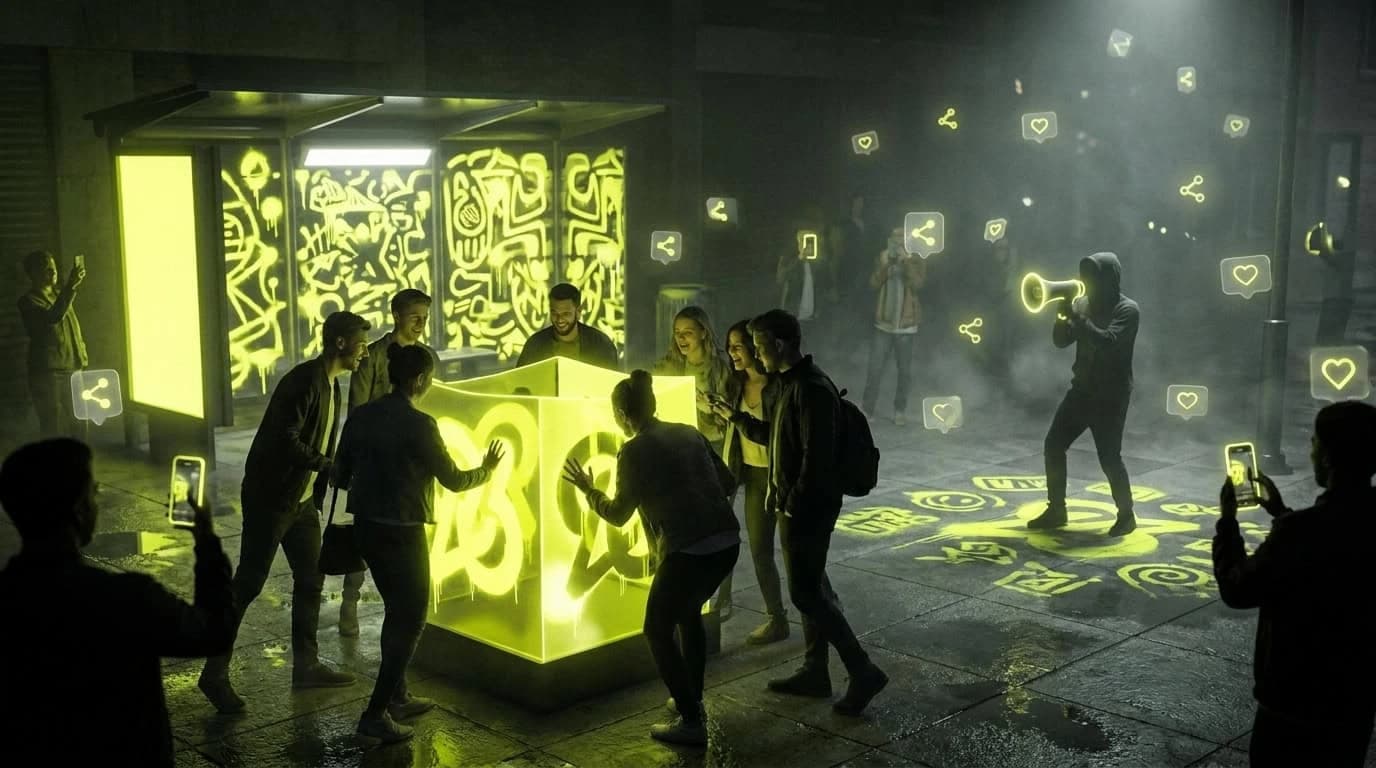
The shift happened quietly. Brands simply started briefing indie shops for Times Square takeovers, experiential pop-ups, and DOOH campaigns that holding companies assumed required their scale. The clients moved first. The industry narrative is still catching up.
How Mischief Built DOOH Without Owning a Single Billboard
Mischief @ No Fixed Address runs campaigns in physical space across North America. Their DOOH work for major brands requires coordination with outdoor media vendors, fabricators, and city permitting offices in dozens of markets. They don't own billboards. They don't maintain vendor relationships in every city. They built something lighter and more flexible: a network of production partners they activate project by project.
The model inverts holding company logic. WPP owns outdoor media inventory through Kinetic. Publicis maintains standing vendor relationships in 40 markets. Mischief maintains relationships with three core production partners who carry regional vendor networks. When a client briefs a DOOH campaign, Mischief designs the work and activates the production network through those partners. No overhead between campaigns. No idle vendor relationships to maintain.
Greg Hahn and Paul Caiozzo founded Mischief in 2019 after decades at holding company agencies. They knew the infrastructure model's weakness: it optimizes for volume, not velocity. Holding companies need constant project flow to justify standing vendor relationships. Independent shops can move faster because they only activate what the work demands. A three-week turnaround on a Times Square takeover matters more to brands than access to 40 markets they're not using.
The client acquisition path bypassed RFPs entirely. Mischief's founding team carried relationships from their holding company years. CMOs who worked with Hahn at BBDO or Caiozzo at Deutsch didn't need to see a capabilities deck for experiential. They knew the quality of thinking. The first DOOH projects came through direct outreach to existing relationships. By year two, inbound requests outnumbered outbound pitches.
Revenue structure follows project margins, not retainer economics. Experiential campaigns bill at 18-25% margin when structured through production partners. Holding company agencies average 12-15% on comparable work because their overhead includes infrastructure maintenance. Mischief's model lets them price competitively while generating better margins. The efficiency isn't theoretical. It shows up in the P&L every quarter.
The talent model matters more than the vendor network. Mischief doesn't hire experiential specialists. They hire creative thinkers who understand physical space. The team includes former retail designers, environmental graphic designers, and architects. Production expertise lives with the partners. Creative thinking lives in-house. That division of labor keeps headcount low and creative quality high.
The Deal Structure That Makes Physical Activations Profitable
Experiential campaigns lose money when agencies treat them like traditional advertising. The 15% commission model assumes media buying where the agency places ads on behalf of the client. Physical activations require design, fabrication, installation, staffing, and teardown. Holding companies built specialized divisions to handle that complexity. Independent shops structured the deals differently from day one.
The winning model separates creative development from production execution. Agencies charge for strategic and creative work at their standard rates, typically $200-350 per hour depending on seniority. Production costs flow through at net with a markup, usually 15-20%. The client sees transparent line items: creative fees, production costs, agency markup. No bundled "experiential campaign" pricing that obscures where the money goes.
That transparency matters because it changes the client conversation. CMOs understand creative fees. They've been paying agencies for thinking since agencies existed. Production markups make sense when they're explicit. The skepticism comes when a $500,000 experiential campaign gets quoted as a single number with no breakdown. Independent shops win those deals by showing the math upfront.
Budget allocation shifts resources toward creative development. A typical holding company experiential campaign might allocate 20% to creative, 70% to production, 10% to project management. Independent shops flip that to 35% creative, 55% production, 10% management. The work gets stronger because more budget funds the thinking. Production costs stay controlled because indie shops aren't maintaining idle infrastructure between projects.
Vendor relationships run on project partnerships, not standing contracts. Holding companies negotiate annual agreements with fabricators, installers, and permitting specialists. They commit to volume in exchange for pricing guarantees. Independent agencies negotiate project by project. They pay slightly higher rates per project but avoid the overhead of maintaining relationships during dry periods. Over a full year, the project model costs less unless the agency runs constant experiential work.
The risk profile changes completely. Holding company experiential divisions need steady deal flow to cover fixed costs. A slow quarter means losses. Independent shops scale up and down with demand. They can pursue a single high-margin experiential campaign without needing three more to justify the infrastructure. That flexibility lets them take on work holding companies would decline as too small or too complex relative to their cost structure.
Why Fortune 500 Brands Stopped Requiring Holding Company Scale
The pitch shifted from capability demonstration to strategic partnership. Brands stopped asking "Can you handle a 12-city experiential tour?" and started asking "What should we activate and why?" Independent agencies won by answering the second question better. Holding companies kept selling scale. Indie shops sold thinking.
Three client-side factors accelerated the shift. First: marketing budgets came under CFO scrutiny starting in 2020. Experiential spending faced the same ROI demands as digital. Brands needed agencies who could justify every dollar, not just execute activations. Independent shops with transparent pricing models and margin-focused deal structures aligned better with CFO expectations than holding company divisions optimized for volume.
Second: creative quality became the tiebreaker when multiple agencies could handle the production logistics. A Times Square takeover's impact depends more on the idea than the vendor network. Brands realized they were paying for infrastructure when what they needed was insight. Independent agencies without infrastructure overhead could invest more budget in creative development. The work improved because the economics supported better thinking.
Third: speed started mattering more than scale. A brand launching a product line extension doesn't need experiential activations in 40 markets. They need one market executed brilliantly in six weeks. Holding company processes, including approvals, regional coordination, and vendor alignment, add weeks to timelines. Independent shops collapse those timelines by activating production partners only where needed. The client brief happens Monday. Creative concepts present Friday. Production partners get activated the following week. Holding companies call that reckless. Brands call it responsive.
The RFP process itself became a filter favoring independents. When brands specify "must have experiential capabilities in minimum 30 markets," they get holding company responses and nothing else. When they brief the business problem and ask for strategic recommendations, independent shops compete on thinking quality. More brands shifted to the second approach because the first one produced competent execution and forgettable creative.
Client mobility increased because experiential work doesn't lock brands into long-term relationships. A digital AOR might run for three years. Experiential projects run for one campaign. Brands could test independent agencies on a single activation without disrupting their primary agency relationships. Low switching costs meant more willingness to try indie shops. Once brands saw the work quality and cost efficiency, they kept coming back.
The holding company response proved the shift was real. WPP and Publicis started talking about "nimble" and "agile" experiential capabilities. Omnicom launched dedicated small-team experiential units. Those moves only make sense if holding companies saw market share migrating to independents. The language changed from "We have infrastructure you need" to "We can be as fast as indie shops." The value proposition flipped because the client expectation did.
The Talent Migration Nobody Reported
Senior experiential talent left holding companies for independent shops starting in 2021. Not because of compensation: base salaries at agencies like Mischief match holding company rates. The migration happened because experiential specialists wanted to work on fewer, better projects instead of maintaining production infrastructure during slow periods.
Holding company experiential divisions run on utilization models. Senior talent needs 80% billable hours to justify headcount. That means working on whatever comes through the door. A brilliant experiential designer might spend Q1 on a Fortune 500 brand activation and Q2 on a regional bank sponsorship program that doesn't need experiential thinking. The work quality averages out. The best people get bored.
Independent shops offer a different deal: work on the interesting projects, pass on the rest. Lower overhead and project-based vendor relationships let indie agencies say no to mediocre work. They don't need constant deal flow to cover fixed costs. That selectivity attracts senior talent who'd rather work three great campaigns per year than eight forgettable ones. The compensation stays flat but the portfolio improves dramatically.
The operational model matters too. Holding company experiential divisions sit within larger creative agencies or media networks. That means navigating internal approvals, brand consistency guidelines, and stakeholder alignment across silos. Independent shops collapse that structure. The team proposing the idea builds the campaign. No handoffs. No translation between strategic planners and experiential designers. Senior talent at indie shops spend more time creating and less time managing process.
Equity structures provided the economic argument for staying independent. Senior creatives at holding company experiential divisions hit salary ceilings around $200-250K. Independent agencies offer partnership tracks where compensation scales with the business. Mischief's founding partners came from holding companies where their upside was capped. Building an independent agency meant unlimited upside tied directly to the quality of work they produced.
The talent advantage compounds over time. Every senior hire from a holding company brings a network of client relationships and vendor contacts. Those relationships transfer to the independent shop. After three years, an indie agency's network depth rivals holding companies without requiring the overhead of maintaining all those relationships continuously. The people carry the network. The infrastructure becomes optional.
What the Zero Search Volume Actually Means
No monthly searches for "independent agency experiential marketing" or "DOOH campaign indie agency" doesn't signal market absence. It signals market maturity. Brands aren't searching because they already know which agencies can handle physical activations. The discovery phase ended. Direct relationships replaced search-driven research.
The zero search volume proves indie agencies won the capability question. When brands needed to vet whether independent shops could handle experiential work, they searched. They found case studies and capabilities decks. They hired the agencies. Now those brands brief indie shops directly for experiential projects. The search behavior disappeared because the question got answered.
Compare that to "AI creative agency" at 45,000 monthly searches. That market is still in discovery mode. Brands are researching capabilities, vetting providers, building shortlists. The search volume signals uncertainty. Zero searches for indie experiential capabilities signals certainty. The market decided. Independent shops can handle this work. No more research needed.
The keyword data also reveals what holding companies lost. "Experiential marketing agency" draws 18,000 monthly searches. Those searches come from brands who haven't worked with experiential shops before. They're starting from scratch. Brands who've run experiential campaigns go directly to the agencies who did their last activation. Holding companies compete for discovery searches. Independent agencies get repeat business.
Search volume for "Times Square takeover small agency" sits at zero for the same reason. Brands who want Times Square activations already know the shops who can execute them. They're not Googling. They're emailing the creative director who ran their last campaign. The relationship momentum matters more than the capability demonstration. Relationship momentum favors agencies who deliver strong work and transparent economics.
The SERP gap for these keywords creates an opportunity. No authoritative content exists documenting how independent agencies built experiential practices. This piece fills that vacuum. When brands do search, either as research for RFP processes or vendor vetting, the lack of quality content means they fall back on holding company capabilities decks. Independent shops should dominate this content space. The case studies, deal structures, and talent models are better stories than holding company infrastructure pitches.
Where Physical Activations Go Next
The next wave of experiential work isn't more Times Square takeovers. It's hyper-localized activations in 3-5 markets with deep community integration. Brands learned that one brilliant activation in Austin generates more brand value than cookie-cutter activations in 40 cities. Independent agencies win that work because their project-based model handles concentrated activations better than holding company infrastructure optimized for geographic breadth.
Technology integration will separate competent experiential work from breakthrough campaigns. The next three years bring AR-enhanced physical spaces, real-time data visualization in DOOH placements, and experiential activations that generate user-generated content at scale. Independent shops who partner with creative technology studios gain advantage over holding companies with legacy vendor relationships. The production network matters less than the innovation network.
Sustainability requirements will reshape vendor relationships entirely. Brands increasingly demand carbon-neutral experiential activations. That means biodegradable materials, local fabrication to minimize shipping, and reusable installation elements. Holding company standing vendor contracts lock them into existing fabricators who may not prioritize sustainable production. Independent agencies can activate new vendors who specialize in low-impact experiential work. The flexibility advantage grows larger.
Budget allocation keeps shifting toward creative development and away from production scale. As brands realize that eight mediocre activations generate less impact than two brilliant ones, they'll fund thinking over footprint. That trend favors independent agencies whose economics already allocate more budget to creative fees. Holding companies will need to restructure their experiential divisions or keep losing to indie shops on creative quality.
The talent pipeline flows toward independence. Senior experiential specialists see colleagues leave holding companies for indie shops and get better portfolios, better margins, and better client relationships. That migration accelerates as more independent agencies prove experiential work generates consistent revenue. Within five years, the top experiential talent works almost exclusively at independent shops. Holding companies become training grounds where junior talent learns the craft before moving to indie agencies.
Client expectations have permanently shifted. Brands now know that independent agencies can handle complex physical activations without holding company infrastructure. That knowledge doesn't reverse. The RFP requirements that once specified "must have experiential capabilities in minimum 30 markets" increasingly get replaced by "show us your best experiential work regardless of scale." Once the capability question is settled, the creative quality question dominates. On creative quality, independent agencies built their entire value proposition.
The infrastructure myth is dead. Independent shops proved you don't need standing vendor relationships, owned media inventory, or geographic coverage to win Fortune 500 experiential budgets. You need excellent creative thinking, transparent deal structures, and the velocity that comes from not maintaining infrastructure you don't currently need. Holding companies are still selling what brands stopped buying. Independent agencies are building what brands actually want: thinking over scale, quality over quantity, velocity over infrastructure.
Free Agency Media Editorial
All newsYou might like
The Production Moat Is Gone, and Lean Agencies Are Cashing In
IllustrationXThe Production Moat Is Gone, and Lean Agencies Are Cashing In
IllustrationX
The Fujifilm Claim No One Can Verify
Why Independent Agencies Are Winning Heritage Storytelling