Why Independent Agencies Are Ignoring Billions in Channel Marketing Budgets
14,800 monthly searches for "what are market development funds" and only one indie agency in the top 100. The MDF opportunity is wide open.

14,800 people search for "what are market development funds" every month. Only one independent agency ranks in the top 100.
That's not a competitive keyword. That's an open goal with no goalkeeper. And the reason almost nobody's taking the shot reveals how independent agencies think about business development: they're still optimizing for brand clients who Google "creative agency Los Angeles" when billions in channel marketing budgets sit untouched because nobody's claiming the language that unlocks them.
Mojenta, an 11-50 person San Diego shop founded in 2010, ranks #93 for that search. Their positioning is surgical: "the go-to HubSpot agency for B2B telecom, IT, and cloud." That's not accident. That's a shop that understood the assignment. While holding company agencies chase Fortune 500 brand budgets and 200-person independents compete for the same CMO attention, Mojenta built a practice around the channel marketing dollars that most agencies don't even know exist.
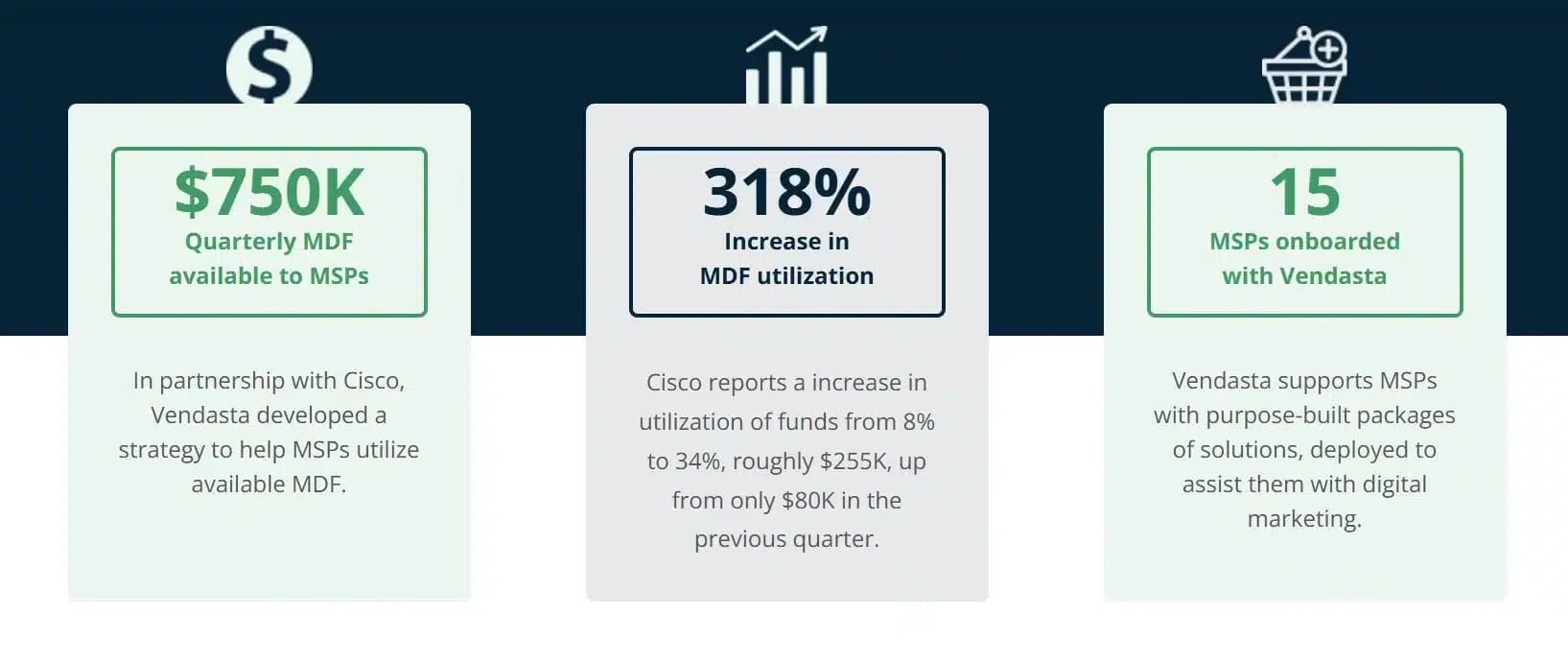
Market development funds are the strategic allocation vendors provide to their channel partners: the resellers, VARs, MSPs, and distributors who move product but lack marketing expertise. Microsoft gives IT resellers $50K to drive leads. Cisco funds VAR event sponsorships. AWS allocates budget to ISVs for co-marketing campaigns. The funds exist. The partners need help deploying them. And holding company agencies are too expensive to make the economics work.
The gap is real. The opportunity is massive. And independent agencies who crack this playbook don't compete on price or prestige. They compete on speed, channel fluency, and the ability to turn co-op dollars into measurable pipeline faster than in-house marketing teams can build a single landing page.
The Channel Partner Problem Nobody Talks About
Channel partners sit on unused marketing budgets like treasure they can't unlock. Vendors allocate the funds. Partners qualify for the money. But deployment requires marketing sophistication most channel businesses don't staff for. A managed services provider with 40 employees and $20M in revenue doesn't employ a creative director. A regional VAR selling networking equipment doesn't have a paid media team. A systems integrator landing enterprise deals doesn't run lead gen campaigns.
They have sales capacity. They have technical depth. What they don't have is marketing muscle. And that's where the MDF dollars sit: approved, available, and expiring unused because the partner can't operationalize the spend fast enough to meet vendor timelines.
The B2B marketing agency eBridge positions this clearly on X: "Vendor MDF is free marketing money allocated to partners. But without strategy, those funds go unused." Their advice to MSPs centers on high-ROI activities: events, digital campaigns, co-branded content, lead generation. The pattern they're tracking is consistent. Partners qualify for funds, vendors approve the allocation, and then nothing happens because the partner lacks bandwidth to execute.
Holding company agencies can't solve this problem at scale. A WPP shop billing $500 per hour can't profitably service a $25K MDF campaign from a mid-market VAR. The math doesn't work. The account is too small. The margin is too thin. And the channel partner doesn't need "brand storytelling" or "integrated campaign strategy." They need 6 landing pages, 3 email nurtures, and paid search campaigns that start running in 14 days. Speed and execution beat sophistication when the goal is budget deployment before the fiscal quarter closes.
In-house teams at channel partners hit a different wall. They're built to support sales, not run standalone marketing programs. The typical channel partner employs one marketing person: a generalist handling events, collateral, social posts, and sales enablement. That person can't suddenly become a paid media expert, content strategist, and web developer when $50K in MDF lands on their desk with a 90-day deployment window. The skills gap is structural, not solvable with training.
Independent agencies fit the pocket perfectly. They're nimble enough to move fast. Specialized enough to speak channel language. Cost-effective enough to make the economics work on five-figure budgets. And hungry enough to view MDF deployment as recurring revenue instead of one-off project work. The holding companies can't match that combination. The in-house teams can't build it. Which means the door stays open for independents willing to learn the vocabulary and own the vertical.
Why Holding Companies Can't Compete Here
The holding company cost structure kills MDF economics before the first kickoff call. A typical HC agency carries overhead that requires $200-300 minimum hourly rates to stay profitable. That works fine for a $2M brand campaign. It collapses instantly when the entire budget is $30K and the client needs results in 8 weeks.
The HC pitch process alone consumes the margin. Three internal stakeholders need to approve scope. Legal reviews the vendor co-op terms. Finance models the profitability. Two weeks pass before the first creative brief. By the time the deck is ready, the independent agency has already launched ads and built the first round of landing pages.
Speed asymmetry is the structural advantage. A 15-person independent can brief, approve, and launch in the time it takes a holding company to schedule the alignment meeting. That velocity compounds when the MDF dollars come with vendor deadlines: "Deploy by end of quarter or the funds revert." Channel partners facing that clock don't care about awards or case studies. They care about execution speed and proof the money got spent according to vendor guidelines.
The other factor holding companies miss: channel partners aren't buying creative prestige. They're buying pipeline. The success metric isn't engagement or brand lift. It's qualified leads delivered to the sales team at a cost-per-lead that beats their internal benchmarks. That's measurable, quantifiable, and tied to revenue. It's also far less interesting to a creative director whose career ladder depends on winning Cannes Lions.
Independent agencies built around performance marketing and B2B lead generation understand this instinctively. Mojenta's positioning as "the go-to HubSpot agency for B2B telecom, IT, and cloud" signals immediate channel fluency. They're not claiming to be a full-service agency. They're claiming domain expertise in the exact verticals where MDF budgets are largest and most underutilized. That specificity is strategy. It's how you rank #93 for a 14,800-volume keyword when 99% of agencies don't even know the search exists. And it's how you build a practice where the work finds you instead of burning budget on outbound that goes nowhere.
The Playbook: How to Position for MDF Work
The shops that win MDF work don't position as "agencies." They position as channel marketing specialists who unlock vendor co-op dollars for partners who lack internal bandwidth. The difference is everything.
Speak channel language from the first conversation. Channel partners don't talk about "brand activations" or "integrated campaigns." They talk about pipeline, cost-per-lead, and MQL-to-SQL conversion. If your positioning deck uses holding company language, you've already lost the room. The pitch has to open with their reality: "You've got $40K in approved MDF from Cisco. You've got 60 days to deploy it. Your one marketing person is already handling 3 events and the sales deck refresh. We can have campaigns live in 2 weeks."
Build vendor program fluency. Every major tech vendor runs channel MDF programs with different rules, approval processes, and eligible spend categories. Microsoft's partner programs differ from AWS's co-marketing funds differ from Cisco's market development budgets. The independent agency that maps these programs and can walk a partner through Vendor A's approval process versus Vendor B's reimbursement timeline becomes indispensable. That's not creative work. That's strategic partnership. And it's worth more than banner ads.
Package services around deployment speed. Channel partners don't need custom everything. They need proven templates deployed fast. The winning service offering is modular: pre-built landing page templates, plug-and-play email sequences, campaign structures optimized for vendor-approved tactics. Launch in 14 days. Prove performance in 30. Iterate in 45. The entire engagement happens inside one fiscal quarter because that's how MDF budgets work.
Price for volume, not prestige. MDF work isn't high-margin brand consulting. It's high-velocity execution at mid-market rates. The smart play is $5K-15K monthly retainers across 8-12 channel partners instead of $100K projects for 2 brands. The math works because the work is repeatable, the processes are documented, and the client acquisition cost drops when you build a referral engine inside one vendor ecosystem. Win 3 Microsoft partners. Get introduced to 10 more. The vendor channel teams become your sales force.
Track the metrics that matter to channel partners. Brand awareness doesn't close deals in channel marketing. Qualified pipeline does. The reporting dashboard needs to show: MQLs generated, cost per MQL, MQL-to-SQL conversion rate, deals influenced, revenue attributed. If you can't tie the MDF spend directly to the partner's sales pipeline, you're not speaking their language. And if you can't show that vendor co-op dollars drove better ROI than their own budget, they'll never come back. The performance transparency isn't optional. It's the entire value proposition.
Where the MDF Dollars Live
Tech channel marketing is the big game. Microsoft, AWS, Google Cloud, Cisco, Dell, VMware, Salesforce: every major vendor runs formal MDF programs because indirect sales account for 60-70% of their revenue. Those vendors need partners to drive local demand. Partners need marketing help. The budget exists. The gap is execution.
Microsoft's partner programs alone allocate billions annually. AWS launched dedicated MDF programs for ISVs (independent software vendors) to drive co-marketing campaigns. Cisco funds partner demand generation, event sponsorships, and digital campaigns. The money flows when partners submit plans that align to vendor objectives: product launches, territory expansion, vertical penetration. A well-constructed MDF proposal gets approved in 2-3 weeks. The problem isn't access. The problem is that most partners don't have the internal capability to write the proposals, execute the campaigns, and report the results in the format vendors require.
Telecom and IT services run a close second. Carriers like Verizon and AT&T push MDF to business channel partners. Cybersecurity vendors fund partner marketing around compliance deadlines and threat awareness. Cloud infrastructure providers co-invest in partner campaigns targeting enterprise migration. The budgets are smaller than Microsoft-scale programs but far less competitive. A 20-person independent agency specializing in cybersecurity channel marketing can own a vertical that holding companies ignore because the individual deal sizes don't clear their minimum thresholds.
The broader B2B channel encompasses industrial equipment, logistics software, vertical SaaS, and manufacturing technology. Every market with an indirect sales model generates MDF budgets. The visibility is lower. The search volume is fragmented across hundreds of niche terms. But the opportunity is real for agencies willing to become domain experts in one channel ecosystem instead of generalists competing for every brand RFP. The specialization compounds. The referrals multiply. And the customer lifetime value climbs because quarterly MDF allocations create natural retention.
The Agencies Building This Practice
Mojenta's ranking for "what are market development funds" isn't luck. It's focus. Their website positions them explicitly as HubSpot specialists for B2B telecom, IT, and cloud. That's three adjacent verticals where channel sales dominate and MDF budgets sit underutilized. They're not chasing consumer brands. They're not pitching Fortune 500 CMOs. They're targeting the VP of marketing at a $30M IT services firm who just got approved for $40K in vendor co-op and needs someone who knows how to deploy it.
The pattern extends beyond Mojenta. Agencies built around B2B performance marketing, channel enablement, and partner ecosystems are finding MDF deployment work more defensible and more profitable than traditional brand agency models. The recurring revenue is higher. The client churn is lower. And the sales cycle is faster because the budget already exists and the pain point is immediate.
The shops that crack this aren't competing on awards or office aesthetics. They're competing on vendor program knowledge, deployment velocity, and the ability to turn allocated dollars into measurable pipeline before the fiscal quarter closes. That's a different game than brand positioning. It's also a game where being 15 people in San Diego beats being 500 people in Manhattan. The economics favor the specialist. The speed favors the independent. And the holding companies can't restructure their way into profitability on five-figure accounts. The math doesn't bend. The model doesn't scale down. Which leaves the field wide open for independents who see the opening and take it.
The Forward Look: Why This Becomes Sustainable
MDF work isn't project-based. It's program-based. Channel partners don't need one campaign. They need ongoing deployment of quarterly MDF allocations, ongoing optimization of vendor-funded programs, and ongoing support navigating the approval processes that determine whether budgets get released or revert. That's recurring revenue. And it's far more defensible than "we pitch for your business every 3 years when the contract is up for review."
The referral economics are structural. Vendor channel teams live or die by partner engagement. If an independent agency helps 5 partners successfully deploy MDF and generate measurable pipeline, the vendor channel manager introduces that agency to 15 more partners. The customer acquisition cost drops to zero. The sales cycle collapses to a warm intro and a proof-of-concept. And the work compounds because each successful deployment creates a case study that unlocks the next tier of partners.
The market is still wide open. Holding companies haven't figured out how to make small-account economics work. In-house teams at channel partners remain too small to execute sophisticated programs. And the majority of independent agencies are still optimizing for brand keyword searches instead of the channel marketing language that unlocks billions in untapped budget.
14,800 searches per month for "what are market development funds." One independent agency in the top 100. That's not competition. That's an invitation. The question isn't whether MDF budgets exist. The question is whether independent agencies are willing to reposition themselves as the unlock partner for channel marketers who need speed, domain fluency, and execution capacity on budgets that holding companies consider too small to service profitably.
The shops that say yes won't compete for brand RFPs anymore. They'll compete for vendor partner-of-the-year awards. And they'll build practices where clients don't churn because the MDF budget renews every quarter, the need never goes away, and the alternative is letting millions in approved vendor dollars expire unused because nobody else showed up to claim them.
Free Agency Media Editorial
All news