The Agency vs. In-House Debate Has a Framework. Nobody's Published It.
6,180 monthly searches for marketing management terms, zero agencies ranking, and the real debate scattered across X threads instead of organized into a decision framework anyone can use.

The keyword "marketing management" pulls 6,180 monthly searches across its cluster. Zero agencies rank for any term in it. Not one indie shop, not one holding company subsidiary, not one fractional CMO practice shows up anywhere in the top ten.
What ranks instead: Wrike's product guide, a Coursera career article, a Wikipedia entry, an AMA glossary page, a Tempo blog post, an Indeed career-advice piece. Nine pieces of content explaining what marketing management is. Zero pieces explaining which model of marketing management actually works for a specific company at a specific stage.
That's the paradox. The volume is real. The demand is real. Six thousand people a month are searching terms related to marketing management, marketing advisors, and marketing consultant jobs, and every single one of them lands on a definition instead of a decision. Meanwhile the actual debate, the one with money and mistrust attached to it, is happening somewhere Google doesn't index well: X. Founders are publicly dissecting agency retainers, in-house payroll math, and AI's disruption of both, in real time, with real numbers. The SERP has a content gap the size of a stadium, and the conversation that should fill it is already written. It's just scattered across threads instead of organized into a framework.
The Search Volume Nobody Is Serving
"Management models" alone pulls 210 searches a month. That's a term with commercial intent buried inside academic phrasing. Nobody searches "management models" to write a term paper. They search it because they're a VP of Marketing, a founder, or an operator trying to decide whether to build a team, hire a shop, or do both.
What do they get? Wikipedia's "strategic organizational discipline" framing. The University of Cincinnati's "complete beginner's guide." Indeed's salary breakdown for people who want the job title, not the org design.
None of these pieces answer the only question that matters to someone searching with buying intent: agency, in-house, or hybrid, and at what stage does the answer change? That's not a small oversight. It's a wide-open lane. Zero agencies compete here, which means zero agencies are capturing an audience that's actively trying to make a resourcing decision. The people ranking are SaaS companies selling project management software and career sites selling job listings. Nobody with actual agency experience, actual client P&Ls, and actual pattern recognition across dozens of engagements has bothered to write the comparison piece. That's the gap, and gaps this size don't stay open forever.
The Cost Myth Nobody Runs the Math On
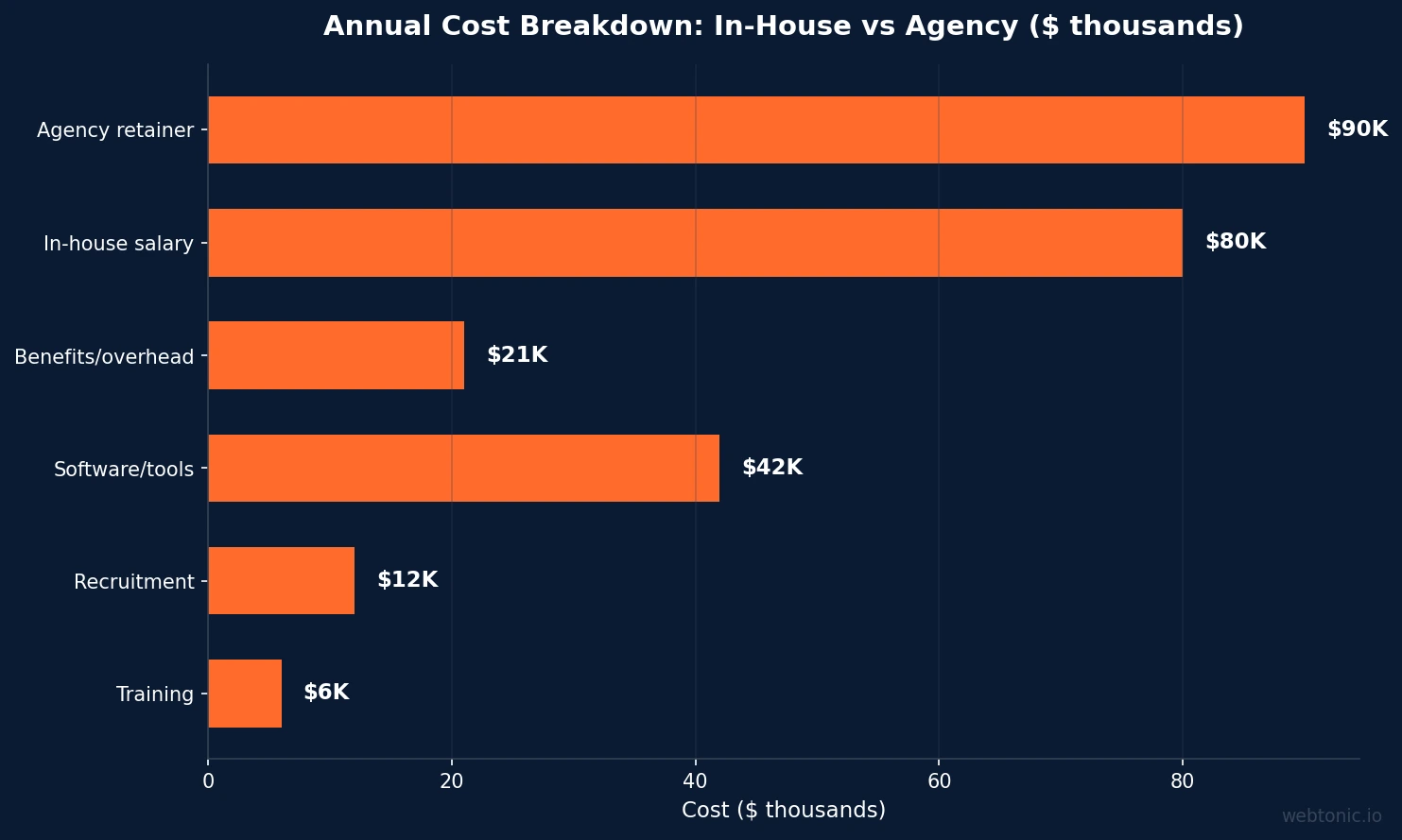
The loudest argument for in-house is always cost. It's also the least examined argument in the entire debate. One recent post on X, from the account HotContentIO, put a name on the actual failure point: the gap between what leadership budgets for a marketing function and what it actually costs to run one. Budgeted spend and actual spend are treated as the same number in board decks. They rarely are. Salary, benefits, tooling, training, management overhead, and the hidden cost of ramp time for every new in-house hire routinely blow past the number that got approved. Agencies get compared against the budgeted number. In-house gets measured against nothing, because nobody goes back and audits whether the internal team actually came in under what an agency would have charged for the same output.
Then there's the other side of the cost conversation: what you're actually paying for versus what you think you're paying for. Founder rashiumapathi posted a specific, ugly example: a $5,000-a-month agency retainer that produced generic content and zero demos over three months. That's $15,000 spent, measurable output at zero, and a contract structure that doesn't require the agency to show results to keep getting paid. That's not a cost problem. That's an incentive problem, and it's the sharper of the two critiques.
Retainer-based agencies are frequently paid to retain the client, not to perform for the client. Those are different jobs. A retainer that renews automatically unless the client actively cancels creates zero pressure to keep proving value month over month. Compare that to in-house, where underperformance is visible daily, tied to a person's name, and addressed in a performance review with actual consequences. The account 0xNairolf went further, calling agencies "even worse than" certain low-quality crypto projects, and Jason______A ranked agencies as the second worst category of vendor behind course sellers, arguing the business model itself pushes clients toward unprofitable spend because that's where the agency's cut comes from.
These aren't fringe opinions. They're describing a real structural flaw in a specific type of agency relationship: the open-ended, output-agnostic, month-to-month retainer with no performance clause. But that critique doesn't indict every agency model. It indicts one agency model. Fixed-scope engagements, outcome-based retainers, and specialist shops hired for a defined deliverable don't have the same incentive misalignment, because the client isn't paying to keep the relationship alive. They're paying for a result, and the contract says so.
Speed, Context, and the Skill You Don't Need Full-Time
Cost is the argument people default to. Speed is the argument that actually decides most outcomes. 321WebMarketing made this point directly on X: shipping slower loses money regardless of which model produced the delay. An in-house team that's fast but mediocre will often outperform an agency that's excellent but slow, because marketing compounds on iteration cycles, not on individual campaign quality. The team that ships, learns, and adjusts twelve times in a quarter beats the team that ships once and waits for a retrospective.
In-house wins on speed for a specific reason: proximity. Daily access to product, daily access to sales calls, daily immersion in brand voice and customer language. An in-house marketer sits in the same Slack as the engineer who shipped the feature last night and can turn that into a campaign by lunch. No brief, no kickoff call, no three-day turnaround on a first draft that misses the point because the agency wasn't in the room when the decision got made.
Agencies win somewhere else entirely: specialization the company doesn't need full-time. Tony Wright made this distinction on X, and it's the cleanest version of the argument: technical SEO overhauls, large-scale paid media testing infrastructure, and other specialist skill sets don't justify a full-time hire. You don't need a technical SEO architect on payroll year-round if you're doing one major site migration every eighteen months. You need that expertise for six weeks, at full intensity, then you need it gone. That's not a limitation of the agency model. That's the agency model working exactly as designed: deep expertise, deployed precisely, without the fixed cost of a permanent seat.
This is where the "agencies are a rip-off" sentiment collapses under its own weight. The complaint is almost always about generalist retainers doing generalist work slowly. It's rarely about a specialist team parachuting in for a defined, technical, high-stakes engagement and delivering something the in-house team structurally couldn't have built themselves, because building it would have required a hire they didn't need for the other fifty weeks of the year.
The Framework: Stage Decides the Model, Not Ideology
Here's where the debate on X gets genuinely useful, because it stops being about which model is morally superior and starts being about which model matches which revenue stage. 321WebMarketing laid out a version of this that maps cleanly onto how resourcing decisions actually get made in practice.
At $1 million to $5 million in ARR, the recommended shape is a senior in-house lead paired with agency support. One person internal, experienced enough to set direction and own context, backed by external specialists for execution capacity the company can't yet justify hiring for. This is the stage where budget is tightest and mistakes are most expensive, so the internal hire needs to be senior enough to catch agency mistakes and translate company context the agency can't get any other way.
At $5 million to $25 million in ARR, the shape shifts: a small in-house team, handling the context-heavy, always-on work, with agencies brought in for scale and surge. This is the stage where the company has enough volume that a full internal team makes sense for the core function, but growth still comes in spikes: product launches, seasonal pushes, new market entries, that a fixed internal headcount can't absorb without either overstaffing in the quiet months or underperforming in the loud ones.
Neither stage says "in-house is better" or "agency is better." Both stages say the same thing: match the model to the shape of the need, not to a general belief about which model is cheaper or which model is more trustworthy. A company at $2 million ARR hiring a five-person internal marketing department is overbuilding. A company at $20 million ARR running its entire marketing function through a single generalist retainer is underbuilding. The mismatch, not the model itself, is what produces the horror stories that end up as viral complaints on X.
This is also the answer to the search volume sitting unclaimed in Google. Someone searching "marketing management models" isn't looking for a definition of marketing management. They're looking for exactly this: a way to figure out where their company sits and what that implies about who should be doing the work. Nobody currently ranking for that term is answering it.
AI Is Rewriting Both Sides of the Ledger
The framework above assumes a stable comparison: agency labor versus in-house labor. That assumption is currently being rewritten in real time, and it's happening fast enough that most of the content ranking in Google for "marketing management" was written before the shift was visible.
On the in-house side, the disruption is structural. One widely discussed post from 0xNoryxx claimed a five-agent AI system replacing a fourteen-person team, cutting costs by millions while improving ROI. Whether the exact numbers hold up under scrutiny is beside the point. The direction is not in dispute: the headcount math that used to justify "just hire in-house, it's cheaper long-term" is being rewritten by tools that make a five-person team do fourteen-person output. The old comparison, agency retainer cost versus in-house salary cost, is becoming a three-way comparison that includes AI-augmented teams of either kind.
On the agency side, the same disruption is producing the opposite structural outcome: smaller, not bigger. Jakezward's read on X described agencies going "so back," not by scaling headcount but by scaling leverage. One-person operations running proprietary tooling and AI agents, hitting margins above 75%, shifting the business model away from human-hours-billed and toward outcome-based retainers priced on results, not staff time. This is the inverse of the retainer complaint from earlier. An outcome-based retainer, priced on a result the agency has to deliver to get paid, doesn't have the incentive misalignment problem that a generic monthly retainer does. AI is what's making that pricing model viable, because it's what's letting a one or two-person specialist operation deliver output that used to require a ten-person account team.
Put those two threads together and the old binary, big in-house team versus big agency team, stops being the relevant comparison. The relevant comparison becomes: a lean in-house operator running AI tooling for context-heavy, always-on work, paired with a lean specialist operator running AI tooling for surge and technical depth. Headcount on both sides shrinks. Leverage on both sides grows. The company that wins isn't the one that picked "agency" or picked "in-house." It's the one that picked the leanest, most outcome-aligned version of both and built a seam between them that doesn't leak context.
Where Independents Actually Win
Strip away the ideology and what's left is a genuinely useful decision structure, and it's one independent agencies should be building content around instead of ceding to career-advice sites and project management software vendors.
Independents win when the engagement is scoped to a result, not to a retainer clock. They win when the skill required is deep and infrequent rather than shallow and constant. They win when the client is at a stage, whether that's $2 million ARR needing senior backup or $20 million ARR needing surge capacity, where building the internal function from scratch costs more in time and mis-hires than borrowing the expertise externally. And increasingly, they win because AI leverage lets a small, specialist, independently owned shop deliver output that used to require the scale of a holding company account team, at a margin structure that makes outcome-based pricing sustainable instead of a race to the bottom.
None of that is the survival story. It's not "independents compete despite agency skepticism on X." It's the opposite: the specific critiques driving that skepticism, the retainer that never ends, the incentive to keep clients rather than deliver for them, the generic output masquerading as strategy, are critiques of a business model that lean, outcome-priced, specialist independents were never running in the first place. The agencies getting called a rip-off on X are, almost without exception, the ones optimized to retain rather than perform. The fix isn't "go in-house." The fix is picking the model, agency or internal, that's actually built to be measured on results.
The search data says nobody's written this down yet. Six thousand plus searches a month, zero agencies ranking, and a live, detailed, opinionated debate happening in public on X that never made it into a framework anyone can act on. That's not a gap that stays empty. Someone is going to write the definitive comparison piece, attach real stage-based numbers to it, and own the search terms that a decade of definitional 101 content left completely undefended. The only question is whether it's an independent agency doing it, the same kind of shop this framework says wins when the incentive structure is honest, or whether it's another SaaS company selling software to people who searched for a decision and got a glossary instead.
Free Agency Media Editorial
All newsYou might like

Why Independent Agencies Were Already Built for the AI Agent Era
WarschawskiThe Production Moat Is Gone, and Lean Agencies Are Cashing In
IllustrationXThe Production Moat Is Gone, and Lean Agencies Are Cashing In
IllustrationX
The Fujifilm Claim No One Can Verify