The One-Sentence Test Agencies Give Clients but Fail Themselves
Agencies drill clients on single-minded positioning, then bury their own pitch under a six-item services list. One Milwaukee shop refused to.
The One-Sentence Test Most Agencies Fail
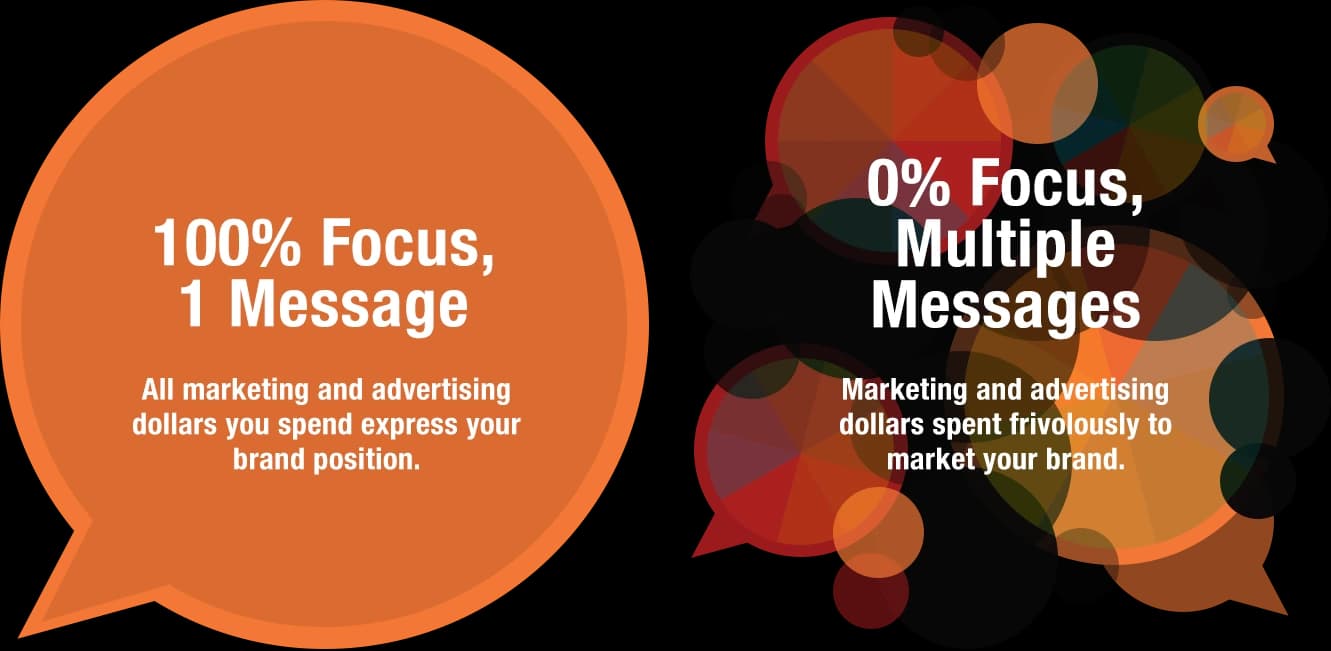
Every agency in the business teaches clients the same discipline. One insight. One benefit, compressed into one sentence that survives contact with a skeptical CMO. Strip the deck down, cut the fluff, find the single-minded proposition, and build the whole campaign around it. It's creative brief 101, and strategists will defend it to the death in a client meeting.
Then those same strategists go build their own agency's homepage and list six services across the top nav.
That's the paradox sitting in plain sight. The single-minded proposition is the most disciplined idea in advertising, and almost nobody applies it to the thing they're actually selling: the agency itself. Walk through most indie shop websites and you'll find a tagline that tries to say something, followed immediately by a capabilities list that says everything. Content Marketing, Design, Creative Services, Advertising, Media Buying & Planning, Branding & Identity. Six disciplines, zero commitment, and a prospective client left to guess what this shop is actually for.
The agencies breaking that pattern aren't doing anything mysterious. They're doing to themselves what they do to clients every day. They're finding the SMP, and they're betting the business on it.
What the Single-Minded Proposition Actually Demands
An SMP isn't a tagline. It's a filter. The discipline of the creative brief was never "say something clever." It was "cut until only one claim survives, then prove it." Everything that doesn't serve that one claim gets thrown out, no matter how true or impressive it might be on its own.
That same filtering logic has been resurfacing lately in a sharper, more operational form: a framework for internal positioning built around four components. Who's the buyer. What's the competitive alternative they'd choose instead of you. What's the one differentiator you can actually prove. And who's the villain: the thing in the market you're explicitly positioned against.
The framework is built for startups pitching investors and customers, but the logic transfers to agencies with almost no modification. An agency's buyer isn't "marketers." It's a specific kind of decision-maker with a specific kind of problem. The competitive alternative isn't "other agencies" in the abstract. It's the holding company network the client is currently overpaying, or the in-house team that's running out of ideas, or the freelance collective that can't scale past a single campaign. The provable differentiator isn't "great creative" or "strategic thinking." Those are claims every agency makes and no agency can prove. And the villain isn't a person. It's the thing in the industry you refuse to be: the committee-written brief, the eighteen-month approval chain, the work engineered to survive a focus group instead of a feed.
Put those four pieces together and you don't get a tagline. You get a decision. And the agencies willing to make that decision in public, not just in an internal strategy doc, are the ones worth studying.
Applying the Framework to an Agency's Own Pitch
That's where most shops get the exercise backward. They treat positioning as a wordsmithing problem: find a punchier way to say "full-service creative agency." The actual work is upstream of language. It's choosing which buyer you're for, which alternative you're competing against, and which claim you're willing to stake the business on.
That's a harder conversation than writing a tagline, because it requires saying no. If your differentiator is speed, you can't also claim you're the most strategic shop in the category. If your buyer is a challenger brand CMO who wants to move fast and break convention, you can't also pitch yourself to risk-averse enterprise marketing departments that need twelve rounds of legal review. The SMP forces a choice. Most agency positioning statements refuse to choose, which is exactly why they read like every other agency positioning statement.
The villain piece is the most uncomfortable part of the framework, and it's also the part that does the most work. Naming a villain means naming what you refuse to be, in public, where competitors and prospects can both read it. Most agencies won't do this because it feels confrontational. But a villain is what makes a differentiator provable. "We're fast" means nothing. "We're fast because we don't run creative through a thirteen-person approval chain before a client ever sees it" names a villain and proves a claim in the same sentence.
SRH Picked a Fight With Half the Industry
This is where the framework stops being theoretical. SRH, an 11 to 50-person independent shop out of Milwaukee, Wisconsin, runs with a tagline that does almost everything the framework asks for in nine words: "This is more interesting than 50% of global advertising."
Read that sentence the way a strategist would read a creative brief. It makes a claim. It's comparative, which means it's falsifiable, which means it's actually a claim instead of a mood. And it names a villain without naming a single competitor: the other half of global advertising. The dull half. The work made to clear a committee instead of earn attention. SRH didn't write a tagline that describes what they do. They wrote one that stakes a position against an entire category of work they're refusing to make.
That's the differentiator and the villain, both delivered in a single line, which is the entire point of a single-minded proposition. Most agencies need a paragraph to say less.
The claim only means something if the work backs it up, and SRH's own site makes the case with a Verlo Mattress spot built around a man jumping out of a plane. That's not a stock boardroom shot of a sleeping couple. It's a swing, the kind of creative decision that either gets killed in approval or becomes the reason a client's work gets talked about. A mattress brand is about as unglamorous a category as advertising offers, and SRH's answer to that brief was an image built for attention, not comfort. That's the "more interesting than 50% of global advertising" promise, tested against one of the hardest categories to make interesting, and it holds.
The work has drawn recognition from Campaign, which matters less as a trophy and more as independent confirmation that the claim in the tagline isn't just internal bravado. Someone outside the agency looked at the work and confirmed it held up. That's the "provable" half of a provable differentiator doing its job.
And the location matters more than it looks like it should. Milwaukee is not New York, not a city the industry defaults to when it imagines where "interesting" advertising comes from. An agency with a nine-word claim against half of global advertising, operating out of Wisconsin with a team in the dozens rather than the hundreds, is itself the paradox worth noticing. The geography does some of the positioning work for free: if the claim came from a Madison Avenue shop with a hundred-person new business team, it would read as expected. Coming from Milwaukee, it reads as a dare.
The Full-Service Menu Still Undercuts the Line
This is the part of the story that keeps the pattern honest instead of turning it into a puff piece. SRH's own site lists six services: Content Marketing, Design, Creative Services, Advertising, Media Buying & Planning, Branding & Identity. That's the full-service menu, the same list that shows up on a hundred other agency sites that have nothing interesting to say about themselves at all.
This is the tension that makes the single-minded proposition hard to apply to an agency rather than a product. A toothpaste brand can commit to "whiter teeth" and ignore everything else the toothpaste does. An agency has to stay credible to RFPs that ask for media buying line items, design capabilities, and content calendars, all on the same procurement form. The services list isn't vanity. It's partly a practical concession to how agencies actually get hired. Nobody wins a holding-company-style RFP by refusing to check the capability boxes.
But that's exactly why the tagline matters more than the services list, not less. The services list is table stakes. It tells a buyer what you're capable of doing, which is the least differentiated information on the page, because every competitor's services list says roughly the same thing in a different order. The tagline is the only place on the site where an agency gets to say what it's actually for. SRH's services list reads like every other shop's. Its tagline doesn't read like anyone else's. That gap is the whole lesson: the capability list can stay broad because it has to, but the positioning claim cannot, because that's the only sentence doing the job the SMP is supposed to do.
This is the pattern across the indie landscape more broadly, not a quirk unique to one shop. Taglines pick a fight. Services pages make peace with everyone. The agencies winning the sharpest positioning battles are the ones that accept the services list will always be a little generic and put the actual differentiation where it belongs: in the one sentence a prospect reads before anything else.
Why Agencies Dodge the Single-Minded Bet
The instinct to hedge is rational, which is why it's so persistent. Narrowing the pitch feels like narrowing the client list, and new business teams are built to avoid turning away anyone who might eventually sign. A services page that lists six disciplines can match six different kinds of RFPs. A tagline that stakes a specific claim against a specific villain will, by design, repel some prospects. That's not a bug in the framework. It's the entire mechanism by which positioning works. A claim that doesn't repel anyone isn't a differentiator. It's a description.
The GTM framework circulating in startup circles treats this directly by keeping the four-part positioning statement internal, a document for the team's own alignment rather than something stamped on the homepage. That's a useful distinction for agencies too. The buyer, alternative, differentiator, and villain don't all need to show up in nine words on a landing page. What they need to do is agree with each other, internally, so that every pitch deck, every case study, every new business call is arguing the same claim instead of five different ones depending on who's in the room.
What SRH's tagline demonstrates is that the public-facing version doesn't have to be a watered-down compromise of that internal work. Nine words did the job of naming a buyer who wants interesting work, a villain made of boring advertising, and a differentiator that's provable against a Verlo Mattress brief. The services list underneath can stay broad because the positioning above it already did the hard work of being specific.
Most agencies skip the hard conversation and go straight to the safe tagline, something that describes a capability instead of staking a claim. "Full-service creative agency built on strategy and craft" isn't a single-minded proposition. It's a sentence constructed specifically to avoid picking a fight with anyone, which means it also avoids being remembered by anyone.
What Wins the Next Round of Pitches
Buyers are scanning faster than they used to, and the agencies competing for their attention know it. A six-item services list takes longer to read than a nine-word claim and communicates less. That math only gets worse as more of the buying process moves through a quick scroll before a call ever gets booked. The agencies that have already done the internal work of naming their buyer, their competitive alternative, their provable differentiator, and their villain are the ones with a sentence ready for that scroll. Everyone else is still relying on a capabilities list to do a job it was never built for.
SRH's tagline is proof the bet works even from Milwaukee, even at 11 to 50 people, even in a category as unglamorous as a mattress brief. The claim held up against the work, the work earned outside recognition, and none of it required pretending to be something the agency isn't. Underneath it, the services list stayed exactly as broad as it needed to stay for the RFPs that require it, while the positioning did the actual differentiating.
The agencies still hiding behind "full-service" as their entire personality aren't protecting their options. They're making themselves interchangeable with every other shop running the same six-item list. The single-minded proposition was never just a tool for writing better client briefs. It's the same discipline that decides whether an agency gets remembered or gets filed under "full-service, Midwest, mid-size" in someone's spreadsheet. The shops willing to pick a fight, name a villain, and prove a claim are the ones that won't need the spreadsheet to get the call.
Free Agency Media Editorial
All newsAgencies in this story
You might like
The One-Sentence Test Agencies Give Clients but Fail Themselves
SRH
The One-Sentence Discipline Small Agencies Use to Win Pitches
SRH
Why Independent Agencies Were Already Built for the AI Agent Era
WarschawskiThe Production Moat Is Gone, and Lean Agencies Are Cashing In
IllustrationX