Creator Marketing Has a Maturity Model. No One's Written It Down.
Hundreds of influencer case studies show off the trophy case, but not one explains how agencies actually build the factory that makes the trophies.

Type "influencer marketing agency case study" into Google and the machine hands you 460 verified campaigns, spread across nine ranking pages, from brands and platforms boasting six-times ROI and content engines producing 2,000-plus units a month. Type almost any variation of "creator-commerce maturity model" into that same search bar and you get close to nothing. Zero dedicated search volume across the cluster. No ranking framework. No operating model. The industry has built an entire content genre around showing off the trophy case and has never once published the blueprint for the factory that makes the trophies.
That gap is not an accident. It's a business decision, made collectively and mostly unconsciously, by every publication and platform currently ranking for these terms. Case studies sell services. Operating models don't, not directly. So nobody writes them. Which means the indie agencies actually climbing from one-off influencer seeding to owned, performance-attributed creator-commerce funnels are doing it with no map, no benchmark, and no vocabulary for the capability gaps standing between where they are and where the retainer money lives.
The Case Study Glut Nobody Can Operationalize
Run the audit and the pattern jumps out fast. Trend.io's "8 Insane (But True) Influencer Marketing Case Studies" leads with Kettle + Fire, Iceland Foods, Warby Parker. The Shelf frames its library around "strategy, casting, and paid-ready content." Modash counts BURGA scaling to 2,000-plus content units a month as its headline proof point. The Influencer Marketing Factory calls its page a "portfolio." Influencer Strategists has built out 460 verified campaigns from brands like Nike, L'Oréal, and Salesforce, organized as a searchable database. Upfluence leads with a flat "6x ROI with creator" claim. The Business of Fashion published a fresh case study in February 2026 on what it calls "the new rules" of influencer strategy.
Nine results, one search term, and every single one of them is structured the same way: here's the campaign, here's the metric, here's the brand logo. None of them answer the question an agency owner actually has, which isn't "what worked for Warby Parker." It's "what do I need to build inside my own shop to go from doing this occasionally to doing this as a repeatable, priced, retainer-based service line."
That's the real SERP gap. It's not that the content is bad. Some of it is genuinely useful for brand marketers shopping for proof points. It's that none of it is written for the agency side of the table. Nobody has mapped the internal capability curve: what infrastructure, what talent, what retainer structure separates a shop that occasionally seeds product to micro-influencers from a shop that owns a performance-attributed creator-commerce funnel with dashboards a CFO would sign off on. Zero search volume across a six-term cluster, creator commerce strategy, UGC ad creative agency, TikTok native content agency, performance influencer marketing, social-first campaign ROAS, and influencer marketing agency case study itself, tells you the category hasn't been named yet, not that it isn't real.
Four Stages, One Missing Map
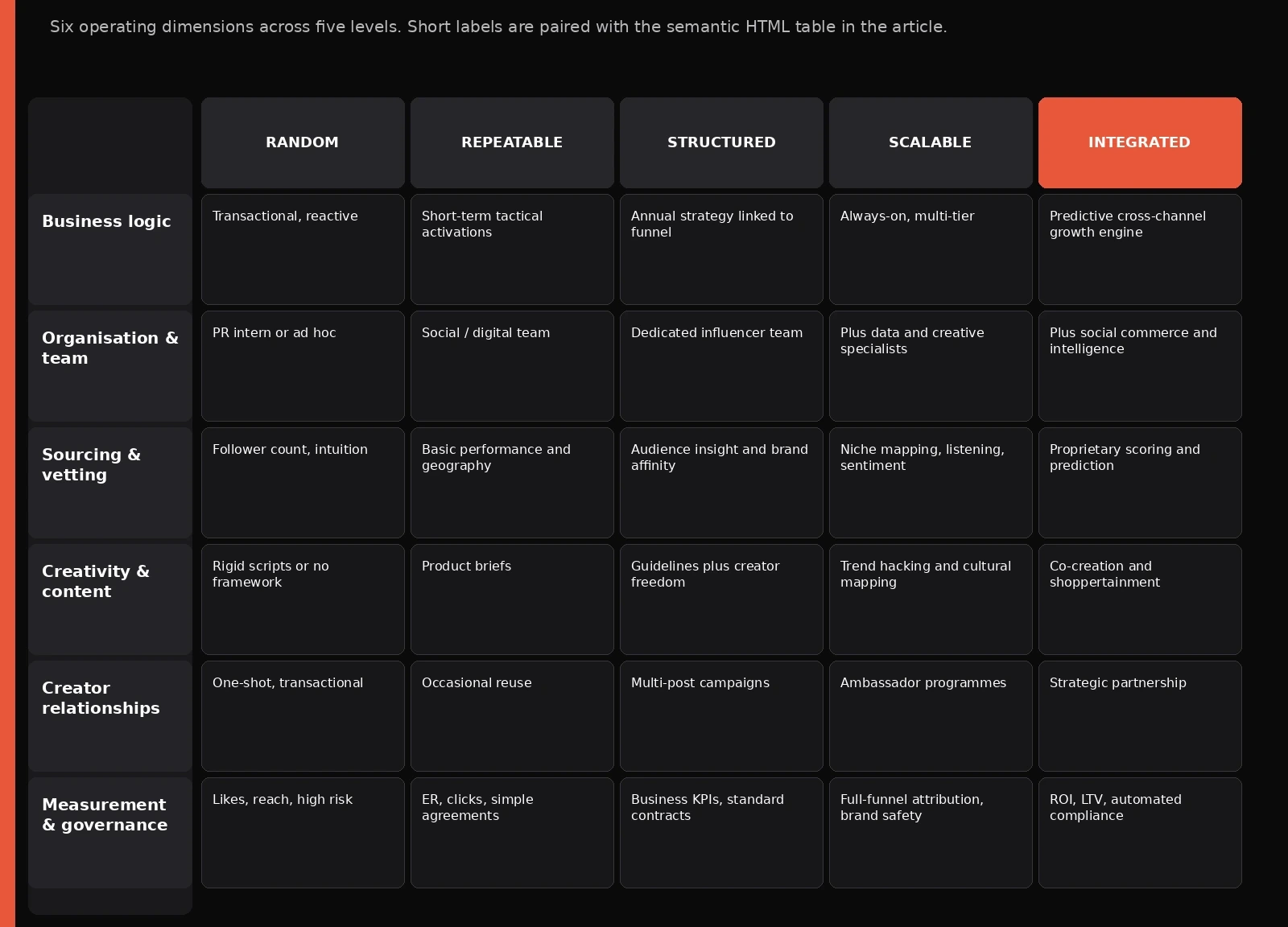
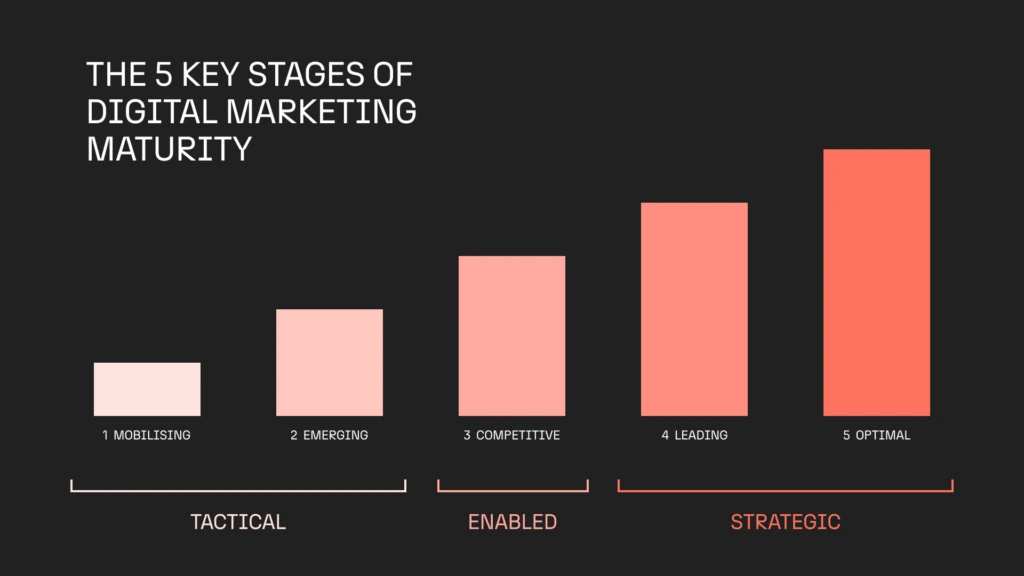
Strip the case-study noise away and the actual maturity curve indie agencies climb has four distinct stages, and the jump between each one is a capability jump, not a client-size jump.
Stage one is transactional seeding. An agency identifies creators, sends product, negotiates a flat fee or a gifting arrangement, and reports back on reach and engagement. There's no proprietary content infrastructure. There's no attribution beyond a promo code or a vanity link. The agency is functionally a matchmaker: creator on one side, brand budget on the other, a single campaign in between. This is where most shops start, and there's nothing wrong with starting here. The problem is staying here past the point where the client asks the obvious next question: what did this actually sell.
Stage two is in-house content and UGC production. This is the first real infrastructure investment. The agency stops just booking creators and starts owning the production pipeline: briefing creators on hooks that convert, running the content through paid social testing frameworks, building a library of UGC ad creative that outperforms brand-produced assets on platforms like TikTok and Meta. This is the stage where "TikTok native content agency" stops being a marketing label and starts being an actual operating description. The agency now has creative ops talent on staff, not just an account team booking talent.
Stage three is performance-attributed creator commerce. Here the funnel gets instrumented. Affiliate links, UTM-tagged creator codes, first-party data pipes back into the brand's CRM or Shopify backend, and the agency starts reporting ROAS by creator, by content format, by platform, not just impressions and engagement. This is where "performance influencer marketing" actually earns its name instead of being a euphemism for "we tracked clicks." The agency has built or licensed data infrastructure, and it's using that infrastructure to defend its retainer instead of re-litigating value every quarter.
Stage four is owned creator-commerce infrastructure. The agency isn't renting a platform's dashboard anymore. It has built, or deeply customized, attribution and creator-ops systems that function as an extension of the client's revenue team. Retainers at this stage aren't priced by campaign or by content unit. They're priced against a revenue outcome, because the agency has the data infrastructure to prove the connection between creator spend and commerce lift. This is the stage that produces the case studies everyone's writing listicles about, except the listicles never mention that the campaign result was downstream of two years of infrastructure the agency built quietly, without a press release.
Four stages. Almost nobody has written them down as a self-assessment tool. Every agency currently competing in the influencer and creator-commerce space is sitting on one of these four rungs right now, whether they've named it or not.
The Agency Whose Homepage Tells You More Than Its Case Studies Would
FAM's own directory data lists exactly one agency actively contesting this specific keyword cluster: creator commerce strategy, performance influencer marketing, UGC ad creative agency, TikTok native content agency, social-first campaign ROAS. That agency is Sodaspoon Marketing, operating at sodaspoonmarketing.com.
The fact worth sitting with is this: as of this writing, sodaspoonmarketing.com returns a 404. Netlify's default message: the page doesn't exist. For a publication built on verification, that's a data point, not something to paper over.
That single fact tells you something the case-study listicles never will. Agencies sitting at stage one and stage two of the maturity curve, transactional seeding and in-house UGC production, routinely run lean on owned marketing infrastructure. The business model runs on inbound referral, platform relationships, and DMs with a brand's paid social manager, not on SEO-optimized homepages competing for "influencer marketing agency case study." The website is the last thing built. The creator relationship is the first.
Agencies that climb into stage three and stage four flip that order completely. By the time a shop owns a performance-attributed funnel generating retainer revenue instead of one-off seeding fees, the website stops being an afterthought. It becomes a sales asset, because the buyer has changed. A stage-one client finds an agency through word of mouth. A stage-four client runs an RFP, and RFPs require a homepage that loads.
That's not a knock on Sodaspoon specifically. It's the pattern the maturity model predicts. The one agency FAM's data shows actively competing in this exact cluster is a live illustration of where the lower rungs of the curve actually sit operationally: infrastructure-light, relationship-heavy, and largely invisible to search. The opportunity sitting in front of every agency at that stage isn't a rebrand. It's the infrastructure jump to stage three, where the attribution data itself becomes the marketing asset.
The Capability Stack: Data Infrastructure, Creator-Ops Talent, Retainer Structures
Climbing this curve isn't a matter of hustle. It's a matter of three specific capability builds, and agencies that skip one of them get stuck regardless of how good their creative is.
Data infrastructure is the first and hardest build. Stage-two agencies can survive on platform-native analytics: TikTok's Creator Marketplace metrics, Meta's ad manager, a spreadsheet stitching it together. Stage-three agencies need something more: UTM discipline applied consistently across every creator and every platform, first-party data integration into the client's commerce stack, and a reporting layer that can answer "what did creator X's content actually sell" without a two-week manual pull. This is infrastructure most indie shops either build in-house with a data hire or license through a middleware platform. Either way, it's a cost center before it's a revenue driver, which is exactly why most agencies stall here.
Creator-ops talent is the second build, and it's a different hire than most agencies expect. A stage-one shop needs a great relationship manager, someone who can source creators and negotiate rates. A stage-three shop needs someone closer to a producer and a media buyer hybrid: someone who can brief a creator on a hook that will actually convert, push that content through paid social testing, and read the performance data well enough to kill underperforming creators fast and double down on winners. That's a specialized skill set, and it doesn't show up on a traditional account services org chart. Agencies that try to staff this function with existing social media managers usually plateau at stage two.
Retainer structure is the third build, and it's the one that determines whether the first two builds ever get funded. Stage-one and stage-two agencies are usually priced by campaign or by content unit: X dollars per video, Y dollars per creator booked. That pricing model caps the agency's ability to invest in infrastructure, because there's no recurring revenue base to fund a data hire against. Stage-three and stage-four agencies restructure the retainer around a performance floor: a base fee tied to funnel management and attribution reporting, with upside tied to ROAS or revenue lift. That restructuring is what actually funds the data infrastructure and the creator-ops hire, not the other way around. Agencies that wait until they've built the infrastructure to change their pricing model usually can't afford to build it in the first place.
The order matters. Retainer restructuring has to come first, or close to first, because it's the only lever an agency controls without needing new headcount or new data contracts. Everything else follows from there.
What the X Conversation Gets Right, and What It's Missing
The public conversation around this shift is happening, just not in maturity-model language yet. HireInfluence framed it plainly in a recent post: "Creator marketing is no longer just about reach. The strongest campaigns connect creators, content, commerce, and measurement to drive real business outcomes." That's a stage-three description without the vocabulary to name it as such.
A separate thread from the account web3righteous went further, arguing the era of the traditional social media influencer is "slowly coming to an end" in favor of what it calls "Creator-Operators," people building a personal brand operating system durable enough to survive algorithm changes and AI disruption rather than just posting for reach. That's the creator-side mirror of the agency-side maturity curve: the individual creator economy is professionalizing at the same time the agency infrastructure around it is.
A guest post shared by lennysan pushed the ecosystem framing further still, describing brands moving past direct channels into micro-influencer and creator-partner networks as a deliberate distribution strategy in an increasingly AI-saturated content environment. Different companies, different context, but the same underlying instinct: reach alone doesn't hold up anymore. Something structural has to sit underneath it.
None of these threads use the words "maturity model." None of them connect the dots between creator-side professionalization and agency-side capability building. That's the white space. The conversation about where creator marketing is headed is loud and active. The conversation about what capability stack an indie agency needs to actually operate at the leading edge of that shift doesn't exist yet, publicly, in a single searchable framework. Zero dedicated search volume across this exact cluster isn't proof nobody cares. It's proof nobody's named it.
The Land Grab Nobody Has Named Yet
The data adds up to this: a keyword cluster with real intent behind it (performance influencer marketing, creator commerce strategy, TikTok native content agency) and effectively zero dedicated search volume for the framework that would help an agency navigate it. Nine ranking results for the adjacent search term, all case studies, none of them operational. One agency in FAM's own data actively contesting this cluster, currently running without a functioning homepage, sitting exactly where the maturity model predicts a stage-one or stage-two shop would sit. An active, unresolved conversation on X about where creator marketing is headed, with no one yet connecting it to the agency-side infrastructure question.
That's not a gap. That's an opening. The independent agencies that name this curve first, that build the data infrastructure, hire the creator-ops talent, and restructure their retainers around performance before their competitors do, aren't going to win because they hustled harder than everyone else. They're going to win because they correctly identified that "creator marketing" stopped being a campaign tactic and became a service line with its own maturity curve, its own capability requirements, and its own pricing logic, years before the search volume caught up to prove it. The agencies still treating this as a campaign category will be writing case studies about the ones who didn't.
Free Agency Media Editorial
All newsAgencies in this story
You might like
The Production Moat Is Gone, and Lean Agencies Are Cashing In
IllustrationXThe Production Moat Is Gone, and Lean Agencies Are Cashing In
IllustrationX
The Fujifilm Claim No One Can Verify
Why Independent Agencies Are Winning Heritage Storytelling