Fortune 500 Brands Quietly Dismantled the Holding Company Model
Major enterprises stopped asking if small agencies can handle their business. Now they're asking why they'd want a big one.

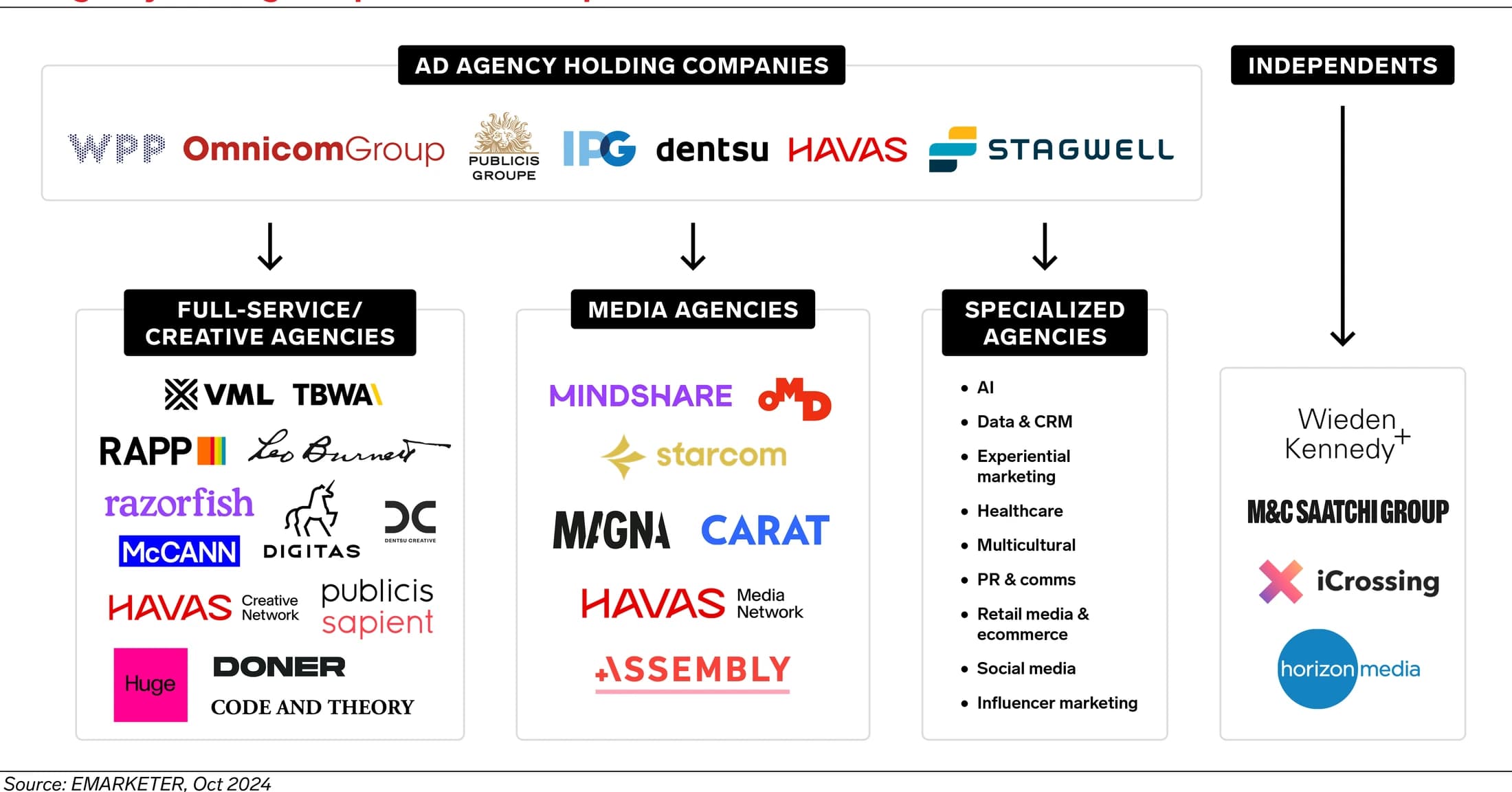
The Fortune 500 just restructured its agency model. Nobody told the holding companies.
Last year, a pattern emerged that redefines what enterprise scale means in advertising. Major brands stopped asking "can a small agency handle our business?" and started asking "why would we want a big one?" The answer appeared in deal structures that carved marketing operations into specialized layers. Full-funnel digital strategy moved to 15-person independents. Brand work stayed with the AOR. Media stayed in-house or with a trading desk. The holding company model assumed clients needed everything under one roof. Clients decided they needed specific things done exceptionally well.
The shift shows up in how brands brief projects. Traditional RFPs ask for "integrated capabilities across paid, owned, and earned media with creative and strategic support." Modern briefs specify "performance marketing execution for lower-funnel conversion with audience segmentation expertise and platform fluency across Meta, Google, and TikTok." That second brief doesn't favor a 2,000-person network shop. It favors a specialist team that lives in those platforms daily.
The Service Model That Changed Enterprise Buying
Enterprise brands structured agency relationships around the Agency of Record model for 40 years. One shop owned the account. One P&L absorbed all marketing spend. One holding company collected the margin. Independence couldn't compete at that scale because independence meant smaller infrastructure, smaller teams, smaller overhead absorption capacity.
Then digital fractured the funnel. Brand awareness required different expertise than consideration nurturing. Consideration required different systems than conversion optimization. Conversion required different talent than retention automation. The Fortune 500 realized they didn't need one agency to do everything adequately. They needed five agencies to do specific things exceptionally.
Independent shops built service models around this fracture. The positioning centered on specialized execution rather than strategic AOR responsibility. Teams formed around platform-specific expertise rather than generalist account management. Contracts structured as project-based retainers rather than percentage-of-spend agreements. A 12-person team replaced what holding companies staffed as 40-person account groups. The economics worked because the scope was precise.
Brands rewarded this precision with contracts that looked nothing like traditional agency agreements. Six-month performance marketing sprints with renewal based on ROAS targets. Quarterly conversion optimization packages with fixed deliverables. Annual SEO programs with traffic benchmarks. Every deal structure assumed the client kept strategic control and the agency delivered tactical excellence. The AOR didn't disappear. It just stopped owning everything below awareness.
Why Small Teams Win Complex Digital Execution
Holding companies respond to enterprise RFPs with organizational charts. Independent agencies respond with platform credentials and performance case studies. The Fortune 500 increasingly picks the latter because organizational complexity doesn't solve execution problems.
A major consumer brand needs Facebook conversion campaigns optimized across 12 product categories with dynamic creative testing and audience segmentation by purchase intent. The holding company assigns a team lead, two strategists, a media planner, a media buyer, a creative director, two designers, a copywriter, a project manager, and an account director. Eleven people coordinate across four departments to ship one campaign. Meetings consume 40% of billable hours. The independent shop assigns three people: a paid social strategist who builds the campaigns, a designer who templates the creative system, and a media director who optimizes daily. They ship in two weeks instead of six.
The efficiency gap widens with platform fluency. Meta changes its algorithm monthly. Google updates Performance Max quarterly. TikTok introduces new ad formats every six weeks. Holding company teams process these changes through layers. Independent specialists implement them immediately because they're already testing in the platform for other clients. The Fortune 500 pays for platform expertise. Platform expertise requires daily immersion. Daily immersion happens in small teams that live in the tools.
Speed matters more than most RFPs admit. A retail brand testing holiday messaging needs creative variants live within 72 hours of the test decision. The network agency routes through creative review, legal review, brand review, and media planning before launch. The independent shop builds variants in-platform and ships same-day. By the time the holding company launches, the independent has three days of performance data showing which message drives revenue.
Enterprise clients expected to sacrifice this speed when they worked with smaller shops. They expected smaller shops couldn't handle complexity. The opposite proved true. Smaller shops handled complexity faster because fewer people made decisions. A 15-person agency runs one approval layer. A 500-person agency runs seven.
The Pitch Strategy That Beats Holding Company Credentials
Independent agencies win Fortune 500 accounts by flipping the credential presentation. Holding companies lead with case studies demonstrating breadth. Independent shops lead with performance dashboards demonstrating depth.
The traditional pitch shows brand work across categories. "We handle CPG for Unilever, automotive for Ford, retail for Target." The independent pitch shows platform work across metrics. "We drove 340% ROAS improvement for e-commerce, 2.8x conversion rate lift for lead gen, 420% traffic growth for content." Breadth signals capacity to handle anything. Depth signals mastery of the specific thing the client actually needs done.
Pitch decks reflect this difference. Holding company presentations run 60-80 slides covering agency history, office locations, leadership bios, client roster, case studies, proposed team structure, and fee breakdown. Independent presentations run 25-35 slides covering platform expertise, performance methodology, specific tactical approach, team credentials in those platforms, and fee structure tied to performance milestones. The holding company sells the relationship. The independent sells the execution.
Client questions expose which approach resonates. CMOs ask holding companies "how do you coordinate across your network?" CMOs ask independents "how quickly can you scale this if it works?" The first question assumes complexity requires management. The second question assumes excellence requires acceleration.
References matter differently. Holding companies provide references from long-term AOR relationships spanning 5-10 years. Independents provide references from 12-18 month performance sprints showing 200%+ improvement in specific KPIs. Long relationships signal stability. Sharp performance improvement signals effectiveness. Brands shopping for lower-funnel execution care more about effectiveness than stability because they're not hiring for stability. They're hiring to fix something broken.
The compensation structure makes the pitch credible. Holding companies propose blended hourly rates or percentage-of-spend fees protecting agency margin regardless of performance. Independents propose hybrid models: base retainer for infrastructure plus performance bonuses tied to traffic, conversion, or revenue targets. The independent makes more money only if the client makes more money. That alignment closes deals because it shifts risk from the client to the agency.
Fortune 500 legal departments initially resisted these structures. Performance-based fees created P&L volatility. Small agencies created vendor management complexity. Working with five specialists instead of one AOR created coordination overhead. Every objection proved solvable because the results justified the friction. A brand that improves conversion by 180% accepts coordination complexity. A CFO who sees 4.2x ROAS accepts P&L volatility. The holding company model optimized for procurement ease. The independent model optimizes for marketing effectiveness. Effectiveness wins when performance becomes measurable.
Deal Structures That Make Enterprise Clients Comfortable
Fortune 500 brands overcame their reluctance to work with smaller agencies by redesigning how they structured agency relationships. Traditional contracts assumed long-term commitment and broad scope. Modern contracts assume short-term testing and narrow scope.
The typical engagement starts as a 90-day pilot with defined deliverables and performance benchmarks. A retail brand gives an independent shop three months to improve email conversion rates by 25%. If the agency hits the target, the contract renews for six months with expanded scope. If they miss, the client terminates with 30 days notice. This structure eliminates the enterprise client's biggest fear about small agencies: being locked into a relationship with a vendor that can't scale or deliver.
Payment terms reflect this testing mindset. Holding companies bill monthly retainers or percentage-of-spend fees regardless of performance. Independents bill milestone-based payments tied to deliverable completion or performance achievement. The client pays 30% at kickoff, 40% at mid-point review, 30% at final delivery and performance validation. If performance targets aren't met, the final 30% gets reduced proportionally. The agency carries performance risk. That risk tolerance signals confidence. Confidence wins client trust.
Scope documents evolved to protect both parties. Enterprise legal teams initially tried to apply AOR contract templates to specialist shops. Those templates included indemnification clauses, IP ownership terms, and liability limits designed for agencies managing $50M media budgets. A 12-person performance marketing shop couldn't sign them. Independent agencies pushed back with specialist scope documents that clearly defined what they controlled and what they didn't. "We optimize paid social campaigns. We don't control brand messaging, creative direction, or media strategy. We execute within parameters the client sets." This clarity prevented scope creep and liability exposure.
The most successful structures created clear boundaries between the AOR and the specialist. The AOR owns brand strategy, creative platform, and media planning. The independent owns platform execution, performance optimization, and conversion improvement. Neither steps on the other's turf. Both report progress separately. Coordination happens through shared dashboards and monthly alignment calls, not through org chart hierarchy. The model works because accountability is clear and metrics are discrete.
Enterprise brands learned to manage multiple specialist relationships through internal marketing operations teams. Instead of one account director at the AOR coordinating everything, brands hired marketing ops professionals who managed vendor relationships, consolidated reporting, and ensured tactical execution aligned with strategic direction. This shift moved coordination overhead from the agency to the client. Clients accepted this trade because specialist execution consistently outperformed generalist execution. Better results justified operational complexity.
The Infrastructure Question That No Longer Matters
Fortune 500 procurement departments spent a decade asking "can a small agency support our volume?" The answer used to be "probably not." The answer today is "volume isn't the constraint."
Holding companies scaled by adding people. A national campaign required account teams in six markets, creative teams in three studios, media teams in two trading desks, strategy teams at headquarters. Supporting a $20M account meant deploying 60+ people across the network. Independent agencies scaled by adding systems. A national campaign required one media director with platform access, two performance specialists with automation tools, one creative lead with templating systems. Supporting a $20M account meant deploying 12 people with the right technology stack.
Technology eliminated the infrastructure advantage. Independent shops use the same marketing automation platforms, the same analytics tools, the same project management systems, the same creative production software that holding companies use. A 15-person team with Asana, Figma, Triple Whale, and Slack coordinates as efficiently as a 150-person team with the same tools. The difference is decision speed. Smaller teams decide faster because fewer people approve.
Cloud infrastructure removed geographic barriers. Holding companies justified their network scale by claiming brands needed local market expertise and regional office presence. Independent agencies operate remotely with talent distributed across markets. A performance marketing shop based in Austin employs specialists in Seattle, Miami, and Chicago who understand those markets intimately without requiring office overhead. The client gets market knowledge without paying for real estate.
Production capacity used to favor large shops. Major campaigns required video production studios, photo shoots, print production, and trafficking coordination that only full-service agencies could handle. Digital-first campaigns require design systems, template libraries, and in-platform creative testing that any competent team can execute. An independent shop building dynamic creative for Facebook doesn't need a production studio. They need a designer who understands the platform's specs and a copywriter who writes for feed behavior.
The volume question persists in client conversations but means something different. "Can you handle our volume?" used to mean "do you have enough bodies?" It now means "do you have enough platform access?" An independent agency with Business Manager access to the client's ad accounts handles unlimited volume because the platform scales infinitely. The bottleneck isn't people. The bottleneck is strategic thinking and optimization judgment. Small teams provide more of both per dollar spent.
What This Means for the Market
The Fortune 500's comfort with independent agencies for specialized digital work creates asymmetric opportunity. Holding companies still win the brand AOR relationships. Independent shops increasingly win the execution work that drives measurable business results.
This pattern shows up in agency revenue models. Traditional shops generate 60-70% of revenue from retainer fees and 30-40% from project work. Specialist independents generate 40% from base retainers and 60% from performance-based upside. When execution drives results, performance compensation scales faster than fixed fees. The independent economic model outperforms the holding company model in high-performance categories.
Talent movement accelerates this shift. Senior practitioners leave holding companies to join specialist independents because compensation ties to performance rather than billable hours. A paid social director at a network agency earns $180K managing process and internal coordination. The same director at an independent shop earns $200K base plus performance bonuses that can double compensation when campaigns exceed targets. The talent follows the money. The money follows the performance. The performance happens at independent shops.
Enterprise clients increasingly structure marketing operations as orchestration rather than delegation. They keep strategic control in-house and distribute tactical execution across specialist vendors. This requires different internal capabilities. Brands hire marketing operations professionals who manage vendor relationships, consolidate performance reporting, and coordinate execution across teams. This internal investment pays off when specialist execution consistently outperforms generalist execution.
The holding companies face a structural problem. Their business model optimizes for revenue scale through retainer fees and percentage-of-spend compensation. That model works when clients buy integrated services and long-term relationships. It breaks when clients buy specialized execution and performance-based outcomes. Holding companies can't easily shift to performance compensation because their overhead structure requires predictable revenue. Independent shops built their entire model around performance volatility because they carry lower overhead and higher risk tolerance.
Market signals suggest this trend accelerates. Search volume for specialist independent agencies remains low because Fortune 500 buyers source through referrals and direct outreach rather than Google searches. But LinkedIn InMail volume from CMOs seeking "performance marketing specialists" and "conversion optimization experts" increased significantly over the past 18 months. The demand exists even if the search data doesn't capture it yet.
The brands that moved early gained competitive advantage. They improved conversion rates, reduced customer acquisition costs, and accelerated revenue growth by deploying specialist execution against specific problems. The brands that waited maintained expensive AOR relationships that delivered adequate work across broad scope but exceptional work in no specific area. In categories where digital execution determines market share, adequate performance doesn't defend position.
Five years ago, working with independent agencies meant accepting limitations. Today it means demanding excellence. The Fortune 500 figured out that small doesn't mean limited. It means focused. Focus beats breadth when the work requires depth.
Free Agency Media Editorial
All news