The Hidden Search Cluster Revealing Why Brands Leave Holding Companies
Four hundred eighty monthly searches expose a content vacuum: buyers aren't hunting for the biggest agency, they're hunting for a way out of the one they already have.



Four hundred and eighty people search some version of "top advertising agencies in the world" every month.
One hundred forty of them type the phrase almost exactly: global advertising agencies. That's the flagship term, the one you'd expect to dominate a cluster like this.
The other three hundred and forty don't ask that question. They search advertising agencies independent. They search agencies independent alternatives. They search independent alternatives outright. Roughly seven in ten searches in this cluster aren't hunting for a leaderboard of the biggest names in the business. They're hunting for a way out of one.
That's the paradox sitting inside four hundred and eighty monthly searches: a keyword cluster that sounds like it's about size is actually about switching. Buyers aren't typing "top advertising agencies" because they want a ranking. They're typing it because they already have a holding company relationship, it isn't working, and they're trying to figure out what comes next. The word "top" is doing less work than the word "independent."
Here's the part that should matter most to every indie founder reading this: nobody has built the resource that answers that actual question. Search those four terms right now and the field is functionally empty. Zero agencies show up consistently occupying this competitive set. Standard rank-tracking returns nothing worth citing. That's not evidence the demand doesn't exist. It's evidence the content vacuum is enormous, and the buyers searching it are being met with holding company self-descriptions instead of an honest comparison.
This piece is that comparison. Not a listicle. Not a "best agencies of 2026" ranking built on award-show sponsorships. A decision framework built on the four things that actually determine whether a brand stays with a holding company network or moves its business to an independent shop: speed to output, senior talent access, conflict-of-interest exposure, and cost transparency. Every indie founder in a pitch room should be able to run this framework cold.
The Search Behavior Already Tells You Where This Is Heading
Search intent is a leading indicator. People don't type "independent alternatives" next to "advertising agencies" because they're curious. They type it because someone in a marketing org, usually a CMO or a brand director who's six months into a holding company contract, is quietly building a case to leave.
That's a different buyer than the one searching "best advertising agency near me" or "advertising agency for small business." Those are discovery searches: someone starting from zero. The searches inside this cluster are comparison searches: someone starting from an existing relationship and testing whether the grass is actually greener. That distinction changes everything about how an independent shop should respond when this buyer shows up in a pitch.
A discovery buyer needs to be convinced independents can do the work at all. A comparison buyer already suspects the holding company can't. They don't need to be sold on independence as a concept. They need to be shown, specifically, where the current relationship is failing and what an alternative structure fixes. That's a sales conversation built on diagnosis, not persuasion. And diagnosis requires a framework, not a deck full of case studies.
This is where most independent agencies leave value on the table. They pitch their work. They should be pitching the comparison.
Four Criteria, Not Vibes
The instinct in most new business conversations is to compete on creative. Show the reel, show the case studies, hope the work speaks for itself. That instinct is wrong for exactly the buyer this search cluster represents, because that buyer isn't questioning whether good creative exists inside holding company networks. They're questioning whether they can access it reliably, quickly, and without paying for someone else's overhead.
Four criteria answer that question. Not adjectives. Not "we're more nimble." Structural criteria that map directly onto why brands actually switch.
| Criterion | Holding Company Structure | Independent Structure | |---|---|---| | Speed to output | Brief moves through account, then creative, then often a second market or discipline office before work comes back | Same team that wins the brief produces against it, frequently in the same building, same week | | Senior talent access | Senior leadership sells the pitch, junior or mid-level teams staff the ongoing account | The people who won the business are the people running the business, day to day | | Conflict-of-interest exposure | A single network can own multiple agencies serving competing brands in the same category | Category exclusivity is frequently a stated condition of the client relationship, not a legal afterthought | | Cost transparency | Production and media costs can move through multiple affiliated entities under one parent, obscuring true markup | Fee structure disclosed upfront, one point of accountability for the invoice |
Each of those rows is a sales conversation an indie founder can have without ever mentioning a client name or a piece of work. And each one maps to a real structural difference, not a personality difference between independent shops and holding company networks.
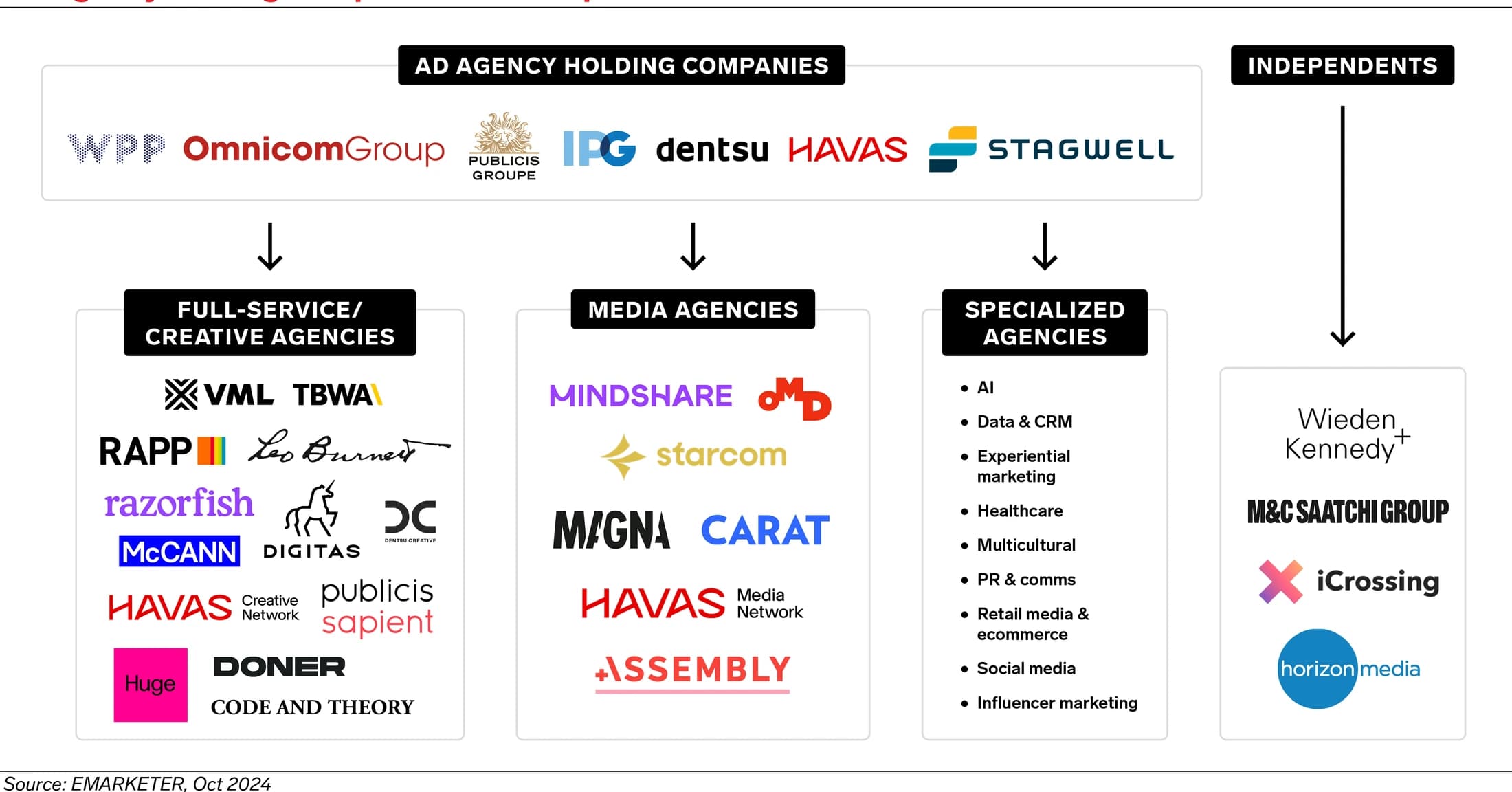
Take conflict-of-interest exposure. Six networks control most of the world's holding company revenue: WPP, Omnicom, Publicis Groupe, IPG, Dentsu, and Havas. Each of those networks operates dozens of individual agencies under one balance sheet. That structure isn't a scandal. It's just math. When one parent company owns the agency serving a beverage brand and another agency inside the same network is pitching that beverage brand's direct competitor, the conflict isn't hypothetical. It's structural. Independent agencies don't face that exposure because there's no shared parent company creating it in the first place. That's not a claim about integrity. It's a claim about org charts.
Speed to output works the same way. A brief that has to travel through an account layer, into a creative department, often across a discipline specialist office, and back through approval isn't slow because the people involved are slow. It's slow because the structure has more stops built into it. An independent shop where the founder or ECD who won the pitch is also the person art-directing the work has fewer stops by design. That's not a work ethic difference. It's an org chart difference.
Senior talent access is the one buyers feel most acutely and articulate least clearly. The pattern is well known enough in the industry that it barely needs restating: senior leadership closes the business, then rotates off to close the next piece of business, leaving account execution to a team the client never met during the pitch. Wieden+Kennedy's forty-year relationship with Nike is instructive here for the opposite reason: it's a case where the senior creative relationship didn't rotate out after the deal closed. That kind of continuity is more structurally available at independent shops precisely because there's no growth mandate pulling senior people onto the next new-business pitch the moment a contract is signed.
Cost transparency is the criterion buyers research the most and discuss the least in the room, because it's uncomfortable to ask a partner directly whether their invoice includes a markup they can't see. Holding company production and media buying can route through affiliated companies under the same parent, which makes a clean accounting of true cost genuinely difficult for a client to reconstruct. An independent agency with a single fee structure and no affiliated production entity to route dollars through doesn't have that opacity available to it even if it wanted to. Structural transparency, not moral transparency.
What Nobody Is Publishing
Here's the uncomfortable part for anyone trying to build an evidence-based case for independents: there is no publicly available, industry-wide dataset tracking how many brands move from holding company networks to independent shops each year, or the reverse. Search volume tells us intent. It doesn't tell us outcomes.
That gap is exactly why the SERP for this keyword cluster is empty. Building a real answer to "should I leave my holding company agency for an independent one" requires either proprietary switching data or enough named, verified examples to make the pattern legible. Most publications default to award counts and client logos instead, because that data is easy to find and impossible to verify against actual switching behavior. It answers "who does good work" without answering "who should I hire instead of who I have now."
That's the resource this search cluster is waiting for, and right now nobody's built it. Four hundred eighty monthly searches isn't a massive number on its own. But a cluster where seventy percent of the volume is comparison-intent, sitting on top of zero competing content, is the kind of gap that either gets filled by a serious publication doing the verification work, or gets filled by whichever holding company writes the most convincing self-defense first. Independent agencies have a narrow window to shape that answer before someone else does it for them, badly.
How to Actually Use This in a Pitch
A framework is only useful if it changes what happens in the room. Here's what changes.
Instead of opening a new business conversation with reel and case studies, open with diagnosis. Ask the prospective client directly: how many approval layers does your brief currently pass through before you see work. Ask who they met during the pitch process and whether those same people are still on the account eighteen months later. Ask whether they've ever tried to get a clean, itemized breakdown of production markup from their current partner. Ask whether they know, for certain, whether their agency's parent company serves a direct competitor.
Those four questions map exactly to the four criteria in the table above, and they do something a case study reel can't do: they make the prospective client diagnose their own current relationship's weaknesses out loud, in their own words, before the independent shop has said a single thing about itself. That's not a sales trick. It's the natural result of asking structurally specific questions to a buyer who's already searching "independent alternatives" at two in the morning.
Once the client has named their own pain point, the independent agency's answer becomes structural, not promotional. Not "we're more creative." Instead: "we don't have that approval layer because the team is twelve people, not twelve hundred." Not "we care more." Instead: "the person who just walked you through this deck will be the person art-directing your next campaign, because there's nowhere else for them to go inside a twenty-person shop." Not "trust us on cost." Instead: "here's the fee structure, here's what's included, there's no affiliated production company for the invoice to route through."
This is the version of "independence as strength" that actually closes business, because it never asks the buyer to take a leap of faith on charisma or hustle. It asks the buyer to recognize a structural fact they've already half-noticed about their current agency relationship, and then shows them a different structure that doesn't produce the same problem. That's a sturdier sales argument than any reel, and it's available to any independent shop willing to run the comparison honestly instead of leading with adjectives.
Where the Comparison Goes Next
The searches behind this cluster aren't going away. If anything, the ratio is likely to keep shifting further toward comparison-intent rather than discovery-intent, because the structural pressures driving that search behavior aren't reversing: conflict exposure inside consolidating networks, slower approval chains as those networks integrate services, cost opacity as production and media functions get folded into shared holding company infrastructure. They're intensifying as the six major networks continue consolidating capabilities under single umbrellas.
That means the buyer typing "advertising agencies independent" into Google next month looks a lot like the buyer typing it this month: already inside a holding company contract, already sensing one of these four structural frictions, already halfway to a decision before any agency, holding company or independent, gets in the room.
The independent shops that win that buyer won't be the ones with the best reel. They'll be the ones who can name the exact structural difference the buyer is already feeling and hasn't been able to articulate. Speed to output. Senior talent access. Conflict exposure. Cost transparency. Four criteria, not vibes, and a search cluster of four hundred eighty people a month quietly confirming that the decision has already started before the pitch ever begins.
The vacuum in this search cluster won't stay empty forever. Whoever fills it first, whether that's a serious publication doing the verification work or an individual agency founder running this exact framework in their next new business meeting, gets to define the terms of the comparison for everyone who searches after them. Right now, that opportunity is sitting wide open, and the data says the buyers are already looking for someone to hand it to them.
Free Agency Media Editorial
All news