Marketing Agencies Have Stopped Marketing Themselves
Search data reveals zero independent agencies competing for basic self-positioning keywords, exposing a blind spot the industry sells solutions for every day.

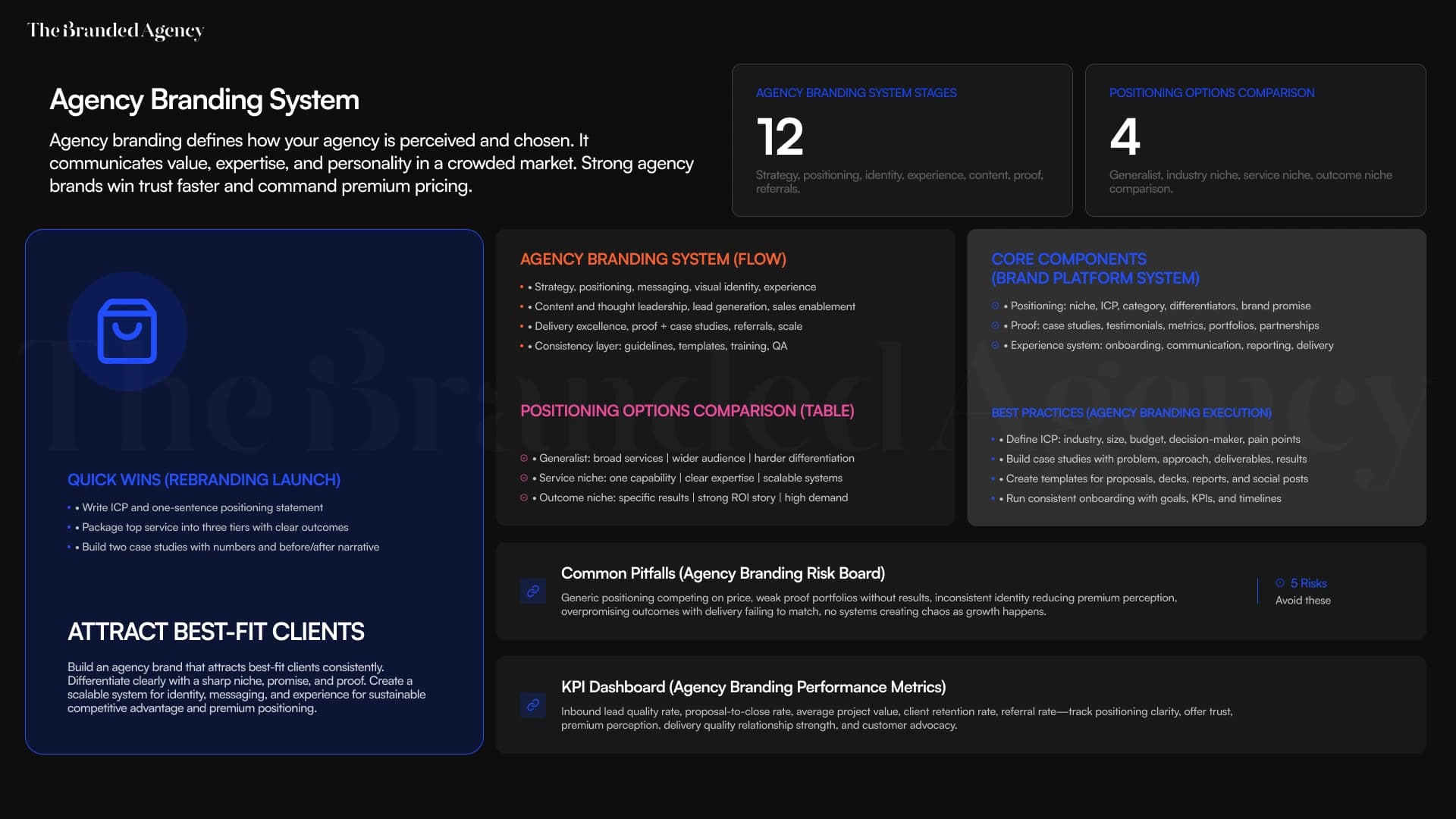
Type "marketing agency logo" into Google right now. Nobody's winning that search. Zero independent agencies show up competing for a keyword cluster pulling 1,560 monthly searches about how agencies present themselves. The industry built on selling positioning to Fortune 500 brands has no position on its own name.
That's the paradox worth sitting with. An entire category of businesses whose core product is helping other companies look sharp, sound distinct, and show up consistently online has, by and large, failed to do any of that for itself. The keyword data doesn't lie: "marketing agency logo," "marketing agency seo," "agency fb," "ad agency instagram," "advertising agency on instagram." Five search terms, all pointed at the same question: what does a well-run agency actually look like when it markets itself? The answer, based on who's actually ranking, is that almost nobody knows.
The Empty Field Nobody's Fighting For
Start with the number that should make every agency founder uncomfortable: 1,560 monthly searches across this cluster, and zero agencies actively competing for it. These agencies aren't underperforming or ranking on page three. They're absent. This isn't a crowded market with weak entries. It's an open field nobody's bothered to walk onto.
Compare that to the standalone volume on "positioning branding," which pulls 1,900 searches a month on its own, more than the entire five-keyword cluster combined. That's not a coincidence. It's a signal. People, brands, and other agencies are searching for what good positioning and branding looks like at a rate higher than they're searching for examples of agencies actually doing it. Demand for the concept outpaces the visible supply of agencies who've demonstrated it. That gap is the story.
Run the math on the cluster itself: five keywords, 1,560 total searches, an average of 312 searches per term. None of it dominated. None of it claimed. In an industry that pitches SEO strategy to clients as a core service line, the fact that zero agencies show up for searches about their own SEO, their own social presence, their own logos isn't an oversight. It's a pattern. And patterns at this scale aren't about one agency dropping the ball. They're about an entire category treating its own brand like an afterthought.
Full-Service Is Not a Position
The pattern shows up loudest in one place: the word "full-service." It's on more agency homepages than any other phrase in the industry, and it says almost nothing. Full-service means we do everything, which functionally means we're not distinctly good at anything a prospective client can point to. It's the marketing agency equivalent of a resume that says "hardworking team player." True, maybe. Useless as a differentiator, definitely.
The irony compounds when you consider what these same agencies tell clients during new business pitches. Nobody walks into a pitch and tells a CMO to describe their brand as "full-service." Every agency deck ever built for a client contains some version of the same lecture: you can't be everything to everyone, positioning requires sacrifice, the brands that win are the brands that stand for something specific. That's Positioning 101, and it's the exact strategic thinking indie shops sell for a living. Then the pitch ends, the deck closes, and the agency goes back to a homepage that says "full-service marketing and advertising agency" next to a stock photo of people looking at a whiteboard.
This isn't a hypothetical failure. It's the default state of the category. Generic positioning isn't a mistake agencies occasionally make. It's the path of least resistance, because real positioning requires the same hard, specific, sometimes uncomfortable choices that agencies charge clients five and six figures to make. That means naming what you're not good at, turning away the wrong-fit briefs, and committing to a point of view that some prospects will actively dislike. Most shops skip that work internally because there's no external client forcing the discipline. Nobody's paying the agency to position the agency. So it doesn't happen, and "full-service" becomes the default because default requires zero decisions.
The Portfolio Site as Time Capsule
Positioning problems don't stay contained to homepage copy. They show up physically, in the portfolio site itself, which for a huge share of independent agencies functions less like a living sales asset and more like a time capsule. Case studies from three, four, five years back sit at the top of the work page because nobody's gone back to reorder them. Client logos linger long after the relationship ended. The "team" page still lists someone who left eighteen months ago.
This matters more than agency founders tend to admit, because a portfolio site isn't a brochure. It's live inventory. When a CMO or brand marketing director is building a pitch list, the agency site does the same job a landing page does for a paid ad: it's the first impression, and it's unattended. A site built to look sharp in 2019 reads as dated in 2026 for the same reason last year's creative reads as dated in a client's ad account. The market moved, the craft evolved, and the artifact didn't move with it.
The agencies winning new business right now aren't necessarily the ones with the biggest redesign budgets. They're the ones treating their own site like an active account, not a static asset. That means work samples get rotated based on what's actually relevant to who's currently in-market. Old logos come down the moment a relationship ends, the same way an agency would never let a client run outdated brand assets in the wild. And the site gets audited the way an agency audits a client's funnel: what's converting, what's stale, what's costing conversions by sitting there unchanged.
The Social Presence Test
If the portfolio site is the time capsule, social presence is the pulse check. And this is where the keyword data gets specific: "agency fb," "ad agency instagram," "advertising agency on instagram." Three of the five terms in this cluster point directly at agency social behavior, which tells you something about who's actually searching. Prospective clients, other agencies benchmarking themselves, even journalists doing background checks. People are actively looking for what a credible agency's social presence looks like, and the search terms suggest they're not finding an obvious answer.
The reason is simple: inconsistency. An agency will post six times in a week during a business development push, then go quiet for two months. The Instagram grid will mix polished case study carousels with a phone-shot photo from an office party, with no consistent visual system tying them together. The Facebook page, if it's maintained at all, often reads like an afterthought bolted onto the Instagram strategy rather than a channel with its own intent.
The part that should sting is this: agencies sell social strategy as a line item. Content calendars, posting cadence, brand voice guidelines, platform-specific creative, all of it packaged and priced for clients. Then the agency's own account posts whenever someone remembers to, with no calendar, no consistent voice, and no clear point of view on what the feed is actually for. It's the same disconnect as the "full-service" problem: the discipline exists, it's just never turned inward.
The agencies breaking that pattern treat their own channels the way they'd treat a retained client account. Someone owns it. There's a cadence. There's a reason each post exists beyond "we should probably post something." And crucially, the content isn't just self-promotional. It shows point of view: opinions on the industry, reactions to work worth reacting to, visibility into how the shop actually thinks. That's positioning, expressed through a channel, executed with the same rigor as a client deliverable.
What Rigor Actually Looks Like
Strip away the specific channels, portfolio sites and social feeds, and what's left is a single underlying discipline: treating your own agency's marketing like a retained account, not a side project. That distinction explains almost every gap in this data.
Rigor means the agency's own SEO gets the same attention as a client's. Zero agencies competing for a 1,560-search cluster isn't a small miss. It's evidence that most shops have never run keyword research on their own name, their own category terms, their own service pages. If an agency pitched a client and admitted "we haven't looked at what people are searching for related to your business," that pitch would end immediately. Yet that's the standing posture most agencies take toward themselves.
The same standard applies to positioning: the statement isn't written once during a rebrand and then forgotten. It's tested, referenced, and defended the same way an agency would push a client to defend a tagline through a full campaign cycle. "Positioning branding" pulling 1,900 monthly searches on its own tells you the market is actively hunting for clarity on what strong positioning even looks like in practice. Agencies sitting on that exact expertise, and not applying it visibly to themselves, are leaving demand unanswered that they are uniquely qualified to answer.
It extends to design decisions too: the logo, the color system, the type get revisited with the same critical eye an agency would bring to a client's dated brand mark. A logo built quickly in year one of a shop's existence, never revisited as the work matured and the client roster leveled up, sends a message whether the founders intend it or not. If a shop hasn't bothered updating its own mark, how seriously does it take craft when nobody's forcing the issue?
And none of it works without consistency. The agencies showing up with a clear identity across their site, their case studies, their social, and their outbound materials aren't necessarily bigger or better funded than the ones with the generic full-service homepage. They've simply decided that the same standards applied to client work apply internally, without exception, without the excuse that there's "no time" or "no budget" for marketing themselves. Every agency has that excuse available. The ones separating from the pack are the ones who didn't take it.
The Compounding Cost of Weak Self-Positioning
None of this is cosmetic. Weak self-positioning has a direct cost, and it compounds. Every prospective client who lands on a "full-service" homepage with a three-year-old portfolio and a dormant Instagram account is forming a judgment before a single email gets exchanged. That judgment doesn't get reversed easily in a first call. It has to be overcome, which means the agency is spending pitch energy fighting a first impression it created for itself, rather than building on a first impression that was already doing work before the meeting started.
Contrast that against the open field the data reveals. Zero agencies competing for 1,560 monthly searches across a self-positioning keyword cluster isn't just an indictment of the category's habits. It's an opportunity sitting unclaimed. The agency willing to treat its own SEO, its own site, its own social presence with the rigor it sells to clients isn't fighting for scraps in a crowded field. It's walking into a field with no competition, because the rest of the category opted out by default.
That's the real story behind this data. It's not that independent agencies lack the skill to position themselves well. It's that positioning yourself requires the same discomfort positioning a client requires: making choices, cutting the vague language, committing to a specific point of view, and maintaining it with a consistency most shops reserve exclusively for billable work. The agencies figuring that out aren't doing anything the rest of the category couldn't do. They're just doing it, while everyone else keeps the discipline pointed outward and leaves their own house unattended.
Where This Goes Next
The keyword data suggests the market is already asking the question: 1,900 monthly searches for positioning and branding concepts, a full cluster of searches probing what credible agency self-presentation looks like, and nobody clearly answering either. That's a short window. Search behavior like this doesn't stay uncontested forever. Somebody claims it, and once an agency starts showing up consistently for terms tied to positioning, branding, and its own digital presence, the compounding advantage of being first is hard to reverse.
The agencies that treat their own marketing like a retained account, not a side project squeezed in between client deadlines, are the ones who'll own that advantage. Not because they're bigger or better resourced. Because they applied the one piece of advice every agency gives every client and finally pointed it at themselves: you can't be everything to everyone, and the market rewards the ones willing to say exactly what they are.
Free Agency Media Editorial
All news