The Reporting Gap: Why Agencies Are Losing the Transparency War
AI tools didn't kill agency retainers by being smarter. They killed the ability to hide pricing. The agencies that survive will show their math first.
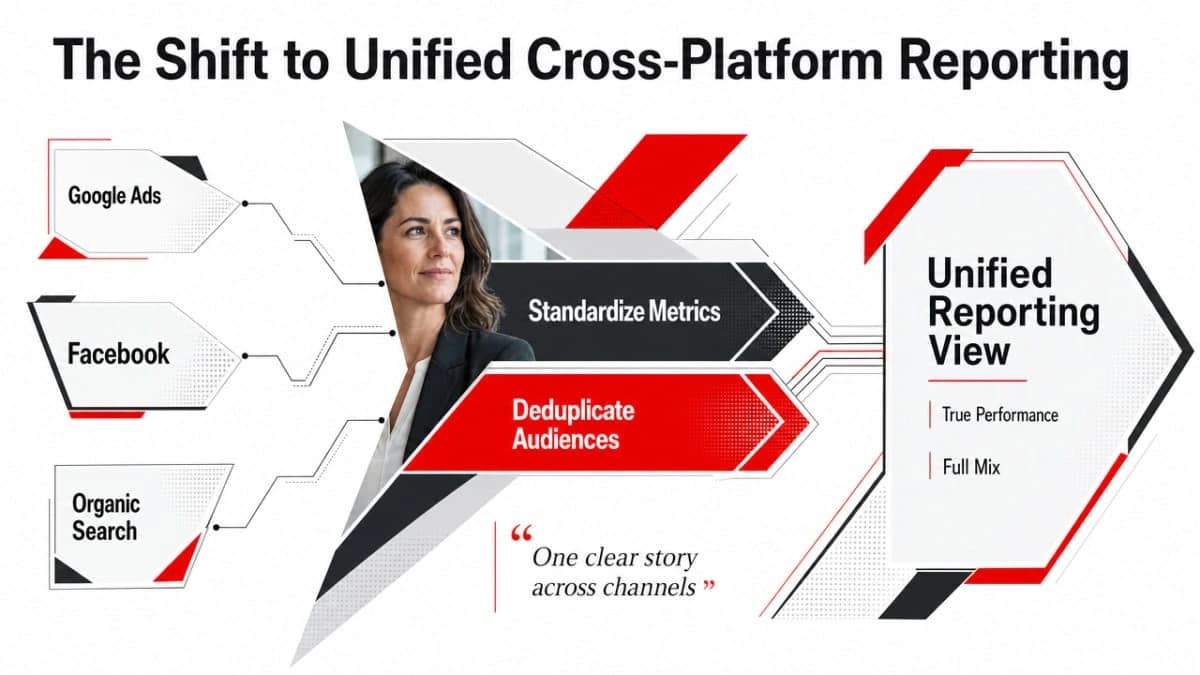



The most searched question in marketing agency reporting right now isn't "which dashboard should I buy." It's a question nobody's answering on page one of Google: if an AI tool can replicate a $15,000-a-month marketing function for $129, why does anyone still pay an agency $8,000 a month for the same channels.
That's not a hypothetical. It's the exact math one X poster laid out when describing Okara's CMO v2 handling SEO, content, and social for $129 a month, a fraction of the cost of the marketing hire it's built to replace. Another thread went further, pointing to a 7-agent AI setup replacing a $356,000-a-year marketing system for $200 a month. These aren't fringe claims. They're the framing agency owners are wrestling with in real time, in public, on the same platform where they used to post case studies.
Meanwhile, the keyword data tells a quieter but related story. "Reporting operations" pulls 390 searches a month. The broader cluster, spanning "marketing agency reporting," "software for advertising agencies," and "marketing campaign management software," totals 840 searches. Zero agencies currently rank in that cluster with editorial content. The entire first page is software vendors and project management blogs selling tools. Nobody's writing about the actual crisis: agencies don't have a tooling problem. They have a trust problem, and reporting is the symptom, not the disease.
The Billing Model That AI Just Made Impossible to Hide
For two decades, agency profitability quietly depended on what one X user, @enochmkt, called "the spread": buying media cheap, billing it high, and never showing the client the difference. It worked because clients couldn't see the receipts. Media buying was opaque by design. The agency negotiated the rate, marked it up, and reported a blended number that made the math unauditable.
That model is dying, and AI is the reason, but not the reason most agency owners think. It's not that AI is replacing the media buying function. It's that AI-native tools are pricing transparently by default. Okara's CMO v2 publishes a flat $129 a month. There's no spread to hide because there's no markup structure at all. When a prospective client compares that flat-rate clarity to an agency invoice that reads "media services: $12,400" with no breakdown, the agency looks like it's hiding something, even if it isn't.
This is the actual disruption. Not that AI tools are better than agencies at strategy, because in most cases they aren't. It's that AI-native pricing has reset the client's expectation of what transparency looks like. A generation of marketers who now use $129-a-month tools with itemized function lists will not tolerate a $15,000 monthly retainer with a single line item.
The agencies responding correctly aren't panicking about the $129 tool. They're panicking about their own invoice format. Gym marketing retainers, cited in the same thread as the spread critique, are increasingly published upfront: flat rate, scope defined, no discovery call required to learn the price. That's not a small tactical shift. It's a full reversal of the industry's default posture, which for years has been "call us and we'll quote you." That posture made sense when pricing power lived with the agency. Now that pricing power has shifted to the client, it just reads as evasive.
Why 840 Searches and Zero Agency Rankings Is the Real Signal
Here's the part the SERP data makes undeniable. Search "marketing agency reporting" and you get thedigitalprojectmanager.com's tool roundup, a Reddit thread of agency owners comparing stacks, Workamajig's six-report framework, Supermetrics' automation pitch, Whatagraph's eight-tool list, ClicData's dashboard product, AgencyAnalytics' homepage, and Swydo's comparison guide. Eight of nine results are software vendors selling the dashboard. One is a Reddit thread of practitioners asking each other what to buy.
Not one result addresses the question underneath the question: what does an agency owe a client in exchange for the fee, and how does reporting prove it. The entire cluster treats reporting as a tooling decision, a checklist of which platform pulls Google Analytics and Meta Ads into one interface fastest. That's a real need. It's also the shallow layer of a much deeper operational question that 390 monthly searchers for "reporting operations" are almost certainly circling without finding an answer.
This is the gap. Agencies that publish content addressing pricing transparency, retainer justification, and reporting-as-retention strategy aren't competing against Whatagraph or AgencyAnalytics for search traffic. They're occupying territory those vendors have no incentive to touch, because a software company's job is to sell the dashboard, not to tell an agency owner that the dashboard alone won't save the retainer.
The agency that writes "here's exactly what we bill for and here's the report that proves it happened" isn't just filling a content gap. It's answering the question that drove the client to search in the first place, which is rarely "which tool" and almost always "can I trust what I'm paying for."
Retainers Still Beat In-House, But Only If the Math Is Shown
The in-house versus agency comparison making rounds on X undercuts the "AI kills agencies" narrative entirely, if the agency is willing to show its work. One widely shared breakdown put a fully loaded 4-person in-house marketing team at $450,000 to $550,000 a year before tools or training. A comprehensive agency partnership covering the same scope: $50,000 to $150,000 a year. That's not a marginal advantage. That's a 3x to 10x cost difference favoring the agency, and it's the single strongest argument available to any independent shop right now.
But that argument only works if the agency can actually show the comparison, and most can't, because most agency pricing is still bundled into a single monthly number that obscures what's inside it. The client doesn't experience the $450,000 they saved. They experience a $9,000 invoice that looks expensive in isolation because nobody showed them the alternative.
Execution-focused retainers in the $3,000 to $20,000 a month range, the band most independent agencies operate in according to the same thread, sit in an uncomfortable middle. They're expensive enough to trigger AI-replacement anxiety in the client's head, but too opaque to trigger the in-house-cost comparison that would justify the fee. That's the exact tension driving the "spread versus transparent retainer" debate. The agencies solving it aren't lowering their prices to compete with $129 AI tools. They're restructuring their invoices to make the in-house comparison impossible to ignore.
That means itemized retainers that break out strategy, execution, and reporting as separate visible line items. It means proactively showing the client what a comparable in-house hire would cost before the client does that math themselves and arrives at the wrong comparison, the one against the $129 tool instead of the $450,000 team. Pricing transparency isn't a courtesy in this environment. It's the entire retention mechanism.
Reporting Stops Being a Deliverable and Becomes the Retention Product
The old model treated reporting as homework: a monthly PDF, assembled the last week of the month, delivered as proof of activity rather than proof of value. That model is now actively working against agencies, because it reinforces the exact perception AI tools are exploiting: that the client is paying for a black box that occasionally produces a document.
The correction showing up across X threads is real-time access replacing monthly recap. One post described client logins that show live data, calls, cases, and ROI traced back to source, replacing the monthly PDF entirely. Another highlighted Databox's free Claude skill generating cross-channel paid ads reports, blended snapshots, budget pacing, and CPA, in under 90 seconds. The speed matters less than what it signals: reporting that used to take a strategist half a day to assemble by hand can now be generated instantly, which means any agency still delivering a static monthly PDF is choosing to look slower and less transparent than the tools their own clients could buy for $129 a month.
The agencies pulling ahead are the ones treating the dashboard as always-on infrastructure the client can check whenever anxiety strikes, not as a monthly ritual the agency controls the timing of. That distinction matters more than it sounds. A client with 24/7 access to a live dashboard showing GA4, Search Console, and rankings pulled into one view with plain-English summaries has no reason to wonder what they're paying for, because the proof is sitting in a tab they can open at 11pm on a Tuesday. A client waiting for a PDF on the 30th has three weeks of silence to fill with doubt, and doubt is exactly what AI-tool comparisons are optimized to fill.
This is the retention reframe the industry hasn't fully processed yet. Real-time reporting isn't a nice-to-have feature bolted onto the retainer. It's the mechanism that answers the AI-replacement question before the client asks it out loud. Every dashboard refresh is a small, continuous justification of the fee. Agencies that understand this are building reporting cadence into the product itself, not treating it as an afterthought assembled by a junior account manager the week before the invoice goes out.
Operations Discipline Is the Quiet Advantage No One's Marketing
The third leg of this, and the one getting the least public attention relative to its impact, is internal operations. One widely circulated post described a "$400,000-a-month Modern Agency Operations Blueprint" aimed at agencies in the $500,000 to $3 million range, built around a concept called decision boundaries: explicit limits on what the agency will and won't take on, designed specifically to prevent service creep from diluting focus.
Service creep is the operational version of the spread problem. Just as opaque billing hides where the money goes, an agency that says yes to every adjacent request, a little SEO here, a landing page there, a rebrand nobody scoped properly, ends up unable to explain where its time goes either. The client can't audit the invoice and the agency can't audit its own margins. Decision boundaries fix both problems at once by forcing the agency to price and scope discretely instead of absorbing scope silently and hoping the retainer covers it.
This connects directly back to reporting transparency. An agency with clear decision boundaries can produce a report that maps precisely to what was billed, because the work itself was bounded in the first place. An agency without boundaries produces a report that's an approximation, a rough narrative of "here's roughly what we did," because the underlying operations never tracked cleanly to begin with. Transparent reporting is downstream of disciplined operations. You cannot report your way out of a scope-creep problem.
The tooling recommendation attached to this discipline is notably unglamorous. Multiple posts pointed to low-overhead stacks, Google Workspace, Slack, and similar tools costing a few hundred dollars a year, with the explicit argument that people, not technology, are the real differentiator. That's a useful corrective to the SERP's obsession with dashboard features. The nine ranking pages for "marketing agency reporting" spend their word count comparing Looker Studio to Whatagraph to AgencyAnalytics. None of them mention that the agencies winning retention fights aren't winning because of which visualization tool they picked. They're winning because their internal operations are disciplined enough that the visualization tool has clean data to show in the first place.
What Defensible Pricing Looks Like From Here
None of this argues that retainers are dying. The 3x to 10x cost advantage over in-house teams is real and durable, and no $129 tool replicates the strategic judgment, the account relationship, or the cross-channel orchestration a competent independent agency provides. What's dying is the ability to charge for that value while hiding how the fee breaks down.
The agencies positioned to win the next two years share three traits, none of which show up in the current SERP's tool comparisons. First, itemized, flat-rate pricing that makes the in-house cost comparison explicit rather than leaving the client to compare against the wrong benchmark. Second, real-time reporting infrastructure that functions as continuous proof rather than monthly homework, closing the anxiety gap that AI-tool marketing is specifically designed to widen. Third, internal decision boundaries disciplined enough that the reporting isn't an approximation of the work but a direct reflection of it.
The 840 searches a month circling this cluster, and the zero agencies currently claiming that territory in Google's results, represent an open door. Not because the keyword volume is enormous, it isn't, but because the content occupying it right now answers the wrong question. It tells agency owners which dashboard to buy. It doesn't tell them how to restructure the invoice, the reporting cadence, or the internal scope boundaries that make the dashboard's numbers defensible in the first place.
That's the piece nobody's written yet, and it's the piece agency owners are actually asking for, in threads about $129 AI tools and $450,000 in-house teams, on a platform where the conversation is louder and further ahead than the search results have caught up to. The agencies that answer it first, in public, with their own pricing shown rather than hidden, aren't going to be competing with software vendors for rankings. They're going to be the ones clients find when they finally type the real question into Google: not "best reporting software," but "why does my agency retainer cost what it costs, and can they prove it."
Free Agency Media Editorial
All news


