Outdoor Marketing Is a Tiny Niche. Everyone Wants a Piece of It.
With only 170 monthly searches, outdoor industry marketing is one of the smallest verticals in B2B. It's also drawing mergers, AI retainer-killers, and a roster of specialists fighting to own it by name.



The keyword "outdoor industry marketing" pulls 30 searches a month. Widen the net to the full cluster around it and you get to 170: less volume than a mid-size subreddit thread generates in comments. Yet in that same twelve-month window, the category absorbed a strategic PR merger, a wave of AI startups pitching themselves as retainer killers, and enough named vertical specialists to fill two competing "best of" listicles on page one of Google. A market this small should not have this much happening in it. That's the story.
Free Agency Media's own tracking shows zero agencies formally logged as competing for this cluster. Not because the category is empty. Because nobody has been watching it closely enough to log it. Outdoor industry marketing is a case study in what happens when a vertical gets small enough to escape holding-company attention and specific enough that a handful of independent shops can own it outright, right up until consolidation and AI both start knocking at the same time.
Five of Nine: What the SERP Reveals About Who Actually Owns This Conversation
Run "outdoor industry marketing agency" through Google and something unusual happens. In most competitive B2B categories, the top of the page belongs to aggregators: Clutch profiles, "best agencies" roundups, review sites monetizing the confusion of buyers who don't know who to hire. Outdoor marketing doesn't work that way. Of the nine organic results currently ranking, five are agency homepages speaking for themselves. Garrison Everest holds position one. Backbone sits at two. Brandon and Origin Outside hold six and seven. 3plains rounds out the page at nine.
That's the tell. When the agencies themselves outrank the listicles trying to rank them, it means the buyers searching this term already know enough to go direct. They're not asking "who's good at this." They're confirming what they already suspect: that Garrison Everest, Backbone, and Origin Outside are the answer, and they just need the URL.
The four results that aren't agency homepages are exactly what you'd expect from a category still forming its center of gravity: Deer Camp Digital's comparison guide, a disruptiveadvertising.com roundup naming Big Canoe Digital as "a premium marketing agency dedicated exclusively to the outdoor and recreation industry," Unruled Agency's "Top 10 Outdoor Lifestyle Marketing Agencies" list crowning TBA Outdoors "Best Overall," and RaveCapture's "Top 7 Marketing Agencies for Outdoor Brands," which names TBA Outdoors, Origin Outside, Seed Factory, and Garrison Everest in the same breath. Strip out the SEO scaffolding and the same six or seven names keep surfacing across every list: Garrison Everest, Backbone, Origin Outside, Brandon, 3plains, TBA Outdoors, Seed Factory, Big Canoe Digital. That's not noise. That's a category small enough to have a knowable roster, which is precisely what makes the consolidation pressure and the AI pitch worth taking seriously. You can't quietly erode a market when everyone in it can name everyone else in it.
What Vertical Fluency Actually Buys
Garrison Everest doesn't describe itself as a general marketing agency that happens to serve outdoor clients. Its own positioning centers on messaging, branding, and "systems to grow your awareness," built specifically for outdoor brands. That's a specific service architecture, not a generic capability list with an outdoor logo slapped on top.
Backbone goes further on scale. It calls itself the nation's leading active lifestyle and outdoor marketing agency, and backs that claim with a full-stack offer: public relations, paid media, and the account management required to run programs for brands whose customers actually use the gear in the conditions it's designed for. That's not a boast you can make from a generalist holding-company outpost that rotates account teams between a bank client and a boot brand every eighteen months.
Origin Outside occupies a different lane inside the same category. Its site describes bringing brands to life through content creation, community management, paid campaigns, and engagement. That's a community-first model, built for brands whose marketing succeeds or fails based on whether the audience believes the brand actually lives the lifestyle rather than licenses it for a quarter.
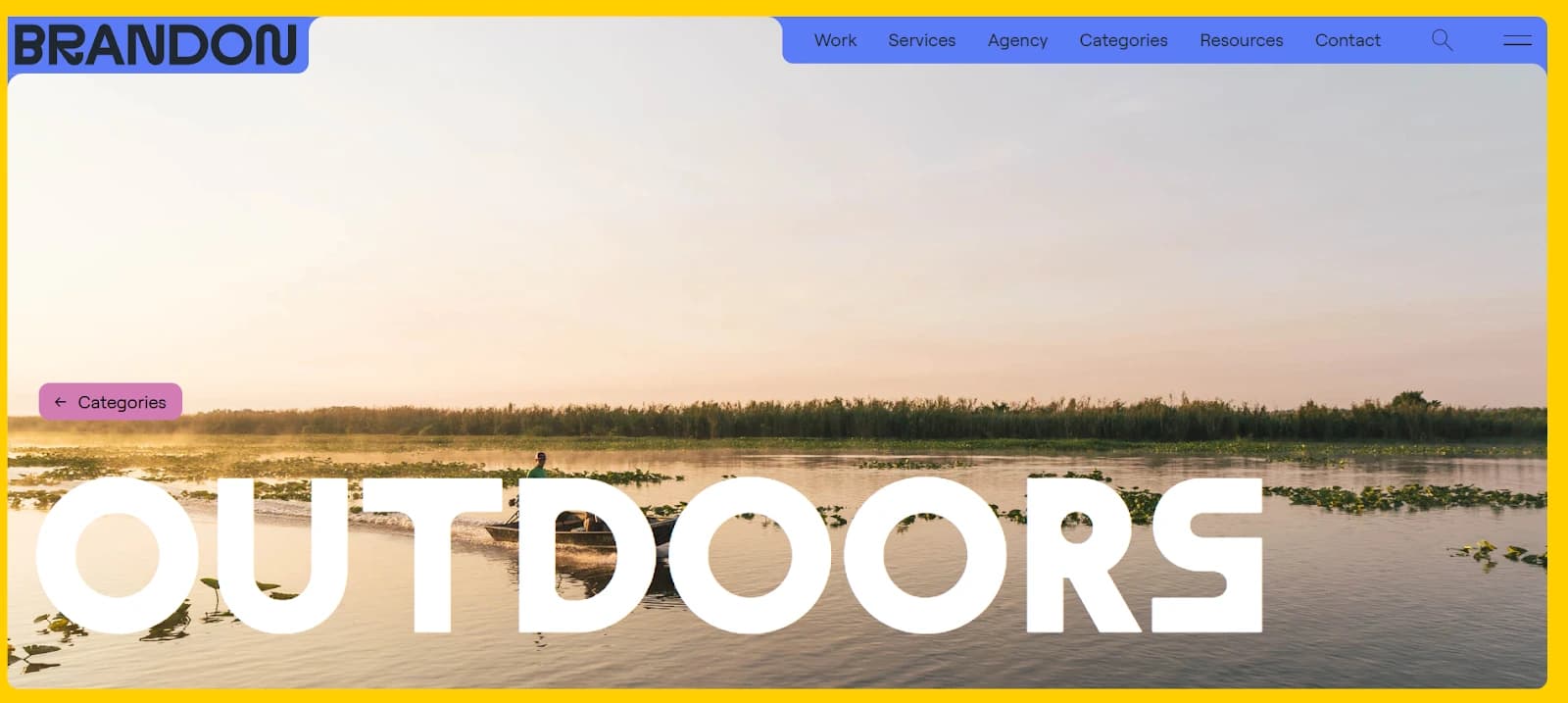
Brandon frames itself around outdoor and active lifestyle expertise specifically, promising "bold creative, smart data" for outdoor brands. And 3plains positions as a full-service outdoor marketing group covering web, branding, and graphic design under one roof. Four different service architectures, four different entry points into the same buyer, and zero overlap in how they'd pitch the same account.
That's the actual advantage vertical specialization buys, and it's not "they understand hunting" as a vibe. It's structural. A generalist shop building a campaign for a backcountry ski brand has to research the customer, the language, the seasonality, and the credibility signals from scratch, then bill for that research. Garrison Everest, Backbone, Origin Outside, Brandon, and 3plains already have it. Their retainer isn't paying for a learning curve. It's paying for a shop that already knows the difference between a brand that authentically shows up at a trailhead and one that's clearly shooting a stock-photo campaign in a studio with a fan blowing dirt around.
That difference shows up on X too, not just in agency copy. Walk 2 West Marketing, founded in 2022 as a social media agency built specifically for the hunting and outdoor industry, has spent its short life arguing exactly this point: organic strategy and authentic content built on years of credibility inside the space beat generic social management applied to a niche audience. The pitch isn't headcount. It's fluency. And fluency compounds in a category this specific in a way it simply doesn't in broader verticals where the customer base is less tribal.
The Obviouslee and Meteorite PR Merger
Here's where the strength frame gets tested. In 2025, Obviouslee, a strategic marketing agency and Certified B Corp, merged with Meteorite PR, a Boulder, Colorado firm built specifically around outdoor industry public relations. On its face, this reads like two specialists combining forces to serve clients better: strategic marketing plus category-native PR, one door instead of two.
Look closer and it's also a signal. Meteorite PR had already done the hard work of building outdoor-specific PR relationships and category credibility in Boulder, a city that sits inside the outdoor industry's actual geography rather than adjacent to it. If pure specialization were an unassailable moat, that credibility alone should have been enough to keep Meteorite independent indefinitely. Instead, it combined. That's not evidence that specialization stopped working. It's evidence that even inside a hyper-specific vertical, scale logic still applies once a category matures past a certain point. Clients want fewer vendors doing more, and a merger is often the fastest way to offer that without diluting the specialization that made both shops valuable in the first place.
This is the pattern worth watching across outdoor marketing broadly, not just in this one deal. A category with 170 monthly searches and a roster of maybe eight recognizable names is small enough that any single merger meaningfully reshapes the competitive map. When Meteorite PR and Obviouslee combined, they didn't just consolidate two client rosters. They changed what "full service outdoor specialist" means for every other shop competing for the same accounts, including Garrison Everest, Backbone, and Origin Outside, all of whom now compete against a combined offer that pairs strategic marketing with category-native PR under one roof.
The lesson isn't that independence is fragile. It's that independence and consolidation aren't opposites. Two independent, specialized shops merging to defend and extend their specialization is a different move entirely than an independent shop selling into a holding company to get absorbed into a generalist network. Obviouslee and Meteorite PR didn't trade their outdoor fluency for scale. They bet that combining two forms of outdoor fluency, strategic and PR, produces more of it. That's consolidation in service of specialization, not consolidation that dilutes it. The distinction matters: it's the difference between a category getting stronger and a category getting swallowed.
The AI Retainer-Killer Pitch, and Why "They Don't Understand the Lifestyle" Cuts Both Ways
The other pressure on this category isn't coming from agencies at all. It's coming from AI tools pitching themselves directly at outdoor brands as retainer replacements. Tools branded around names like BrushFire, Driftpine, and FieldFrame have been promoted on X as always-on agents handling SEO, social, email, content, paid ads, and competitor monitoring, tuned to seasonal outdoor moments like hunting openers or ice-out, all positioned as a way to eliminate six-figure agency fees entirely.
The pitch leans on a real grievance. A recurring complaint aimed at conventional marketing agencies is that they don't understand the outdoor lifestyle, that they treat a hunting brand's marketing calendar the same way they'd treat a SaaS company's, missing the seasonal and cultural specificity that actually drives outdoor purchasing behavior. That criticism is fair when it's aimed at generalist shops. It's considerably less fair when it's aimed at Garrison Everest, Backbone, Origin Outside, Brandon, or 3plains, all five of whom built their entire positioning around exactly the fluency the AI pitch claims doesn't exist in agency form.
That's the actual weakness in the AI-replacement argument: an AI agent tuned to fire content around "hunting openers" or "ice-out" is automating a calendar, not building a relationship. Origin Outside's stated model is community management and engagement, which is a human trust function, not a scheduling function. Backbone's PR work depends on relationships with editors and outlets who need to believe a pitch is credible, not just timely. None of that is what BrushFire, Driftpine, or FieldFrame are actually built to replace, no matter how the promotional copy frames it. The AI tools are competing for the scheduling and execution layer of the retainer. They are not competing for the trust layer, which is precisely the layer that vertical specialists like Garrison Everest and Backbone have spent years building and that a generalist AI agent, however well-tuned to seasonal keywords, cannot borrow or fake.
That distinction matters more in outdoor marketing than in almost any other vertical, because the outdoor customer base is unusually skilled at detecting inauthenticity. A hunting brand's audience can tell within one post whether the person behind the account has actually spent a morning in a stand. An AI agent optimizing for "ice-out" as a seasonal keyword doesn't know what ice-out smells like. The specialists do, or they've built teams and processes around people who do. That's not a soft advantage. In a category this identity-driven, it's the whole advantage.
Budget Discipline as a Competitive Signal
There's a third pressure worth naming, separate from mergers and AI: the instinct to cut marketing spend when conditions get uncertain. A recent post from a PR professional aimed squarely at outdoor industry brands argued against slashing marketing and PR budgets during uncertain periods, urging smarter strategy over simply "outshouting" competitors with volume.
That advice matters specifically in a category this small. When total category search demand sits at 170 monthly searches and the visible roster of specialists numbers under ten, every brand's budget decision reshapes the competitive landscape for every agency in it. A brand that cuts its PR retainer with a specialist like Backbone or Meteorite PR-Obviouslee doesn't just save money. It opens space for a competitor brand to buy that same specialist's full attention, or it pushes that specialist to take on a client outside its usual caliber to fill the gap. In a category this concentrated, budget discipline isn't a private decision. It's a market signal that ripples through a genuinely small number of relationships.
The brands making smart, sustained bets in this category, working with specialists who understand seasonality, community, and credibility rather than chasing the cheapest available execution layer, are the ones setting up to own the category's next cycle. The ones cutting budget in favor of AI-agent tools tuned to fire seasonal content are optimizing for a cost line, not a market position. In a vertical this identity-driven, that's a bet against the thing that actually built the category's best brands in the first place.
Where This Category Goes From Here
Outdoor industry marketing is small enough to map by hand and specific enough that the map actually matters. Garrison Everest and Backbone hold the top two organic positions for the category's core search term, not because they gamed an algorithm but because buyers already know to go direct to them. Origin Outside, Brandon, and 3plains round out a roster of named specialists whose service architectures, messaging and systems, PR and paid media, content and community, creative and data, web and branding, don't overlap enough to compete on price alone. That's a healthy market structure. It's also a fragile one, because a category this concentrated changes fast when any single piece moves.
Two pieces already have. Obviouslee and Meteorite PR combined their strategic marketing and outdoor PR fluency into one offer in 2025, proving that consolidation inside a specialized vertical doesn't have to mean dilution, but does mean the competitive bar for "full-service outdoor specialist" just moved for everyone else in the category. And a wave of AI tools, BrushFire, Driftpine, and FieldFrame among them, is pitching outdoor brands on the idea that seasonal fluency can be automated rather than earned, a pitch that works right up until a brand's audience notices the difference between scheduled content and lived experience.
The specialists best positioned for what comes next aren't the ones treating either pressure as an existential threat. They're the ones like Walk 2 West Marketing, betting that credibility built over years inside a specific outdoor niche compounds in ways neither a holding company's generalist network nor an AI agent's seasonal keyword targeting can replicate on any timeline shorter than the years it actually took to build. Independence in this category was never about staying small to survive. It's about staying specific enough that the biggest threats to the model, consolidation and automation, both have to prove they understand the lifestyle before they can take the account. So far, in a market of 170 monthly searches and a roster you can count on two hands, the specialists are still the ones buyers search for by name.
Free Agency Media Editorial
All news


