The Empty Search Term Exposing Performance Marketing's Pricing Problem
No independent agency owns the search term "performance-based marketing agencies." That vacancy reveals a pricing model most shops are getting backwards.

The keyword "performance-based marketing agencies" pulls 140 searches a month. The broader cluster adds another 30. Zero independent agencies show up in the top ten results claiming that identity as their own. Not one homepage. Not one founder's bio. Just five roundup posts, a Reddit thread asking if anyone's found a real one, and a definitional explainer telling you what the term means, as if nobody's actually proven it yet.
That's the paradox. Demand is real. Ownership is empty. The agencies best positioned to win this search term aren't showing up in it, and the ones showing up aren't agencies at all. They're listicles written by other agencies: Directive Consulting ranking "18 Best Performance Marketing Agencies For B2B," Lyfe Marketing countering with "Top 36 Performance Marketing Agencies In The US 2026." Two publications, competing to be the authority on a category nobody in the category wants to actually stand behind.
There's a reason for that. Performance-based pricing sounds like the smartest deal in the industry until you run the math on who actually wins it.
The Model Most Agencies Get Backwards
Performance pricing promises alignment. You get paid when the client gets results. It's a clean story and an easy pitch, and it explains why Directive's list and Lyfe's list both keep circling back to the same handful of names: NoGood, described in Directive's roundup as "a growth-focused performance marketing agency known for rapid experimentation," and AdParlor, which Lyfe's list frames as "specializing in paid media and influencer marketing." Two different publications, two different rankings, same instinct: performance marketing gets defined by execution speed and channel specialization.
That's the trap. Execution speed and channel specialization are exactly what algorithms do now, and algorithms don't need a retainer.
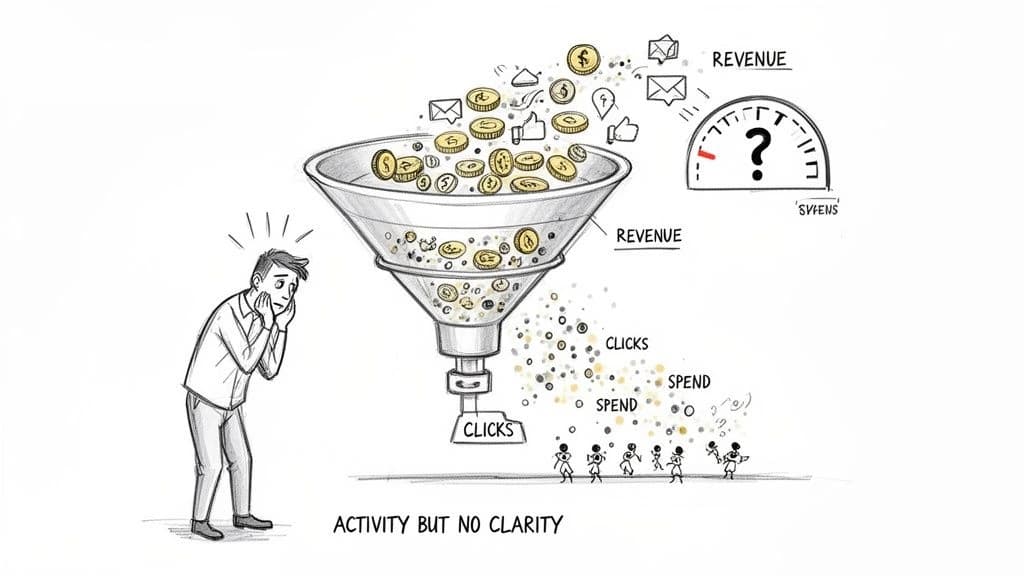
An agency that prices itself on media-buying execution, on hitting a target ROAS or a cost-per-lead threshold, is pricing itself against Google's own bidding algorithm and Meta's Advantage+ campaigns. Those systems reallocate budget in real time, test creative variants faster than any human trafficker, and cost the client nothing extra to run. When your performance fee is tied to outcomes that an ad platform's own automation is already optimizing for, you're not adding value on top of the algorithm. You're a markup on it.
That's not a theory. It's the exact critique circulating on X right now. One recent post from @Jessie_HealyDTC lays it out directly: algorithms and AI now handle much of the media buying, so agencies have to pivot to sophisticated creative strategy, testing, landing pages, and CRO, or they simply aren't adding enough value as ads get more expensive and competition increases. Read that again. The agency's job isn't to buy media better than the machine. It's to give the machine something better to work with, and to own what happens after the click.
What Contribution Margin Has to Do With Any of This
Here's where most performance deals fall apart, and it's not a pricing problem. It's a metrics problem.
@Rohitintheflesh's take on X names it precisely: too many self-described "performance marketers" optimize only for ROAS without understanding broader business metrics like contribution margin, payback periods, retention, or cash flow. That's the entire failure mode in one sentence. An agency can hit a 4x ROAS target and still lose the client money, because ROAS doesn't know what the product costs to fulfill, what the refund rate looks like, or how long it takes to recover customer acquisition cost. Contribution margin knows. Payback period knows. Lifetime value knows.
This is the real fork in the road for any agency considering performance pricing: are you pricing against a marketing metric or a business metric? Marketing metrics like ROAS, CPA, and CTR are things a media-buying algorithm already optimizes for free. Business metrics like contribution margin, LTV, and payback period require someone who understands the client's unit economics well enough to know when a "successful" campaign is actually bleeding the business dry on the back end.
Agencies pricing performance deals on marketing metrics are competing with software. Agencies pricing performance deals on business outcomes are doing something no algorithm can touch, because no algorithm has access to the client's cost of goods sold, churn curve, or cash conversion cycle. That access, and the judgment to act on it, is the actual product. Everything else is execution, and execution is getting commoditized fast.
Why Zero Agencies Own This Search Term
Go back to that empty top ten. It's not an accident that no independent agency claims "performance-based marketing agency" as core positioning. It's evidence of exactly how few shops are confident enough in their outcome-ownership to put their name on the promise.
InnoVision's page ranks for the term with the pitch "we don't get paid until you've performed," which is the purest version of the old model: pay-for-performance tied to activity, not business impact. LFG Media Group's explainer, ranking fifth, defines the category correctly on paper, "a performance-based marketing agency is a partner that ties its revenue to your results," but stops at definition. It doesn't name a single agency actually structuring deals around contribution margin or payback period. Metadata.io's entry, dated February 2025, frames performance agencies as integrators of "marketing data and sales," but again, no operator naming their own risk-reward structure.
Nine listed results. Not one homepage where an agency says: here's our contribution margin threshold, here's the LTV multiple we require before we'll take equity-adjacent risk, here's our payback period ceiling. That's the gap. Search volume of 140 a month for the head term, another 30 across the cluster's long tail, and the entire SERP is roundups and definitions. The agency that fills that gap with an actual framework, not a promise, owns a search term with real commercial intent and zero independent competition.
The Framework: Who Should Actually Take Performance Deals
Not every agency should touch performance pricing. That's the part most "pay for performance" pitches skip, because saying no to a pricing model is bad marketing copy. But the framework matters more than the pitch.
Data infrastructure first. An agency taking on contribution-margin-based pricing needs access to the client's actual unit economics: COGS, fulfillment cost, refund rate, churn. Without that pipeline, "performance" reverts to vanity ROAS, and you're back to competing with the algorithm. If the agency can't see the P&L, it shouldn't be pricing against the P&L.
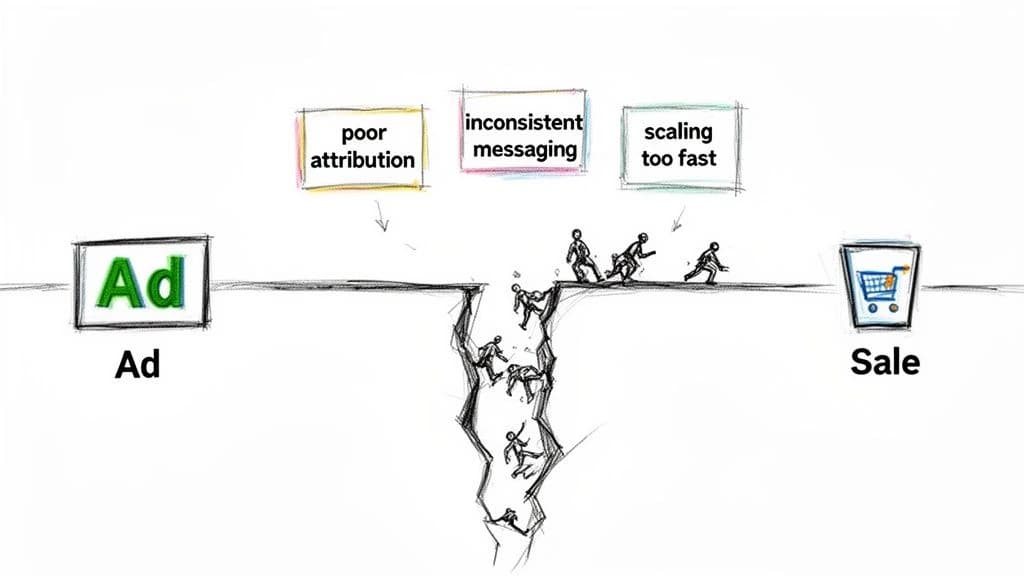
Attribution maturity second. LTV and payback period are only useful numbers if you can attribute revenue to the campaign across a multi-month window, not just a last-click conversion. Agencies without multi-touch or incrementality testing capability are guessing at LTV, and guessing at LTV with real money on the line is how agencies go under, not how they win.
Margin cushion third. Performance pricing structured around business outcomes means slower payment cycles. A 90-day payback period means the agency doesn't see the full performance fee for 90 days. Agencies without six figures of cushion can't survive that lag, no matter how good the work is. This is a structural constraint, not a creative one, and it's why performance pricing skews toward agencies with either scale or investor backing, not toward the smallest independent shops chasing their first enterprise logo.
Category fit fourth. Subscription and recurring-revenue businesses, SaaS, DTC subscription, membership models, are the best fit for LTV-based performance pricing because the revenue curve is long and predictable enough to model. One-time-purchase ecommerce and lead-gen categories are better suited to payback-period structures, since there's no recurring LTV curve to price against. An agency applying the wrong structure to the wrong business model is how "performance-based" deals collapse into disputes six months in.
Agencies that hit all four should be pricing performance deals on contribution margin and LTV, not CPA and ROAS. Agencies that don't should stay on retainer, and that's not a demotion. It's honest positioning. The market doesn't need every shop chasing a pricing model that only works with the right infrastructure behind it.
Structuring the Risk-Reward Split
Once an agency qualifies, the split itself needs structure, not vibes. Three variables actually matter.
The floor. A base retainer that covers the agency's true cost of delivery, not zero, not "we'll figure it out." Full performance-only models with no floor are how agencies underprice their own risk and burn out mid-engagement. The floor protects the agency's ability to keep doing the work well, which protects the client's outcome too.
The trigger. Define the exact metric and threshold before work starts: contribution margin above X%, payback period under Y days, LTV:CAC ratio above Z. Not "when things are going well." Vague triggers are where performance disputes live, and they're the reason "pay for performance" pitches like WIT Group's, "our performance advertising agency will develop profitable advertising campaigns that convert into new clients," sound appealing but rarely survive a real audit of what "profitable" actually measured.
The ceiling and the upside share. A capped downside (the floor) needs a corresponding upside: a percentage of incremental contribution margin above baseline, paid out on a cadence tied to the client's own reporting cycle, not the agency's invoice cycle. This is the part that actually rewards agencies for owning business outcomes instead of media execution. If the upside is capped low or paid on a schedule that doesn't match how the client recognizes the value, the agency is taking business-owner-level risk for employee-level reward. That math doesn't hold for long, which is why so many performance deals quietly get renegotiated back to retainer within a year.
AI Is Compressing the Execution Layer, Not the Strategy Layer
The X conversation makes the timeline clear. @0xbambamy's take on the space: the real bottleneck has always been acting on data quickly, and tools positioned as the future of media buying, Creatify_AI among them, are built to close that gap directly. @AIwithNatalia's framing is softer but points the same direction: AI is freeing marketers from routine reporting so they can focus on higher-impact work. Both takes describe the same compression from different ends. The layer of performance marketing that used to justify a management fee, bid adjustments, budget reallocation, A/B testing at scale, dashboard reporting, is becoming infrastructure, not service.
This is exactly why pricing performance deals on media-execution outcomes is a shrinking strategy, not a stable one. Every quarter that AI gets better at bid optimization and creative testing, the margin available to an agency charging for that execution gets thinner. Meanwhile the layer AI can't touch, understanding a client's contribution margin, structuring a risk-reward deal around it, making the judgment call on when a campaign is actually growing the business versus just hitting a vanity metric, doesn't compress. It gets more valuable, because it requires a human relationship with the client's actual financials, not just their ad account.
@iammenthor's broader point about incentives applies directly here: what you measure shapes behavior. Agencies that keep measuring themselves against ROAS are training their own teams to optimize for a number an algorithm already owns. Agencies that measure themselves against contribution margin and payback period are training their teams to think like the client's own finance department, which is a much harder thing for AI to replace and a much harder thing for a holding company's automated dashboard to replicate at scale.
What's Actually Happening on the Ground
Not every signal from the industry is strategic pivoting. Plenty of it is the ordinary churn of a growing category: StoryHull expanding from Hull into Leeds, Bolder Agency working through a rebrand, RoundPieApp experimenting publicly with in-house video editing. That's a healthy sign in its own right. It means the category has enough demand that agencies are investing in geographic and creative expansion rather than just defending existing retainers. Growth activity and pricing-model evolution aren't the same story, but they're happening in the same window, which suggests the performance marketing category is stable enough to support both operational expansion and a pricing reckoning at once.
The reckoning is the more important story, because the current SERP proves the market hasn't resolved it yet. Nine ranking pages for "performance based marketing agency," and the closest thing to a real answer is LFG Media Group's definitional post, still working at the level of "ties revenue to results" rather than naming the actual mechanics: which metric, what threshold, what floor, what ceiling. Metadata.io's framing of performance agencies "integrating marketing data and sales" gestures at the outcome-ownership pivot without building it out. Darkroom Agency's 2026 ecommerce shortlist and Businessofapps' broader guide both catalog agencies by channel specialization, paid media, influencer, B2B, rather than by pricing sophistication, which tells you the entire category is still being sorted by what agencies do, not by how they price what they do or what they're actually willing to be held accountable for.
That sorting is exactly backwards, and it's exactly the opening. The 140 monthly searches for "performance-based marketing agencies" aren't people looking for another channel specialist. The Reddit thread that opens the search results says it plainly: someone looking for a shop that will "work closely with brands even in early" stages, tying their fee to something real. That's a buyer looking for a partner willing to underwrite the client's own risk, not another vendor promising to spend media budget efficiently.
Where This Goes Next
The agencies that win the next three years of performance marketing won't be the ones who price fastest against ROAS. They'll be the ones who can sit across from a client's CFO and talk contribution margin, payback period, and LTV:CAC with the same fluency they bring to a creative brief. That's a narrower group than the category currently pretends, and it's a smaller group than the nine listicles and definitional posts currently occupying the search results would suggest.
AI is going to keep eating the execution layer. Bid management, budget pacing, even first-draft creative testing are heading toward infrastructure, not service, and the agencies still pricing themselves against that layer are pricing themselves against a shrinking number. The agencies pricing themselves against business outcomes, contribution margin above threshold, payback period under a defined ceiling, LTV growth tied to a real cohort curve, are pricing themselves against something no algorithm owns and no holding company dashboard fully replicates.
Zero agencies currently own the search term that names this shift. That's not a permanent condition. It's a 140-searches-a-month opening, sitting in plain sight, waiting for an agency willing to name its own risk-reward structure in public instead of hiding behind "we don't get paid until you perform" and hoping nobody asks what "perform" actually measures.
Free Agency Media Editorial
All news


