The Performance Influencer Agencies Building ROI Infrastructure Nobody Knows to Search For
Zero monthly searches for "influencer agency ROI." Yet specialized shops are rewriting creator economics with attribution models that prove incremental revenue while the industry still optimizes for engagement rates.

The Performance Influencer Agencies Building ROI Infrastructure Nobody Knows to Search For
The search volume tells a story nobody wants to hear: zero monthly searches for "influencer agency ROI." Zero for "influencer marketing performance metrics." Zero for "performance influencer marketing." The industry hasn't figured out how to ask the right questions yet.
Meanwhile, a category of specialized shops is rewriting the playbook on creator economics by treating influencer campaigns like direct response instead of awareness theater. They're building metrics infrastructure that most holding company social teams don't have. They're educating CMOs on attribution models that go three layers deeper than engagement rates. And they're doing it without the search volume that would tell them anyone's looking.
This is what happens when operational reality runs ahead of industry conversation. The work is happening. The clients are writing checks. The performance data is accumulating. The language to describe it hasn't crystallized into searchable intent.
That gap represents the competitive advantage for early movers. The agencies building attribution frameworks now will define the category when brands finally learn to ask for proof.
The Logistics Trap
For a decade, influencer marketing agencies sold coordination. Find the creators. Negotiate the rates. Manage the content calendar. Ship the product. Track the posts. Invoice the client.
The entire service model optimized for operational efficiency: how many creators can we activate per campaign manager? How fast can we turn around a brief? Can we scale to 50 creators in 30 days?
The metrics matched the model. Impressions delivered. Engagement rates. Follower counts. Cost per post. Every dashboard showed volume metrics because volume was what the agency sold. A brand briefed them on reach. The agency delivered reach. The loop closed.
Nobody asked what happened after the impression because the contract didn't include "after."
That model worked when influencer budgets came from experimental line items and awareness campaigns. CMOs treated creator activations like they treated billboards: you buy the space, you measure the eyeballs, you move on. Attribution was someone else's problem. The influencer agency coordinated. The brand measured separately. Or didn't measure at all.
The breaking point came when influencer budgets started pulling from performance marketing allocations. The same CMO who would never approve a paid social campaign without conversion tracking suddenly had $500K in creator spend with nothing but screenshots of Instagram Stories to show for it.
The logistics vendors who'd built their entire stack around coordination had no infrastructure for what came next. No pixel integration. No UTM discipline. No multi-touch attribution. No cohort analysis. Nothing that would satisfy a performance marketer's first question: "What did we buy?"
Some agencies watched the budget shift and kept selling logistics. They're competing on creator access and per-post pricing now. A race to the bottom on the only axis they know how to measure.
Others saw the shift and rebuilt from attribution backwards.
The Performance Stack
Building a performance influencer agency requires infrastructure most shops don't have and clients don't know to ask for.
Start with tracking. Every creator gets a unique UTM. Not per campaign. Per post. Per platform. Per creator. A 50-creator TikTok campaign generates 50 tracking links before a single video goes live. The ops burden triples, but the data granularity changes the entire value proposition.
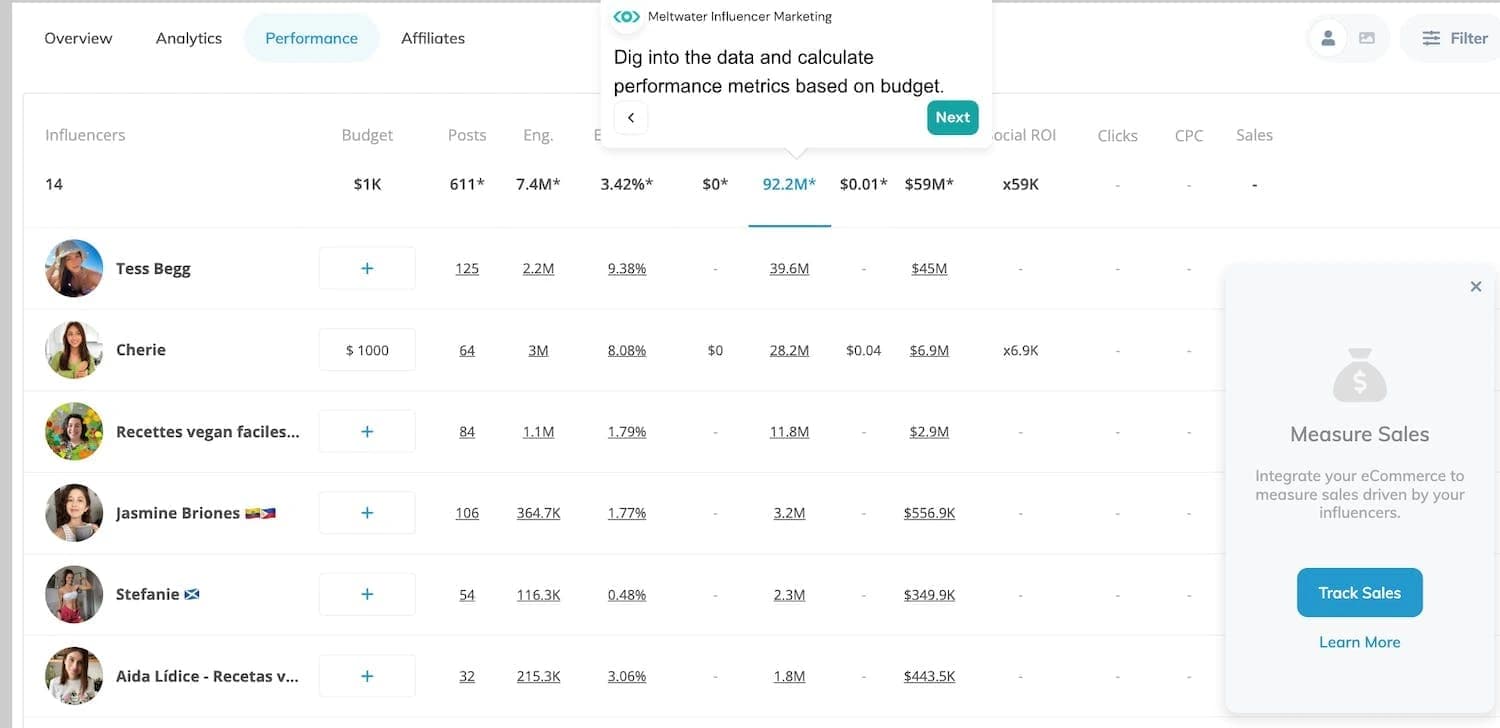
Layer two: pixel integration. The influencer agency doesn't just hand off traffic. They track it through conversion. Which creators drove add-to-cart? Which ones drove purchase? Which creators brought customers who bought once and never came back versus customers who became repeat buyers?
The agency that can answer those questions owns a different conversation than the agency reporting engagement rates.
Layer three: cohort analysis. A customer acquired through Creator A versus Creator B: do they behave differently? Lifetime value. Repeat purchase rate. Category expansion. The performance shop doesn't just report conversions. They report customer quality by acquisition source.
That's the data that turns influencer marketing from a campaign tactic into a customer acquisition channel.
Layer four: incrementality testing. Holdout groups. Geo splits. The discipline of asking "what would have happened anyway?" The most operationally complex layer because it requires convincing clients to leave money on the table in the short term to prove value in the long term.
Most agencies won't fight that battle. The ones who do separate themselves permanently.
The agencies building this stack aren't adding a performance dashboard to their existing coordination model. They're restructuring operations around attribution from day one. That means different hiring. Performance marketers, not influencer coordinators. Data analysts, not campaign managers. Engineers who can build custom attribution models, not project managers who can wrangle spreadsheets.
The entire org chart reorients around a different question: not "how many creators can we activate?" but "how much revenue can we prove?"
The Client Education Problem
Selling performance infrastructure to a CMO who's used to buying creator logistics is not a pitch meeting. It's a semester-long course in digital attribution taught to someone who doesn't know they need it yet.
Most shops give up at "this will cost more and take longer." The ones who succeed treat client education as product.
The conversation starts before the brief. "You're asking for 30 TikTok creators at $5K each. What happens after they post?" Most brands don't have an answer. They have a landing page. Maybe a promo code. Rarely a coherent measurement plan.
The performance agency walks them backwards from business objective to tracking infrastructure. "If the goal is acquisition, here's what we need in place before we brief a single creator." That upfront strategy work adds weeks to the timeline. It also screens out the clients who just want posts.
The second education layer is metric hierarchy. Engagement rate is not a performance metric. It's a signal of creative resonance, but it doesn't connect to revenue.
The agency has to rebuild the client's mental model: impressions matter less than click-through. Click-through matters less than add-to-cart. Add-to-cart matters less than purchase. Purchase matters less than 90-day LTV. Every metric is a proxy for the one below it. The client who optimizes for engagement will always undervalue the work.
The third layer is time horizon. A performance influencer campaign doesn't report out in 7 days. It reports out in 90. Maybe 180. The customer acquired in week one might not purchase until week eight. The revenue model requires patience most clients don't have and most agencies can't afford.
Bridging that gap requires contract structures that pay for setup and pay again for results. It requires showing leading indicators that predict lagging outcomes. It requires constant education on why the metrics that matter take time to materialize.
The agencies winning this aren't just good at performance marketing. They're good at teaching performance marketing to clients who were trained to buy awareness. That consultative muscle is harder to build than the tracking stack.
The Competitive Wedge
Specialized performance influencer shops face competition from three directions. Traditional agencies adding influencer services. Platform-owned creator marketplaces. And the logistics vendors trying to bolt on attribution after the fact.
The traditional agency model starts with a structural disadvantage. The holding company social team runs influencer campaigns through the same process they run paid social. Brief the planners. Route to creative. Get client approval. Activate.
The coordination layer adds weeks. The approval chain adds gatekeepers. The result is influencer campaigns that move at the speed of TV production, not creator culture. A specialized shop can brief, activate, and report results in the time it takes the traditional agency to get legal sign-off on the creator contracts.
The second advantage is focus. The holding company team serves the integrated brief. Influencer is one tactic in a multi-channel plan. The specialized shop serves the influencer-native client. Every process, every tool, every team member optimizes for creator activation at scale.
They don't need to explain why influencer deserves budget. They assume it. That focus shows up in velocity. A TikTok trend breaks on Tuesday. The specialized shop has creators activated by Thursday. The traditional agency is still scheduling the kickoff call.
Platform-owned creator marketplaces offer the opposite trade. Maximum efficiency, minimum strategy. TikTok Creator Marketplace connects brands directly to creators. No agency markup. No coordination overhead. Press a button, activate a creator, get a post.
For brands optimizing on cost per post, it's unbeatable. For brands optimizing on performance, it's a black box. No custom attribution. No audience strategy. No creative direction beyond the brief template. The brand gets the post. They don't get the thinking.
The specialized performance shop positions against both by solving the central problem: proving incremental revenue from creator spend. The traditional agency can't move fast enough to catch trends. The platform marketplace can't build custom attribution.
The performance shop does both. They activate at creator speed and report at CFO rigor. That combination is the wedge.
The Category That Doesn't Exist Yet
Zero search volume for "influencer agency ROI" means the market hasn't formed language around the problem. Brands know they want proof. They don't know what to call it. They search for "influencer marketing agency" (118,000 monthly searches globally, estimated) and sort by case studies. They ask their networks. They reverse-engineer competitor campaigns.
But they're not searching for performance infrastructure because they don't know it exists.
That creates a window. The agencies building attribution capabilities now have 12 to 24 months before the category coalesces and competition floods in. Once "performance influencer marketing" becomes a search term with volume, the platform marketplaces will build dashboards. The holding companies will acquire specialists. The logistics vendors will rebrand.
Right now, it's greenfield.
The agencies who win will do three things. First, publish the playbook. The case studies. The attribution models. The metric frameworks. Teach the market what to ask for. That education becomes demand generation.
Second, build platform relationships. TikTok wants to prove ROI to enterprise brands. Meta wants to position Reels as performance, not awareness. The platforms will co-sell with agencies who have the tracking infrastructure to make the case.
Third, move upmarket fast. Enterprise clients have the budget for custom attribution and the patience for 90-day measurement windows. SMB clients want posts, not performance infrastructure. The agencies that chase volume over value end up competing on cost per post.
The irony is sharp: the category with the most sophisticated measurement infrastructure has the least searchable demand signal. But that's always how new categories form. The operational work happens before the industry develops language to describe it.
The agencies building performance capabilities now are writing the language the industry will use to describe the work in 2027. By the time "performance influencer marketing" has search volume, the category leaders will already be built.
Free Agency Media Editorial
All news