The Remote Agency Category Nobody With Credibility Has Claimed
1,950 people a month search for a real strategic model, and find job boards instead of operators. The distributed agencies actually proving it works haven't shown up yet.
The keyword cluster for "remote marketing agency" pulls 1,950 searches a month. Zero agencies are competing for it. Not because zero relevant agencies exist, but because zero are showing up where the buyers are looking.
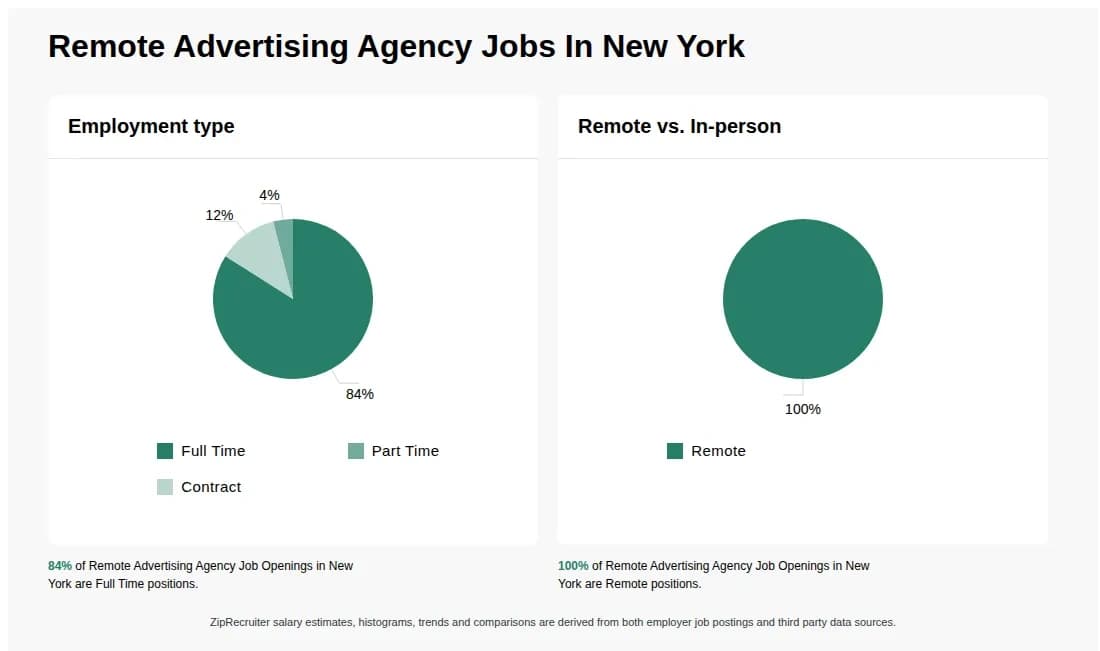
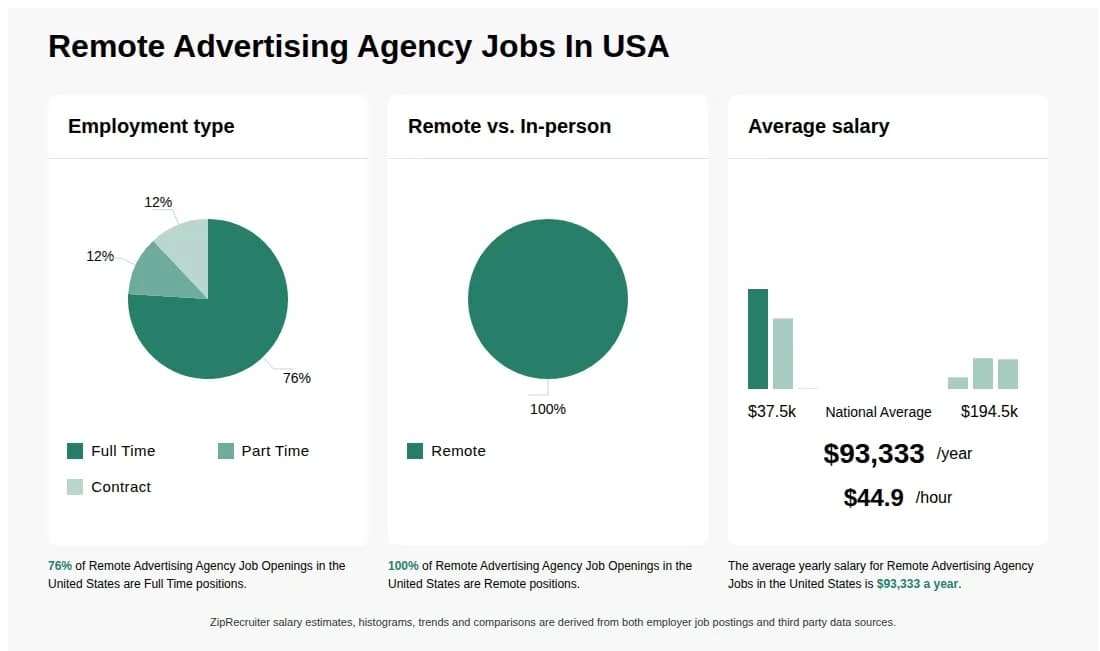
Instead, the top 10 results are Indeed listing 5,802 remote digital agency job openings. ZipRecruiter posting for Tampa. BuiltIn ranking "fully remote agency" as a company benefit tag. A Reddit thread asking if anyone knows fully remote shops in the US. This is what happens when a real operating model gets treated like a hiring perk instead of a strategic decision: the entire search category gets colonized by job boards while the founders actually running distributed P&Ls have no presence at all.
That's the paradox. Distributed is one of the most consequential structural shifts happening inside independent agencies right now, and almost nobody with the operator experience to explain why is writing about it. The people who could tell you how a 16-person team hit €2M ARR without an office are busy running the agency, not fighting Indeed for SEO real estate. The gap isn't a content gap. It's a credibility gap, and it's wide open.
The Overhead Math Holding Companies Can't Replicate
Holding companies are built on real estate, layered management, and utilization targets that assume bodies in seats. That structure was a feature when clients wanted proximity and headcount as a proxy for capability. It's a liability now that clients want speed and margin transparency.
Independent operators running distributed teams are quietly rewriting the cost equation. Jonas Strambach, who built a fully remote marketing agency to €2M ARR with 16 employees before transitioning the business into SaaS, described the arc publicly on X as "humbling" but instructive. Read past the modesty and the numbers do the talking: €2M in revenue, 16 people, no office lease, no regional overhead layered into every client invoice. That's roughly $125,000 in revenue per head, with none of the fixed cost holding companies carry as a permanent tax on every engagement.
Compare that to the structural reality holdcos operate inside: real estate across a dozen offices, management layers that exist to coordinate the real estate, and utilization targets that exist to justify the management layers. None of that overhead disappears when a client cuts a budget mid-year. It gets absorbed, then passed forward in scope creep and diluted senior attention. Distributed independents don't carry that weight because they never built it in the first place.
This is the strength frame, not the survival frame. A distributed team isn't a compromise forced by constraints. It's independents refusing to build cost structures that don't serve the work. The €2M ARR case is a single data point, but it's a data point that shouldn't exist if the "you need an office to be credible" logic still held. It doesn't. It hasn't for a while. The market just hadn't produced enough public case studies to say so plainly, and the ones that exist aren't showing up in the search results where buyers are looking for them.
Talent Arbitrage Is the Quiet Advantage Nobody's Marketing
Distributed isn't just about cutting the office line item. It's about who you can hire once geography stops being the constraint.
Samuel Colvin's take on X reframed remote hiring as a competitive strength rather than a workaround: global talent recruitment, no commute tax on candidate energy, lower effective salary requirements in distributed labor markets, and reduced poaching risk because the team isn't clustered in one media market where every competitor is fishing from the same pool. Add AI-driven documentation into the mix, he noted, and the coordination overhead that used to justify centralized offices mostly evaporates too.
That's not theoretical. One operator posting on X described a live operational setup with teams spanning Kenya, India, and the Philippines, running crypto payments and investment operations seamlessly across time zones using Slack as the connective tissue. That's a distributed operations model functioning in real time across three continents, coordinated through consumer software, with zero geographic premium paid for talent that would cost multiples more if it had to be hired inside a single expensive market.
The job market data backs the pattern up from the demand side, too. A remote PPC role posted for Israel-based B2B tech campaigns explicitly selected for candidates "comfortable with distributed work" as a qualifying trait, not a tolerated inconvenience. That's a hiring filter, not a perk description. Agencies running distributed models aren't apologizing for the setup anymore. They're screening for people who thrive inside it.
The arbitrage in plain terms: a holding company hiring a strategist in New York pays New York rates, New York real estate allocation, and New York management overhead layered on top. An independent running distributed operations hires the best strategist available globally, pays a rate matched to value delivered rather than zip code, and reinvests the spread into either margin or better talent at every other seat. That's not a cost-cutting story. That's a capability story. The distributed independent isn't hiring cheaper. It's hiring wider, and the price difference is the byproduct, not the point.
AI Is Absorbing Execution, Which Raises the Stakes on Judgment
The conversation happening on X right now isn't subtle about where this is heading. One widely circulated post cited an Anthropic and Stanford study claiming five AI agents could replace a 14-person marketing team, saving $4.5M a year while simultaneously boosting ROI and lowering customer acquisition cost. Another account described autonomous AI "marketing teams" handling SEO, content, distribution, and analytics for a flat $99 a month, positioned directly against agencies charging $60,000 to $160,000-plus annually for comparable scopes.
Read that gap again. $99 a month versus $160,000 a year. That's not a pricing pressure story. That's an extinction-level threat to any agency whose value proposition begins and ends with execution capacity.
This is exactly why the distributed model matters more now than it did three years ago, and exactly why it's not the same conversation as "can we save on office rent." Jessie Healy's critique on X cuts to the real fault line: AI handles the grunt work competently, but agencies still have to solve creative strategy and cut through noise in oversaturated competitive environments. That's the part AI agents aren't close to replacing, and it's the part that never lived in an office to begin with.
Rashi Umapathi's post on X sharpened the critique further, pointing out that plenty of agencies, remote or not, have been coasting on generic deliverables, basic blog posts and LinkedIn content with no measurable demos or leads attached, while operating on an incentive structure that pays them to retain clients rather than deliver results. That's not an argument against distributed agencies. That's an argument against agencies of any structure that built their value proposition around output volume instead of judgment.
This is where distributed independents have a structural edge that holding companies don't: when overhead is already lean because there's no real estate and no management layers to protect, the AI-driven collapse in execution costs doesn't threaten the business model. It clears the runway for it. A distributed team already organized around senior judgment applied at scale, rather than junior hours billed at volume, absorbs the $99-a-month AI agent as a tool that makes its senior people faster. A holding company built on billable junior hours has to explain to shareholders why its entire staffing pyramid just got a lot less defensible.
What's Actually Ranking, and What It Says About the Opportunity
Go back to the SERP for "remote marketing agency" and look at who's actually there. RemoteAgency.com ranks with a positioning line about breaking boundaries "so you can, too." Laire Digital ranks describing itself as "100% remote digital marketing agency" with a fully distributed team. Voy Media shows up inside a listicle described as operating as "a fully remote performance marketing agency with deep expertise in emerging platforms." Beyond those three, the rest of page one is Indeed, ZipRecruiter, BuiltIn, and a Reddit thread where someone's asking strangers to name agencies because the strategic content doesn't exist to answer the question directly.
Even the Reddit thread is instructive. Commenters name 22squared and Trade School as "mostly remote," and mention FCB Health positions, not because those are confirmed as fully distributed operating models, but because the community has nowhere better to go for this information. That's the tell. When the best available source for "which agencies actually run distributed" is a comment thread with secondhand recollections, the category has no authoritative voice. The three agencies that do show up, RemoteAgency, Laire Digital, Voy Media, are describing themselves in a sentence or two of self-marketing copy, not making the strategic case for why the model wins.
1,950 monthly searches isn't a massive number in isolation. But it's 1,950 searches from people actively looking for an operating model, currently being served almost entirely by job listings and directory pages. Nobody is answering the actual question being asked, which isn't "where can I find a remote marketing job." It's closer to "is this a real strategic choice, and who's proving it works." Right now the honest answer to that second question lives scattered across X threads and founder anecdotes, not in any single authoritative piece of coverage. That's the gap. It's not a keyword gap. It's an authority vacuum with 1,950 monthly visitors standing in it, unattended.
The Tradeoffs That Decide Whether This Actually Works
None of this is a case for distributed-by-default. The model has real failure modes, and the agencies making it work are the ones who've built specifically against those failure modes, not the ones who simply skipped the office lease and called it strategy.
Culture is the first casualty when it's not deliberately engineered. A distributed team coordinated through Slack across Kenya, India, and the Philippines, as described in the X thread referenced earlier, works because the operations are transactional and process-driven: crypto payments, structured investment workflows, clear handoffs. Creative and strategic work doesn't compress into that same clean handoff logic nearly as easily. The senior judgment that Jessie Healy pointed to as the thing AI can't replace is also the thing that's hardest to build consensus around asynchronously, across time zones, without the informal correction that happens when people argue over a conference table. Distributed agencies that survive past their first few years of scaling have almost always solved this deliberately, with real rituals for debate and alignment, not by assuming Slack threads substitute for the room.
Client trust is the second failure mode, and it's the one that kills distributed agencies faster than culture does. Buyers who've spent decades associating capability with a physical office and a visible bench are not automatically going to extend that trust to a team spread across three continents, no matter how strong the work is. The agencies winning this argument aren't hiding the distributed model. They're making it the pitch: faster senior access because there's no travel friction, tighter cost transparency because there's no hidden real estate tax, and global talent access framed explicitly as capability rather than confessed as compromise. Rashi Umapathi's critique of misaligned incentives applies here directly: a client who's been burned by an agency, remote or centralized, that optimized for retention over results is going to scrutinize any new pitch harder. Distributed agencies that win that scrutiny do it with transparent reporting and named senior accountability, not with vague promises about flexibility.
Delivery consistency is the third and least forgiving failure mode. A distributed model that works at 16 people, the scale Jonas Strambach described hitting €2M ARR at, does not automatically work at 60 or 160. The coordination tooling that feels lightweight at 16 people starts creaking at 60 unless the agency has built real operating discipline around documentation, decision rights, and quality control that doesn't depend on physical proximity to catch. This is exactly where AI-assisted documentation, the advantage Samuel Colvin pointed to on X, starts to matter less as a nice-to-have and more as core infrastructure. The agencies that treat AI tooling as the connective tissue holding distributed delivery together at scale are the ones with a real shot at growing past the founder-scale case studies currently anchoring this whole conversation.
Where This Goes From Here
The AI execution collapse dominating X right now, five agents replacing 14 people, $99-a-month autonomous marketing teams undercutting six-figure retainers, isn't going to spare centralized agencies and skip distributed ones. It's going to hit both. But it hits them from different structural positions. A holding company defending a real estate footprint and a management pyramid has to explain why its cost base still makes sense when the execution layer it was built to staff is collapsing in price by orders of magnitude. A distributed independent, already organized around senior judgment with a thin cost base and no legacy infrastructure to defend, absorbs that same execution collapse as leverage. The same $99-a-month tools that threaten a bloated agency model make a lean one faster.
That's the actual strategic story sitting underneath 1,950 monthly searches for "remote marketing agency," a story currently being answered by job boards instead of the operators living it. The next agencies to win this category publicly won't be the ones simply announcing they're remote. They'll be the ones treating distributed as the operating thesis it actually is: overhead arbitrage that holding companies structurally can't replicate, talent access that ignores zip codes, and a cost base built lean enough that AI's execution collapse becomes fuel instead of threat. The search results haven't caught up to that story yet. The agencies that tell it first, with real numbers attached the way Jonas Strambach did on X, are the ones who'll own the term before the job boards figure out there was ever a strategic conversation to be had here at all.
Free Agency Media Editorial
All newsYou might like

TRAINOR's 41 Years Complicate the Death-of-Full-Service Debate
TRAINOR
The One-Sentence Test Agencies Give Clients but Fail Themselves
SRH
The One-Sentence Discipline Small Agencies Use to Win Pitches
SRH