The Top SEO Agency Rankings Are Broken. Here's the Fix
4,720 monthly searches for 'top SEO agency' terms go unclaimed by real independent shops. Here's the ownership, pricing, and case-study test buyers should run instead.
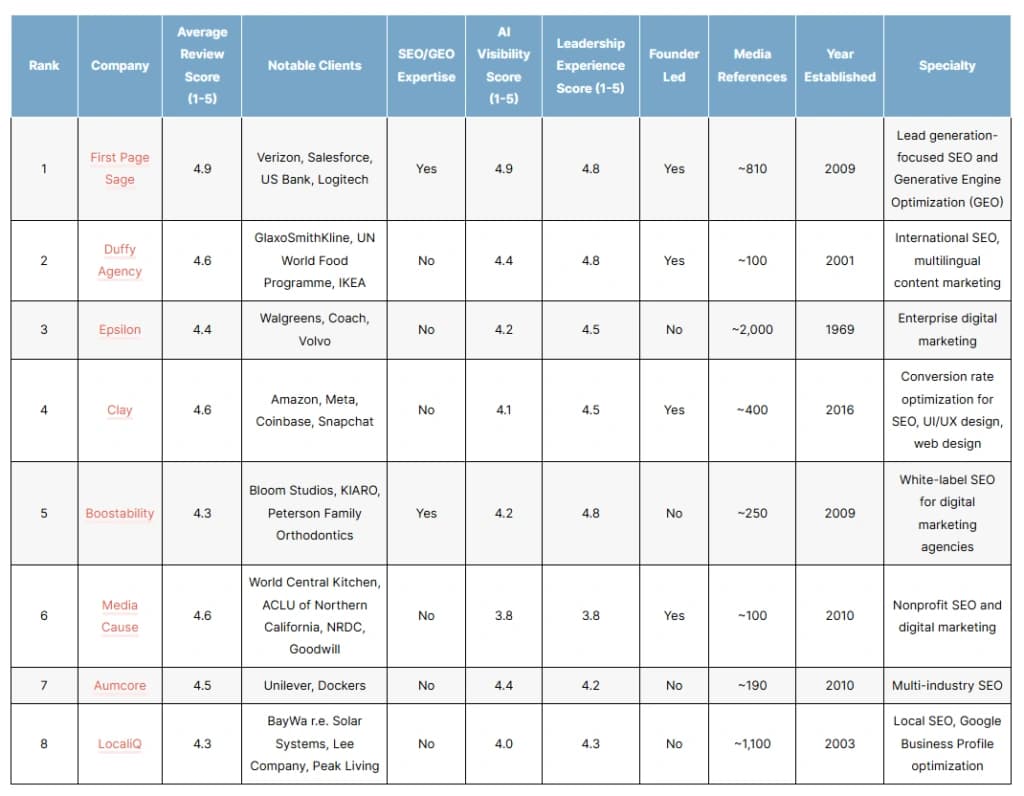
The best evidence that "top SEO agency" listicles are broken isn't a bad list. It's the search data itself. Twelve keywords cluster around this exact buying decision: best SEO services company, top rated SEO company, top ranked SEO company, technical SEO agency, local SEO marketing company. Together they pull 4,720 searches a month from people who've already decided they need help and are trying to figure out who to trust with it. Right now, zero independent agencies are showing up to claim that demand on their own terms.
That's not a gap in SEO. That's a gap in honesty. The people searching these terms aren't looking for a directory. They're looking for a filter: someone to tell them which of the hundreds of firms calling themselves "boutique" or "independent" actually are, and which ones are a holding company subsidiary wearing a founder's name like a costume. Nobody's built that filter. So we will.
The Zero Agencies Ranking Nobody Talks About
Search "top 10 SEO companies" and you get exactly what you'd expect: aggregator content, comparison sites, and rankings assembled by platforms that make money when agencies pay to be featured. None of that is inherently criminal. It's just not vetting. It's inventory.
The 4,720 monthly searches across this cluster represent real buying intent split across two distinct behaviors. Some of it is generic and national: "best SEO services company," "top ranking SEO companies," people casting a wide net with no geographic anchor. Some of it is hyperlocal and specific: "Virginia SEO company," "Virginia SEO firm," "Minneapolis SEO agency." Those aren't casual searches. Someone typing "Minneapolis SEO agency" into Google has usually already ruled out working with a national firm and wants a shop that understands their market, their competitors, and their budget reality without a 45-minute discovery call explaining what a SERP is.
Here's the pattern that should worry every buyer running this search: the demand for independent, verifiably local, verifiably boutique SEO expertise is sitting right there in the data, unclaimed, while the SERP fills up with content optimized to rank rather than content built to actually help someone choose. That's the paradox at the center of this entire category. The people who'd benefit most from a real buyer's framework are the ones least likely to get one, because nobody profits from giving it to them.
The Pay-to-Play Listicle Problem
Most "top SEO agency" rankings work the same way review-driven B2B directories have worked for a decade. An agency pays for a profile, pays more for placement, and the ranking reflects ad spend more than performance. Some platforms disclose this. Most bury it in a terms-of-service page nobody reads. The buyer sees "#3 SEO Agency" and assumes it means something like a Yelp star rating. It usually means the agency's marketing team filled out a form and wrote a check.
This matters more in SEO than almost any other agency category, because SEO is uniquely hard to fake in the short term and uniquely easy to fake in a case study. A paid social agency can show you a screenshot of a live campaign. An SEO agency can show you a ranking graph that trends up for eight months and never mention that the client churned in month nine, or that the ranking gains came from a Google algorithm update that happened to favor their existing content, not from anything the agency did.
So the listicle problem compounds itself. Pay-to-play rankings surface agencies based on marketing budget, not retention or client outcomes. Those agencies then produce case studies with no independent verification standard behind them. The buyer reading "top rated SEO company" content is getting recommendations filtered through exactly zero of the criteria that actually predict whether an agency will do good work: who owns them, how they price, and whether their case studies hold up to a five-minute cross-check.
None of that is a reason to distrust independent SEO agencies. It's a reason to distrust the discovery layer sitting between buyers and independent agencies. Those are different problems with different solutions, and only one of them requires the buyer to do any work.
The Three-Question Ownership Test
"Independent" has become a marketing word before it's an ownership category, and that's the first thing any buyer needs to unwind. An agency with 14 people and a founder's name on the door can still be 60% owned by a holding company rollup. The website will say "independent, founder-led boutique." The cap table will say Stagwell, or S4 Capital, or a private equity fund that owns eleven other agencies under different brand names in different cities.
This isn't a hypothetical risk in SEO specifically. It's a structural feature of how the industry consolidated over the past decade. Holding companies and PE rollups learned that buyers pay a trust premium for "independent," so instead of running everything under one recognizable holdco umbrella, they acquired dozens of smaller shops and let the founder-facing branding stay intact. The agency you're vetting might genuinely believe it's independent because operationally, day to day, nothing changed. The org chart says otherwise.
Three questions expose this in under ten minutes, and any legitimately independent agency will answer all three without hesitation.
Who owns the company, by percentage, and can you show me? A founder-owned agency will answer this immediately, often with pride. An agency owned by a rollup will pivot to talking about "strategic partnerships" or "growth capital" without naming the entity or the stake.
Has the agency been acquired, invested in, or merged in the last five years? Search the agency name alongside "acquired," "acquisition," or "investment" before the call. Trade press covers most of these deals. If the agency's own website never mentions a transaction that trade press covered, that's a disclosure gap worth asking about directly.
Does leadership change when the parent company changes strategy? Rollup-owned agencies tend to have leadership churn tied to portfolio decisions made two levels up. Ask how long the current strategy lead or head of SEO has been in that seat, and what happened to the person before them.
None of this is about punishing agencies for taking outside capital. Growth capital isn't the enemy. The problem is buyers making a decision based on "independent" as a trust signal when the ownership structure says something completely different, and no listicle in existence is built to catch that gap.
Pricing Models: What Legitimate Looks Like Versus What Extracts Value
SEO pricing is where a lot of otherwise reasonable buyers get taken apart, because the category supports three fundamentally different business models and almost no agency clearly discloses which one they're running until the contract's already signed.
The first model is the flat monthly retainer tied to a defined scope: X hours of technical work, Y pieces of content, Z link acquisition targets, reviewed quarterly against ranking and traffic benchmarks. This is the healthiest model because the agency's incentive is retention through results. If the client doesn't see movement, the client leaves, and the agency loses the retainer. Skin in the game, structurally.
The second model is the hourly or project-based engagement, common with technical SEO agencies doing audit work, migrations, or site architecture overhauls. This model is fine and often appropriate for narrow, defined work, but it should come with a hard scope and a hard endpoint. If a technical SEO agency proposes hourly billing with no cap and no defined deliverable, that's not a pricing model. That's an open tab.
The third model is the one buyers need to interrogate hardest: pay-for-performance tied to keyword rankings. On the surface it sounds like the ultimate alignment of incentive: the agency only gets paid when rankings improve. In practice it incentivizes exactly the wrong behavior: chasing easy, low-value, low-competition keywords that move fast and look good in a report, while ignoring the harder, more commercially valuable terms that actually drive revenue. An agency optimizing for "keywords ranked" as a billing trigger is optimizing for a number that means nothing to the client's business.
The buyer's job isn't to reject any of these models outright. It's to ask the agency to explain, in plain language, why they price the way they do, and to get suspicious of any answer that dodges the question with vague language like "we customize pricing to fit your needs." That's not customization. That's an agency that hasn't decided what it's actually selling, or one that has decided and doesn't want to say it out loud.
A useful rule: any agency unwilling to put its pricing logic in writing, before a discovery call, is telling a buyer something important about how the rest of the relationship will go. Contracts with 90-day lock-ins and no early termination clause are a specific red flag in this category. Legitimate agencies that trust their own results don't need to trap clients in a contract to keep them.
Case Studies and Retention: The Verification Standard
A case study with no client name, no timeframe, and no specific numbers isn't a case study. It's a testimonial dressed up in a chart. SEO is a category where vague case studies are especially easy to produce, because "traffic increased" or "rankings improved" sounds like proof of competence when it's actually the least meaningful claim an agency can make.
Real verification requires four specific pieces of information, and any agency that has actually done the work will have all four ready.
Named client, named timeframe. "We helped a national retailer increase organic traffic" is not verifiable. "We worked with [named brand] from March 2023 to present" is. The refusal to name a client is sometimes legitimate, driven by an NDA, but a legitimate agency will say so explicitly and offer a reference call instead of just omitting the detail and hoping the buyer doesn't notice.
Baseline and outcome, not just outcome. "Ranked #1 for [keyword]" means nothing without knowing where that keyword ranked before the engagement started, and what the actual search volume and business value of that keyword is. A #1 ranking for a keyword with 20 monthly searches is not the same claim as a #1 ranking for a keyword with 20,000.
Retention length, stated plainly. Ask directly how long the case study client has been retained. An agency that can say "36 months and counting" is showing you something meaningful. An agency that pivots away from the question, or produces a case study from a client relationship that ended after four months, is showing you the opposite, whether they realize it or not.
Independent confirmation. LinkedIn is the fastest cross-check available. If a case study names a client company, search for people who worked at that company during the stated engagement window and see if the relationship is corroborated anywhere outside the agency's own marketing materials. This takes five minutes and eliminates a meaningful percentage of fabricated or heavily exaggerated case studies before a single call happens.
The agencies that pass this test aren't hiding anything, which is exactly the point. Verification isn't hostile due diligence aimed at catching liars. It's the baseline standard that any agency confident in its own work should welcome, because it's the fastest way to separate itself from the ones that can't survive the same scrutiny.
The Local Search Gap and What Comes Next
The geographic terms in this keyword cluster deserve more attention than they usually get. "Virginia SEO company," "Virginia SEO firm," and "Minneapolis SEO agency" aren't vanity searches. They represent a buyer explicitly choosing to work with someone local, often because they've already had a bad experience with a national firm that treated their business like a template. This is where independent agencies get to compete on something a rollup structurally can't replicate: actual, specific knowledge of a regional market, its competitive landscape, and the buyer behavior that's unique to it.
A holding-company-owned agency operating under a "local boutique" brand can hire local staff. It can't replicate the incentive structure of a founder whose reputation in a specific metro area is the actual business asset. That distinction shows up in retention, in referral rates, and in the willingness to actually pick up the phone when something breaks: none of which show up in a pay-to-play listicle ranking.
The 4,720 monthly searches in this cluster aren't going away, and they're not going to start converting better just because someone builds a slicker directory. What changes the category is buyers applying an actual framework instead of trusting a ranking that was purchased rather than earned: verify ownership with three direct questions, read pricing models for incentive alignment instead of accepting vague customization language, and demand case studies with named clients, stated baselines, and confirmed retention length.
The agencies that pass all three tests are already out there, doing technical SEO work and local SEO work and everything in between, without a single one of them currently owning the search terms that describe exactly what buyers are looking for. That's not a permanent condition. It's an open door. The independent agencies willing to publish their ownership structure, their pricing logic, and their real retention numbers, in public, without being asked, are the ones who'll eventually close the gap between 4,720 monthly searches and zero verified answers. Whoever builds the trust layer first doesn't just win the ranking. They redefine what "top SEO company" is actually supposed to mean.
Free Agency Media Editorial
All news