The Vertical Marketing Gap No Agency Has Claimed Yet
12,700 monthly searches for restaurant, legal, real estate, music, and fashion marketing turn up zero specialized agencies. That's not a saturated market. That's an opening.



Twelve thousand seven hundred people a month type some version of "restaurant marketing," "real estate marketing agency," "marketing for law firms," "music marketing," or "fashion marketing" into Google. That's the combined monthly search volume across this cluster. And according to the data we track at Free Agency Media, zero agencies show up as verified, indexed players actively claiming this ground.
Zero. Not a crowded market with one dominant name. Not three shops splitting the traffic. An open field, twelve thousand seven hundred monthly searches wide, with nobody's flag planted in it.
That gap is the story. Not because vertical-specific marketing is a new idea: restaurant consultants and legal marketing shops have existed for decades. The story is that the demand signal is large, segmented, and specific enough to support real businesses, and the indie agency world hasn't caught up to what the search data is already telling it. Somebody is about to build a moat here. The only question is who moves first.
The Search Volume Doesn't Lie, But the Directory Does
Break the cluster apart and the pattern gets sharper. Five distinct keyword groups, five distinct buyers, five distinct sales conversations. A restaurant owner searching "restaurant marketing" isn't shopping for the same thing as a managing partner searching "marketing for law firms." A boutique label searching "music marketing" has a completely different budget, timeline, and definition of success than a mid-size brokerage searching "real estate marketing agency." These aren't overlapping segments of one generalist market. They're five separate markets that happen to share a search bar.
Split the 12,700 monthly searches evenly across the five terms and you get roughly 2,540 searches per vertical every month. That's not a rounding error. That's a sustained, recurring pool of buying intent, month after month, for categories where the current data shows no verified independent agency claiming specialist positioning.
Here's the part that should make every generalist shop uncomfortable: none of this volume is going to holding company subsidiaries either. Zero agencies competing means zero, across the board. Not "zero small shops, but the big networks have it locked up." Zero, period. The demand exists. The supply, at least the kind that shows up as a named, findable, specialized option, doesn't.
Why Restaurant Real Estate Is the Tell
Look at "restaurant real estate." Two hundred and ten searches a month. On its face, a small number: a rounding error next to the cluster's 12,700 total, about 1.7% of it. But small search volume on a highly specific compound term is exactly the signal that separates a real vertical niche from a marketing buzzword.
Nobody searches "restaurant real estate" by accident. That phrase belongs to a founder or ops director thinking about site selection, lease negotiation, foot traffic modeling, and brand positioning as one interconnected problem, not three separate vendor relationships. It's a sub-niche inside a niche: the intersection of restaurant marketing and commercial real estate strategy, a category too specific for a generalist shop to stumble into and too small for a holding company to build a dedicated practice around.
That's precisely where indie specialization works best. A shop that understands both the restaurant category and the real estate mechanics behind restaurant growth: lease structures, market selection, the marketing that has to happen before a location even opens, isn't competing against ten thousand generalist agencies. It's competing against nobody, because nobody else has bothered to combine those two bodies of expertise into one offer. The remaining 12,490 searches in the cluster, spread roughly 3,123 apiece across the other four terms, tell the same story at a slightly larger scale: real, segmented, currently unclaimed demand.
The Flywheel Economics of Niching Down
Vertical specialization isn't a positioning trick. It's a different cost structure wearing a positioning trick's clothes.
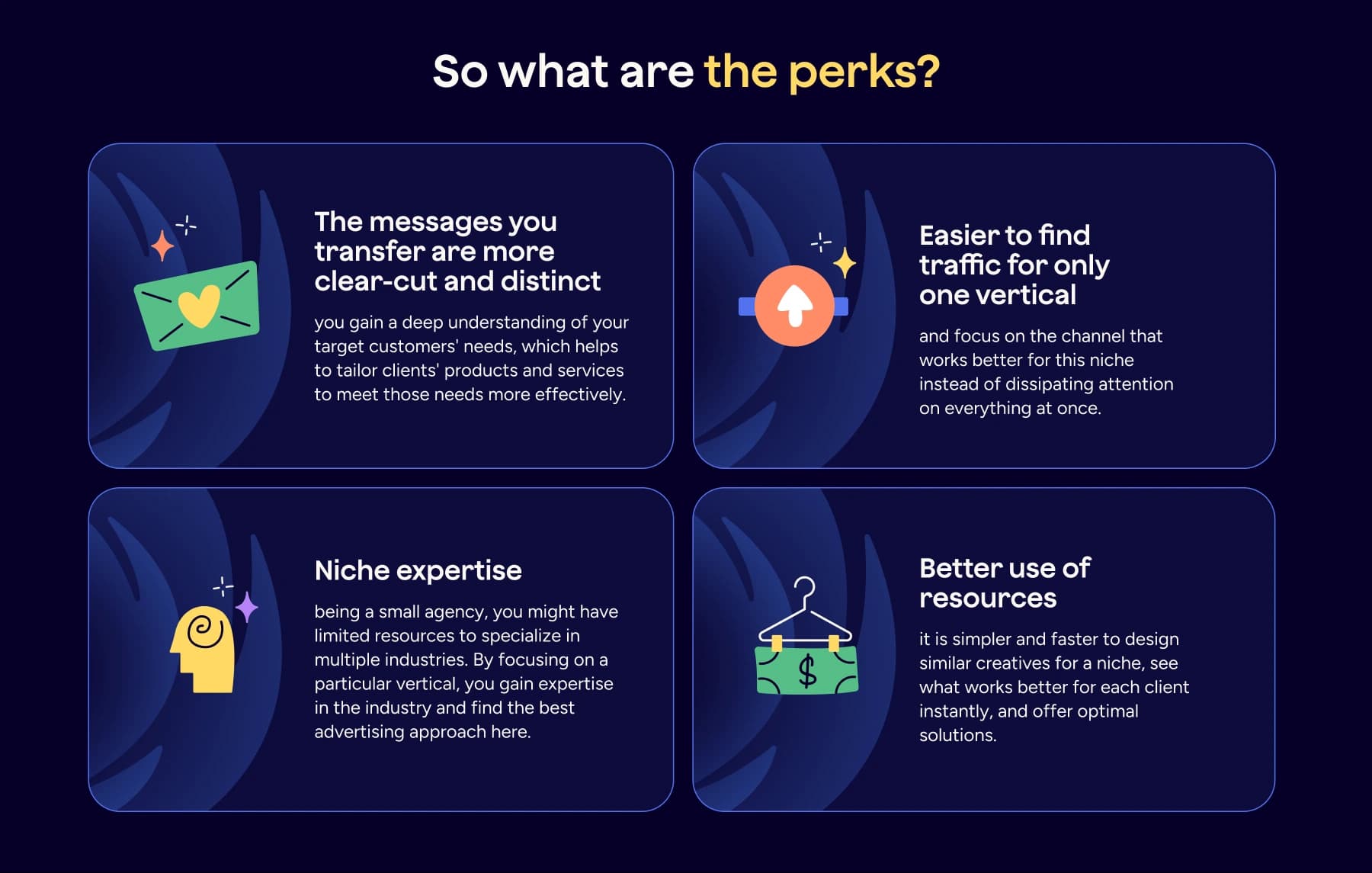
Start with referrals. A restaurant marketing shop that does great work for one regional chain doesn't just get a testimonial. It gets introduced to the ownership group's next concept, the supplier they share a table with at the annual conference, the franchise consultant who fields calls from operators asking "who do you know that actually gets restaurants." Legal marketing works the same way: managing partners talk to other managing partners, at bar association events, at referral networks, in the group chats nobody outside the profession sees. A generalist agency pitching a law firm has to explain what it knows about legal marketing from scratch, every single time. A specialist agency walks in already fluent, already vouched for, already past the credibility test that eats the first three meetings of every generalist pitch.
That fluency compounds into pricing power. A shop that has built five, ten, twenty restaurant marketing engagements has already solved the problems that are new to every restaurant client: how to market a concept through a slow opening, how to handle seasonal traffic dips, how review platforms actually move covers versus how everyone assumes they do. The client isn't paying for hours. They're paying to skip the six months of trial and error a generalist would need to relearn the category from zero. That premium isn't extracted through negotiation tactics. It's earned through repetition, and repetition is the one thing generalist shops structurally can't buy their way into without giving up the breadth that makes them generalist in the first place.
Onboarding gets faster for the same reason. A restaurant marketing specialist doesn't spend the first month of an engagement learning what a comp ratio is, how third-party delivery margins actually work, or why a five-star Yelp average with forty reviews is a red flag instead of a green light. That knowledge is already installed. The client feels it immediately: the first strategy call sounds like a peer conversation, not an education session. In a pitch process, that difference is often the entire decision. Holding company shops and horizontal independents are frequently pitching the client on capability. Vertical specialists are pitching on already having solved the client's exact problem, for someone just like them, recently.
And then there's the part that rarely gets said out loud: a specialist's pitch deck defends itself. When the case studies are all restaurants, or all law firms, or all real estate brokerages, no explaining is required. The prospect sees their own category staring back at them and does the translation work themselves. A generalist deck full of a beverage brand, a fintech app, and a nonprofit campaign asks the prospect to trust that range of experience transfers to their specific vertical. A specialist deck doesn't ask for that trust. It removes the need for it.
The Moat Holding Companies Can't Build
Here's the structural reason the current data shows zero agencies claiming this space, and why it's likely to stay that way for holding companies specifically, even as independents move in.
Holding company economics run on utilization. Staff get built to serve a roster of accounts across categories, because a network's profitability depends on keeping large teams busy across a portfolio, not on any single team becoming the best in the world at one narrow vertical. Building a genuine restaurant-only or legal-only specialist practice means dedicating senior talent to a category with a real but bounded ceiling. Restaurant marketing and legal marketing are real businesses, not the multi-hundred-million-dollar categories that justify holding company overhead. The math doesn't clear the bar that holding company P&Ls require. So the category gets treated as a client type within a generalist team's roster, not as a practice with its own reputation, its own case study library, its own referral network.
That's not a knock on the talent inside those networks. It's an incentive structure problem. A generalist team serving a restaurant client alongside a CPG account and a B2B SaaS account will do competent work. But competent isn't the bar in a market where 2,540 monthly searches are actively looking for someone who has already solved this exact category's problems. Competent loses to fluent, every time, once a real specialist enters the pitch.
Independent agencies don't have that utilization math working against them. A ten-person shop that decides to go all in on restaurant marketing doesn't need a portfolio of unrelated accounts to keep the lights on. It needs enough restaurant clients to be busy, and the flywheel described above means those clients increasingly find the shop instead of the other way around. The smaller the team, the less breadth it needs to sustain itself, and the more completely it can specialize without diluting focus across categories that don't reinforce each other. That's the moat: not size, not budget, not headcount. Depth that a larger, more horizontally structured competitor is structurally disincentivized from matching.
The Ceiling, the Key Person, and the Downturn
None of this is a free lunch, and pretending otherwise would be exactly the kind of unverified enthusiasm this publication doesn't traffic in.
A vertical has a ceiling. Restaurant marketing is a real, durable category, but it's not an unbounded one. Once a specialist shop has captured a meaningful share of the addressable restaurant clients willing to pay agency rates in its target geography or restaurant sub-segment, growth slows in a way that a horizontal agency serving multiple categories doesn't experience at the same point. The 2,540 monthly searches in a given vertical are a real signal of demand, but they're also a real cap on how large that specific pool can get before the shop has to either expand geography, expand up or down market, or expand into an adjacent category, at which point it starts trading away some of the specialization that built the moat in the first place.
Key-person dependency compounds the ceiling problem. Vertical expertise often lives in a small number of people, sometimes one founder, who built the restaurant industry relationships or the legal marketing credibility that the entire referral flywheel depends on. That's a fragile foundation if it's not deliberately built into institutional knowledge, case study infrastructure, and a bench of people who can carry category fluency without the founder in every room. A generalist shop losing its best account director is a bad quarter. A vertical specialist losing the person who is the category relationship is closer to a business model risk.
Then there's the downturn exposure that horizontal agencies simply don't carry in the same concentrated form. A restaurant marketing specialist is directly exposed to restaurant industry cycles: labor cost spikes, commercial rent pressure, the kind of consumer pullback in dining out that shows up fast in restaurant P&Ls and faster in restaurant marketing budgets. A legal marketing specialist rides the cycles of law firm economics. A music marketing specialist is tied to a notoriously volatile revenue environment for artists and labels. None of these risks show up in the keyword data. All of them show up eventually in the client roster of any shop that's put all its specialization into one basket.
The honest read: vertical specialization is a genuine competitive moat, not a hedge against risk. It trades market breadth for market depth, and depth wins pitches, wins referrals, and wins pricing power in a way breadth structurally cannot. But it requires the same discipline any concentrated bet requires: building the institutional muscle to survive losing a key person, and building enough resilience or optionality to survive a vertical-specific downturn without the diversification a horizontal shop has by default.
What Gets Built in the Next 24 Months
The data is unambiguous about demand. Twelve thousand seven hundred monthly searches across five distinct verticals, with a compound term like "restaurant real estate" pulling 210 of its own, don't happen by accident and don't disappear on their own. That's sustained buyer intent looking for a specific kind of expertise that the current field of verified independent agencies has not yet organized itself to claim.
The data is equally unambiguous about supply. Zero agencies currently show up as claiming this ground with the kind of specialization the search behavior is asking for. That's not a permanent condition. It's a temporary one, and temporary gaps in a market this well-defined tend to close fast once even a handful of shops recognize what the search volume is telling them.
The agencies that move first into restaurant marketing, real estate marketing, legal marketing, music marketing, or fashion marketing as an explicit, structured, single-category focus, rather than a client type buried inside a generalist roster, get first claim on the referral flywheel, the pricing premium, and the case study library that makes every subsequent pitch in that category easier than the last. The ones that wait will be pitching against a specialist with a defensible position instead of pitching into an open field.
Independence isn't a workaround here. Independence is the precondition. A shop unencumbered by holding company utilization math can go all in on 2,540 monthly searches worth of restaurant marketing demand and make it a real business, in a way the incentive structure of a network simply won't permit. That's the advantage working exactly as designed. The moat is sitting there, twelve thousand seven hundred searches a month wide, waiting for whoever decides to build on it first.
Free Agency Media Editorial
All newsYou might like
The Production Moat Is Gone, and Lean Agencies Are Cashing In
IllustrationXThe Production Moat Is Gone, and Lean Agencies Are Cashing In
IllustrationX
The Fujifilm Claim No One Can Verify

Why Independent Agencies Are Winning Heritage Storytelling