The Vertical Specialist Paradox: How Independents Win AORs by Knowing Less
Holding companies pitch integration. Independents pitch expertise in three verticals. The depth-for-breadth trade is working, and CMOs are signing three-year deals again.

The Vertical Specialist Paradox
The holding companies spent 2024 pitching "integrated capabilities." The independents spent it becoming the world's best agencies for three things.
Zero searches for "agency of record appointments." Zero searches for "vertical specialist agencies." Zero searches for "niche agency growth." The industry isn't Googling the shift because the shift is happening in boardrooms, not blog posts. CMOs aren't searching for frameworks. They're calling the 22-person shop that knows their category better than the 2,000-person network that claims to know everything.
The pattern is invisible in search volume but unmistakable in pitch outcomes. Independents are winning multi-year AOR relationships not by offering more services but by offering deeper expertise in fewer verticals. The breadth-for-depth trade is working. The question isn't whether vertical specialization wins anymore. The question is which verticals are defensible and how fast other shops can copy the playbook.
Why AOR Appointments Became Winnable Again
The agency of record model died in 2019. Project work. Roster approaches. In-house teams. The narrative said brands wanted flexibility, not commitment. Then 2023 happened and Fortune 500 marketing chiefs started signing three-year deals again.
The resurrection has nothing to do with brands rediscovering loyalty. It has everything to do with independents offering something holding company networks structurally cannot: actual expertise in a specific business problem.
When a brand briefs six agencies on an AOR pitch, five will show up with "our process" and "our capabilities deck" and "our strategic framework." One will show up having already solved this exact problem for four other clients in this vertical. That agency walks out with a multi-year contract. Not because they pitched better. Because they already knew more.
The vertical specialist doesn't need the first three months to learn the category. They don't need the brand to explain why their customers behave differently. They already worked the DTC subscription model. They already cracked the B2B enterprise sales cycle. They already figured out how CPG launches work when the buyer is Gen Z and the channel is TikTok.
Holding companies can't build this depth because their structure rewards horizontal scale. An Omnicom agency serving automotive, pharma, and retail simultaneously will never know any of those categories as well as the independent that only serves one. The generalist's business model requires saying yes to every vertical. The specialist's business model requires saying no to most of them.
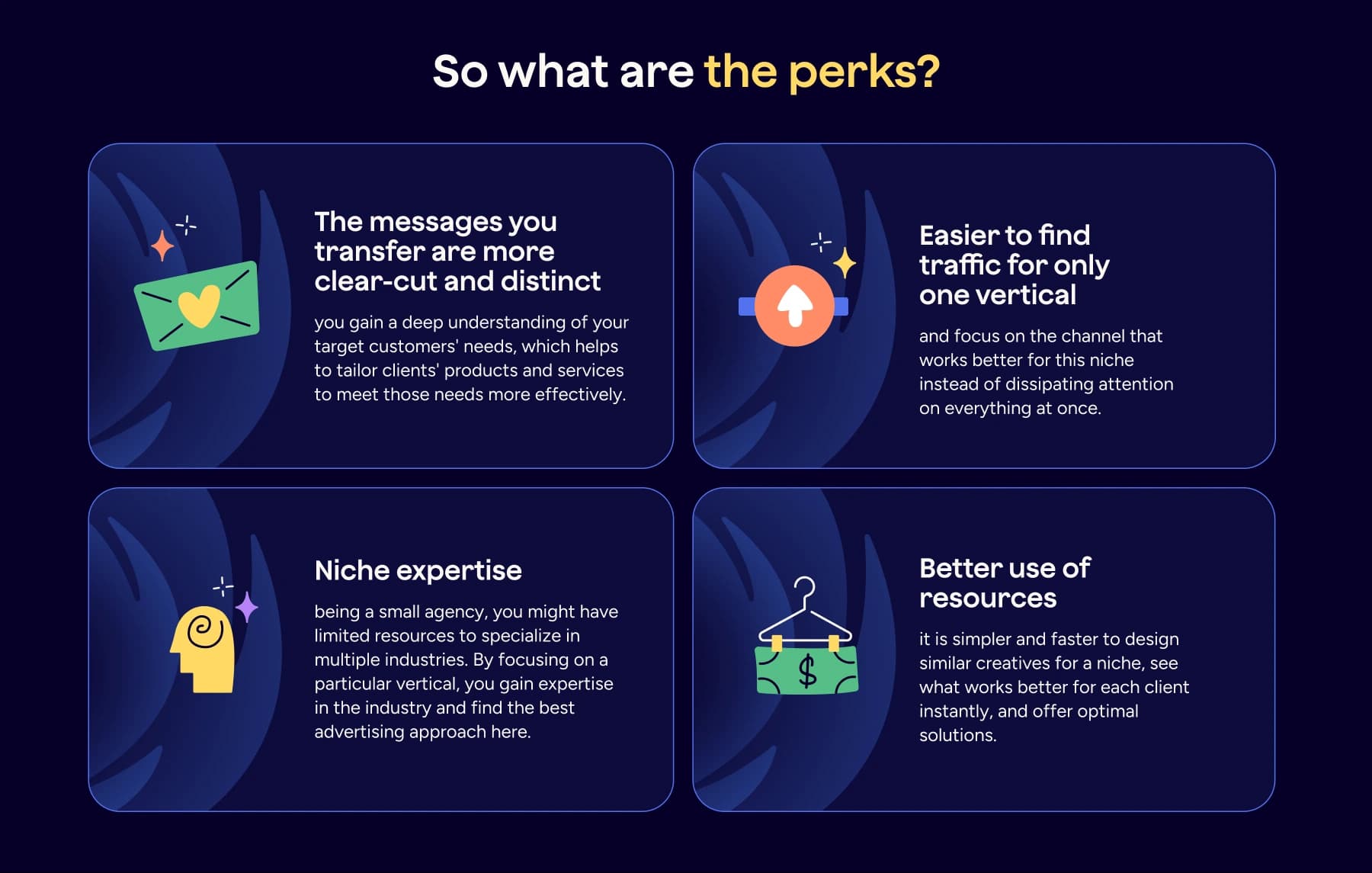
This creates the paradox. Knowing less is worth more. The shop that turned down 80 percent of inbound leads to focus on healthcare now commands premiums the full-service agency cannot justify. Constraint became competitive advantage. Saying no became the strategy.
The Four Verticals Where Independence Is an Unfair Advantage
Not every category rewards vertical specialization equally. Some verticals have structural characteristics that make independence an advantage rather than a limitation.
DTC and subscription brands. Speed is the existential requirement. Product cycles run 90 days. A brand launches, iterates based on customer data, and relaunches before a holding company deck clears legal review. The 18-person independent brief-to-concept cycle runs four days. The holding company equivalent runs four weeks. When the core business requirement is velocity, the small shop isn't disadvantaged by size. Size is the disadvantage.
The DTC vertical also rewards pattern recognition over strategic frameworks. Every subscription brand faces the same eight problems: acquisition cost inflation, retention curve degradation, LTV modeling complexity, channel saturation, creative fatigue, attribution breakdown, margin compression, and product-market fit evolution. The specialist agency has solved all eight problems 40 times across 40 clients. The generalist agency solves each one from first principles every time. The expertise gap compounds with each new client.
Regulated industries. Healthcare. Financial services. Cannabis. Every category where compliance is non-negotiable and getting it wrong means the client gets sued. The learning curve is vertical. The barriers to entry are high. Once an independent cracks the regulatory framework and builds the client list to prove it, that expertise becomes nearly impossible to replicate. A pharma brand doesn't brief 12 agencies. They brief the three shops that have actually navigated FDA regulations and lived to tell about it.
The regulatory moat is self-reinforcing. Each successful project generates documentation that makes the next project faster. Each regulatory approval creates institutional knowledge that becomes proprietary IP. The holding company agency can hire compliance expertise. The specialist agency has compliance expertise embedded in their operating system. One is a capability. The other is a culture.
Emerging tech. AI companies. Web3 brands. Climate tech. Any vertical where the category itself is being invented in real time. The holding company playbook doesn't exist yet because the category is six months old. The independent that figures it out first and documents the lessons becomes the de facto expert. The next 10 brands in that vertical don't want the safe choice. They want the shop that already made the mistakes on someone else's budget.
Emerging categories also have compressed decision cycles. The AI startup raising a Series B and launching enterprise sales in Q1 doesn't have six months for agency selection. They have three weeks. The specialist agency that already worked with five AI companies can start Monday. The generalist agency needs a month of category education before the first strategy deck. Speed of deployment beats sophistication of process.
Mission-driven categories. The shop working exclusively with B Corps or climate brands or social impact organizations isn't just positioning. It's proof the agency understands why the stakeholder map looks different and why traditional marketing frameworks break when purpose is the product. The generalist agency can claim they "get it." The specialist agency has a client list that proves they do.
Mission-driven verticals require cultural fluency the holding company structure can't manufacture. The climate tech agency team personally believes in decarbonization. The social impact shop's staff came from nonprofits. The B Corp specialist agency is itself a B Corp. Values alignment isn't a pitch deck slide. It's the reason everyone took a pay cut to work there. Clients can tell the difference.
These four verticals share a pattern: depth beats breadth. The category expertise is more valuable than the service offering breadth. A DTC-specialist shop with creative and media capabilities will out-pitch the full-service holding company agency every time. Not because they offer more services. Because they've already solved this specific problem 40 times.
Building Category Credibility Without Faking the Resume
The vertical specialist playbook requires proof, not positioning. Saying "we're the healthcare agency" means nothing. Having five pharmaceutical clients and 60 successfully navigated regulatory submissions means everything.
The credibility stack starts with concentrated client lists. One independent serves seven DTC subscription brands. Another serves 11 B2B SaaS companies. Another serves six cannabis retailers across four states. The pattern is unmistakable. The expertise is demonstrable. When the eighth DTC brand or the 12th SaaS company evaluates agencies, they see a client list that looks like their cap table. That's the signal. Not the capability deck. The client roster.
Client concentration also generates referral velocity. Seven DTC clients know 200 other DTC founders. When one founder asks the group chat for agency recommendations, three people recommend the same specialist shop. The generalist agency with one DTC client in a portfolio of 30 never shows up in those conversations. Network effects reward concentration.
Case studies become category education. The vertical specialist doesn't just show the work. They document what they learned solving this specific business problem in this specific vertical. The case study isn't "we increased brand awareness 40%." It's "here's how we navigated the iOS 14.5 attribution changes for a subscription beauty brand with 60-day replenishment cycles." That level of specificity is the credibility. The generalist agency can't write that case study because they've never lived that problem.
The best case studies also teach the category dynamics. A healthcare agency case study explaining FDA submission timelines and clearance strategies educates the prospect while demonstrating expertise. The prospect finishes reading and thinks "they understand my world" instead of "they made good ads." That shift in perception is the entire game.
The founding story has to be true. The most defensible vertical specialists didn't choose their vertical through strategic planning. They chose it through early client concentration. The agency landed two healthcare clients by accident, realized the category dynamics were fascinating, and made a deliberate decision to say no to everything else. The "we're the X agency" positioning came after the client pattern, not before. The backstory has to be authentic because clients can tell when it isn't.
Authenticity also shows up in the team composition. The healthcare agency hired three people who came from pharma brand-side roles. The cannabis agency's leadership team includes former dispensary operators. The DTC shop's strategy director ran growth for a successful subscription brand. The resumes prove the positioning isn't just marketing.
Public category contributions matter more than advertising. The independent writing the definitive newsletter on DTC subscription economics builds more credibility than the independent running DTC subscription ads. The shop publishing the annual state-of-cannabis-marketing report becomes the default expert whether they're the biggest or not. Thought leadership isn't marketing when it's vertical-specific. It's proof you've thought more deeply about this category than anyone else.
Content distribution also creates discovery mechanisms. The brand searching "B2B SaaS customer acquisition strategies" finds the specialist agency's 3,000-word guide before they find the generalist agency's capability deck. The educational content pre-qualifies the prospect and positions the agency as the category authority before the first conversation happens.
Converting Expertise Into Retained Relationships
Vertical expertise gets you in the pitch. Converting that expertise into a three-year AOR contract requires a different set of moves.
The retained relationship structure has changed. AOR no longer means "we do everything for you forever." It means "you're our strategic partner for this category and we have right of first refusal on major initiatives." The modern AOR gives the brand flexibility to bring in specialists for one-off projects while keeping the core strategic relationship and the majority of the work with one shop. The independent wins the AOR not by promising to handle every possible marketing need. They win by becoming the brand's in-house category expert who happens to sit outside the building.
This structure also shifts power dynamics. The old AOR put agencies in reactive mode, responding to briefs. The new AOR puts specialist agencies in proactive mode, identifying category opportunities before the brand does. "We're seeing three of your competitors test this channel strategy. Here's why it's working and how we'd adapt it for your business model." That's not vendor behavior. That's partner behavior.
Pricing models shifted from project to partnership. The vertical specialist can offer retained pricing structures the generalist cannot. A flat monthly retainer covering strategic counsel, ongoing creative support, and media optimization works when the agency deeply understands the category variables and can accurately forecast resource needs. The generalist agency selling hours and deliverables can't offer that predictability. They don't know the category well enough to price the relationship rather than the projects.
Retainer pricing also aligns incentives differently. Project pricing rewards scope expansion. Retainer pricing rewards outcome delivery. The brand doesn't care how many hours the agency spent. They care whether the product launch hit revenue targets. The specialist agency can confidently commit to outcomes because they've seen this exact scenario 30 times.
The scope document became a category roadmap. The old AOR scope of work listed services and deliverables. The new one outlines the category challenges the brand faces over the next 18 months and how the agency's expertise maps to solving them. "You're launching in three new states with different regulatory frameworks. We've done this 40 times. Here's the 12-month plan." That's not a services agreement. That's a strategic partnership anchored in category expertise the brand cannot build internally.
The roadmap approach also changes budget conversations. Instead of negotiating over hourly rates, the conversation centers on which category challenges to prioritize and what success looks like. The pricing discussion happens after strategic alignment, not before. This sequencing dramatically increases close rates.
Performance benchmarks use category comparables. The vertical specialist isn't measured against generic industry benchmarks. They're measured against the best performance in their category. The DTC specialist's success metrics reference other DTC subscription brands. The B2B SaaS agency's KPIs reflect enterprise sales cycle realities. The category expertise makes the success criteria more specific and more achievable because both sides understand what good looks like in this vertical.
Category benchmarks also create competitive transparency. The agency can say "top quartile performance for subscription beauty brands is 35% repeat purchase rate at 90 days. You're at 28%. Here's the six-month plan to get you to 37%." That specificity is impossible without deep category data. The generalist agency quotes industry averages. The specialist agency quotes category leaders.
Why This Playbook Is Harder to Execute Than It Looks
Every independent agency will read this and think "we should go vertical." Most will fail. The strategy works. The execution requires making decisions most agencies aren't willing to make.
Saying no is expensive in the short term. The agency with four clients in three different verticals gets an RFP from a great brand in a fourth vertical. Turning it down feels insane. The revenue is real. The vertical strategy is theoretical. Most shops take the client and rationalize that four verticals isn't that different from three. The vertical specialist playbook requires turning down good revenue today to build defensible positioning tomorrow. That trade is intellectually obvious and emotionally brutal.
The math makes it worse. Turning down a $300K project to maintain vertical focus means trusting that vertical concentration will eventually generate $300K projects that close faster and retain longer. That future value is real but uncertain. The immediate $300K is certain but strategically wrong. Most agencies optimize for certain revenue. The specialist playbook requires optimizing for long-term positioning.
The case study portfolio gets narrower before it gets wider. For 18 months, every new client case study looks similar. Same category. Same challenges. Same solutions with small variations. The portfolio looks less impressive to generalist CMOs and more impressive to category-specific ones. The transition period is uncomfortable. The agency looks like they only know how to do one thing. Because they're deliberately choosing to only do one thing until they're the best at it.
This creates awkward new business conversations. The prospect from outside your vertical asks "can you show me work from our category?" The honest answer is no. The strategic answer is "we deliberately don't work in your category because we're focused on being the best healthcare agency, not a good everything agency." Some prospects respect that answer. Most don't call back. The ones who call back become great clients.
Category expertise expires. A healthcare agency built for HIPAA compliance in 2019 has to rebuild half their systems for 2024's regulatory environment. The DTC subscription playbook for iOS 14.5 doesn't work post-ATT framework. Vertical specialization requires continuous category learning. The expertise advantage lasts as long as the agency stays ahead of category evolution. That's a different operational burden than the generalist agency running last decade's playbook with this year's aesthetic.
The learning investment is also non-linear. Some years require minor updates. Some years require complete strategic rebuilds. When TikTok Shop launched, every DTC specialist agency spent six months re-learning e-commerce fundamentals. When AI coding assistants emerged, every B2B SaaS agency rethought content production workflows. The category specialist can't ignore these shifts. The generalist agency can wait for the dust to settle. That optionality has value.
The client concentration risk is real. An agency serving eight clients in one vertical has an existential problem if that vertical implodes. The cannabis agency has a rough 2024 if cannabis retail contracts by 30 percent. The crypto agency had a very bad 2022. The vertical specialist playbook trades client diversification for category depth. That trade works until the category doesn't. The risk is manageable but it's not imaginary.
The mitigation strategy is geographic or sub-vertical diversification within the category. The cannabis agency works dispensaries in six states with different regulatory environments. The DTC agency works subscription, marketplace, and direct-sale brands. The B2B agency serves early-stage startups and enterprise software companies. The diversification happens within the vertical, not across verticals. This provides some insulation without sacrificing category depth.
What Fortune 500 Marketing Chiefs Are Actually Buying
The AOR comeback isn't about brands wanting relationships again. It's about brands realizing the project model pushed costs up, not down. Running six simultaneous agency relationships for six simultaneous projects means six onboarding processes, six strategic briefings, six rounds of explaining how the business works. The "flexibility" of project work turned into the overhead of perpetual vendor management.
The hidden cost is knowledge loss. Each project starts from zero. The brand re-explains their business model, their customer insights, their competitive landscape, their internal stakeholder dynamics. That explanation process takes three weeks per agency. Multiply by six agencies per year. The CMO just spent 18 weeks of aggregate time educating vendors. The AOR model front-loads that education once and amortizes it over three years.
The vertical specialist solves this problem by front-loading the category expertise. The first project requires onboarding. The second project requires a brief. By the third project, the agency is proposing solutions before the brand articulates the problem. That's when the CMO realizes the retained relationship is cheaper than the project model. Not because the agency charges less. Because the agency requires less explaining.
The modern AOR win happens when the category expertise becomes valuable enough that keeping it in-house through hiring would cost more than keeping it retained through an agency relationship. The brand can hire one strategist with healthcare expertise or retain an agency with 40 healthcare clients worth of pattern recognition. The math favors the agency until the brand hits the scale where building an internal category team makes sense. For most brands, that inflection point never arrives.
The calculation also factors in talent retention risk. The brand hires a category expert. That expert leaves 18 months later. The knowledge walks out the door. The agency retains category knowledge institutionally. Individual team members turn over but the expertise persists in documented playbooks, historical project files, and collective team memory. The institutional knowledge is the asset the brand is buying.
The 2025 Playbook: Identifying Your Defensible Vertical
The agencies winning multi-year AOR commitments right now made their vertical specialization decision three years ago. The shops that will dominate 2027 are making that decision in the next six months.
Start with honest client concentration analysis. Most agencies have accidental vertical concentration they've never weaponized. Look at the client list. Four of your eight clients are B2B SaaS. Three of your ten are DTC subscription. Two of your six are healthcare adjacent. The pattern is already there. The strategic question isn't which vertical to enter. It's which accidental concentration to make deliberate.
The analysis also reveals which concentrations are real versus coincidental. Four B2B SaaS clients might mean category expertise. Or it might mean one salesperson has good SaaS connections. Dig into the work. Did you solve similar problems across those clients? Did insights from client one inform strategy for client three? If yes, you have the foundation for specialization. If no, you have a client list coincidence.
Test category depth before committing. Winning the vertical specialist game requires being able to answer category questions competitors haven't thought to ask. Can you explain why customer acquisition costs in your category move seasonally? Can you map the competitive landscape from memory? Can you articulate the three business model variations and their marketing implications? If the honest answer is no, you don't have category expertise yet. You have category exposure. Those are not the same thing.
The depth test also identifies knowledge gaps. Maybe you understand DTC subscription brand customer acquisition but not retention mechanics. Maybe you know B2B SaaS demand generation but not enterprise sales enablement. Those gaps define the next 12 months of learning investment. The goal isn't comprehensive category knowledge from day one. The goal is knowing what you don't know and building a roadmap to fill the gaps.
The vertical has to be big enough to build a business but small enough to dominate. "We're the retail agency" is too broad. "We're the DTC sustainable fashion agency" might be too narrow. The Goldilocks test: can you name 50 potential clients? If yes, the vertical is big enough. Can you become the obvious expert within 24 months? If yes, it's small enough. Both conditions have to be true.
The market sizing calculation also factors in growth trajectory. A vertical with 40 potential clients today but 200 potential clients in three years is more attractive than a vertical with 100 potential clients today but declining category growth. Look for categories where the TAM is expanding. The rising tide lifts specialist agencies faster than established ones.
Look for structural advantages independents own. The best verticals for independent specialists are categories where independence itself is an asset. Healthcare brands choosing agencies that aren't part of holding companies with pharma conflicts. Cannabis brands needing partners who can move faster than corporate legal departments allow. Mission-driven brands wanting shops where values aren't just positioning. Find the verticals where "small and independent" is the feature, not the bug.
Structural advantages also include category dynamics that favor small teams. Emerging tech categories evolve too fast for holding company approval processes. Regulated industries require deep expertise that holding companies can't maintain across 200 clients. Mission-driven categories need cultural alignment that holding company scale dilutes. The best verticals for independents are categories where the holding company business model is the disadvantage.
The decision timeline matters. The agency that commits to vertical specialization in Q1 2025 will have 24 months of concentrated client work, documented case studies, and category thought leadership by 2027. That's when the next wave of AOR appointments happens. The agency that waits until 2026 to decide will still be building credibility while competitors are winning retained contracts.
The AOR economy is back. But it's not the AOR economy of 2015. The new version rewards depth over breadth, expertise over capabilities, and specialists over generalists. The agencies winning multi-year commitments aren't winning because they got better at pitching. They're winning because they got better at one specific thing and stopped pretending they're good at everything else.
The holding companies will keep selling integration. The independents will keep selling expertise. Right now, in category after category, expertise is winning. The only question is which agencies will make the hard choices required to build it.
Free Agency Media Editorial
All news