The Agency Trend With Zero Search Volume and a 24-Month Head Start
Six keyword clusters tied to AI-driven agency models show zero search volume today. That silence isn't the absence of a trend. It's the head start.

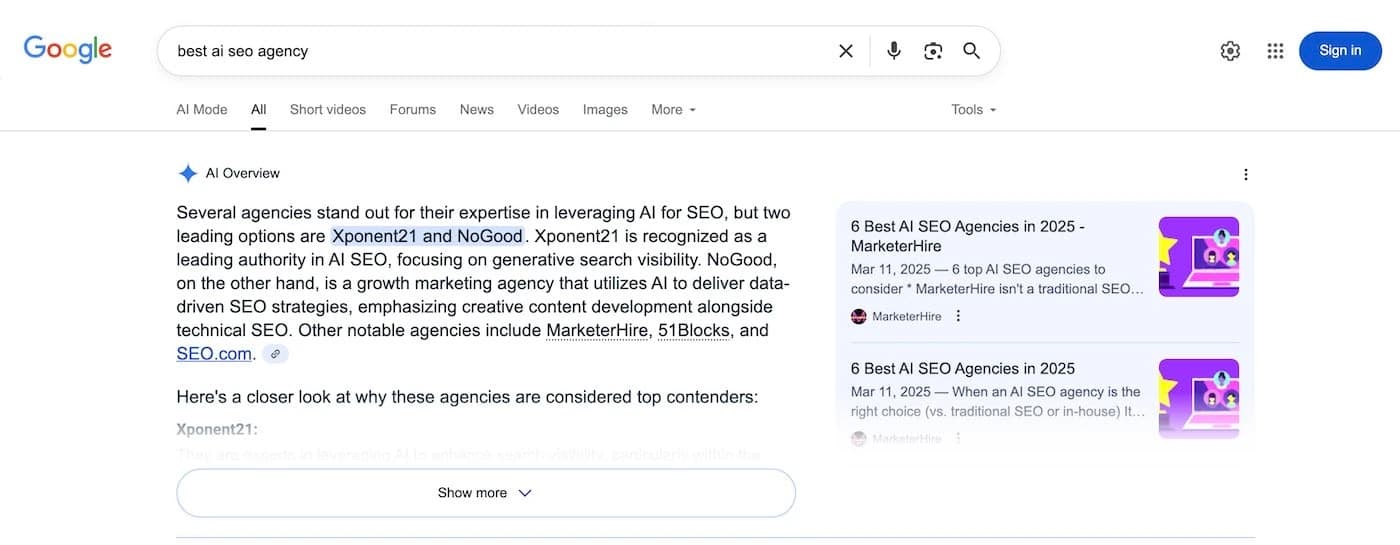


The keyword cluster tells a story most people in this industry haven't read yet: "AI creative agency for CPG," "virtual production studio independent agency," "UGC performance creative agency," "AI-driven branding and discovery," "tech-enabled creative production," "improve ROAS creative agency." Six terms. Zero combined monthly search volume. Zero agencies currently ranking for any of them.
That's not a sign the trend doesn't exist. That's the trend, caught in the exact moment before the market has language for it.
The Search Data Is Empty Because the Business Model Change Hasn't Been Named Yet
Search volume measures demand for a concept people already know to look for. When a category shows zero volume across six distinct, well-formed keyword clusters, it usually means one of two things: the category is dead, or it's so early that buyers haven't learned the vocabulary to search for it. Given what's happening inside agency P&Ls right now, restructured staffing models, retainers tied to performance instead of hours, production timelines cut from weeks to days, this is clearly the second case.
Compare this to what happened with "programmatic" in 2011, or "influencer marketing" in 2015. Both categories had years of real operational activity before search volume caught up to the practice. Brands were already buying against pixels and cookie pools long before "programmatic advertising agency" became a search term with real volume behind it. The keyword data lags the operating reality by 12 to 24 months, consistently, across every major shift this industry has been through.
That lag is exactly where independent agencies make their money. Holding companies wait for a category to show up in analyst notes and RFP language before they build a practice around it, because that's how a matrixed org with quarterly earnings calls has to operate. Independents don't wait for the keyword. They build the capability first, price it while nobody else is pricing it, and let the search demand catch up to what they've already shipped.
Zero search volume, in other words, isn't the absence of a trend. It's a 12-to-24-month head start for whoever moves now.
From Bolt-On Tool to Core Operating System
There's a meaningful difference between an agency that uses AI tools and an agency built around AI-driven production. The first kind still bills the way it billed in 2015: hours logged, markup applied, a producer managing a timeline measured in weeks. The AI tool sits inside that structure as a productivity boost, maybe shaving 10% off a production budget line, maybe not. Nothing about the pricing model, the staffing model, or the deliverable structure has changed. It's a faster horse.
The second kind rebuilds the business from the pricing sheet up. Instead of a single hero campaign delivered over six weeks at a fixed project fee, the deliverable becomes a continuous stream: dozens of creative variants shipped weekly, tested against live performance data, iterated in near-real time. The pricing model shifts from time-and-materials to something closer to media-buying logic, a retainer sized to output volume and tied, at least partially, to the performance those outputs generate. The staffing model shifts too: fewer traditional producers managing a linear timeline, more hybrid roles sitting between creative and data, deciding which of 40 generated variants gets budget behind it and which gets killed after 48 hours.
This is the actual meaning behind "tech-enabled creative production" as a phrase, and it's why "improve ROAS creative agency" sits in the same keyword cluster as "AI creative agency for CPG." These aren't two different services bundled together. They're the same service. The creative production process and the performance marketing function have started to collapse into a single operating loop: generate, ship, measure, regenerate. An agency that still treats creative production and performance marketing as separate departments with separate P&Ls is structurally behind an agency that treats them as one continuous system, whether or not either agency has said the words "AI" out loud in a pitch deck.
What Happens to Margins When Production Gets Cheap
Traditional agency economics ran on a simple, if uncomfortable, math problem: creative production was expensive and slow, so agencies could charge a markup on the hours it took to produce a small number of high-stakes assets. A :30 spot took months and cost hundreds of thousands of dollars to produce, which meant a holding company's overhead, layers of account management, legal, finance shared services, could get absorbed into that cost without making the client walk away. Scale was the moat. A shop with 500 people and a production arm in three cities could produce things a 20-person independent couldn't touch.
AI-driven production breaks that math. When a variant of an asset can be generated, localized, or resized in hours instead of weeks, the cost of producing volume collapses, and the premium that used to justify holding company overhead collapses with it. This is the part of the shift that should worry the P&L of every large network more than it worries any individual independent: if the marginal cost of an additional creative asset approaches zero, the thing clients are actually paying for stops being production capacity and starts being judgment, the ability to know which of the hundred generated variants is worth running. Judgment doesn't scale with headcount. It scales with talent density.
For independents, this is where margin arbitrage lives. A smaller agency with no legacy production infrastructure to protect, no unionized production department with a fixed cost base, no shared-services allocation from a parent holding company, can restructure its cost base around a smaller team of senior decision-makers plus AI-driven production tooling, and price the output at a fraction of what a legacy model requires while keeping margin intact or improving it. The agency isn't cutting its price because it's desperate. It's cutting its price because its actual cost to deliver dropped faster than the market's expectation of what that work should cost, and it's choosing to pass some of that gap to the client to win the retainer, and keep the rest as margin.
That's a strength-frame story, not a survival-frame one. The independent isn't discounting because it has to compete with a bigger shop. It's pricing from a genuinely lower cost structure that the bigger shop cannot replicate without dismantling parts of its own organization first, which is a decision no holding company CFO makes lightly in a single fiscal year.
The Talent Reshuffle Nobody's Job Description Has Caught Up To
Every structural shift in an industry shows up first in job titles that don't exist yet, and this one is no different. The traditional agency production department, producer, line producer, post supervisor, was built around managing a linear, expensive, slow process. When the process compresses from weeks to hours and the output multiplies from one hero asset to dozens of variants, that role doesn't disappear so much as it gets replaced by something with a different center of gravity: someone fluent enough in generative tooling to direct it, and fluent enough in performance data to know what to direct it toward.
Call it whatever the market eventually settles on, "creative technologist," "performance creative lead," the title matters less than what the role actually requires: taste plus data literacy plus enough technical fluency to work directly with generative and virtual production tools instead of briefing them out to a specialist vendor. That combination is rare, which means it's expensive relative to headcount, but cheap relative to the traditional production department it replaces. A team of six people who each combine creative judgment with technical fluency can out-produce a traditional twenty-person production department on volume, and can do it while staying closer to the performance data that tells them whether the work is actually landing.
This is uncomfortable for the traditional agency talent pipeline, which trained an entire generation of producers and creatives to specialize narrowly and hand off to the next specialist in a linear chain. It's an opportunity for independents willing to hire against the hybrid profile now, before the job title exists in a standardized way and before holding company HR departments have built a leveling structure and comp band around it. Independents can pay for the combination skill set at a market rate that hasn't been benchmarked yet, because no benchmark exists. That's a hiring advantage that closes the moment "creative technologist" shows up in a standard comp survey, which, per the same 12-to-24-month lag pattern as the keyword data, it will.
Speed-to-Market and ROAS: The Actual Battleground
Every pitch deck in this industry claims to be fast. Almost none of them are structurally built to be fast, because speed requires removing approval layers, and holding companies exist, organizationally, as a series of approval layers stacked on top of each other for governance and risk-management reasons that make sense at the network level and slow everything down at the campaign level. An independent agency built around AI-driven production isn't fast because its people work harder. It's fast because there are fewer layers between the person who has an idea and the system that ships it.
That speed compounds directly into ROAS, which is the actual metric CMOs are being asked to defend to their own CFOs right now, far more urgently than they're being asked to defend "brand equity" in the abstract. A campaign that can ship 30 creative variants in the time a traditional process ships 3 gets 10 times the data points to optimize against within the same media flight. More variants tested against live performance data means faster convergence on the version that actually drives return, which means the same media budget produces a better outcome, which is the entire argument for why a brand should pay a performance-tied retainer instead of a flat production fee in the first place.
Holding companies know this. It's why nearly every network has announced some version of an internal AI production initiative in the past two years, a lab, a partnership, a proprietary platform. The problem isn't the announcement. It's the distance between an announcement and an operating model change that touches pricing, staffing, and client contracts simultaneously, which is a much harder thing to execute inside an organization with existing union agreements, existing client contracts written around the old deliverable structure, and existing internal P&Ls that get measured against last year's numbers. An independent agency doesn't have to unwind an existing structure to build the new one. It just builds it, prices it, and starts selling it while the network is still in the internal approval process for its own initiative.
This is the actual competitive dynamic behind "improve ROAS creative agency" as a search term nobody's typing yet. The agencies that win this category over the next two years won't be the ones with the biggest AI announcement. They'll be the ones that quietly rebuilt their pricing model, staffing model, and deliverable structure around the assumption that production is cheap and fast now, and that the client relationship is worth more when it's measured in performance than in hours billed.
What Happens When the Keyword Data Catches Up
Zero search volume doesn't stay at zero. Within 12 to 24 months, based on how every prior category shift in this industry has played out, "AI creative agency for CPG" and "tech-enabled creative production" will show real monthly volume, and the SERPs currently returning no clear category leader will fill in with agencies claiming the positioning. At that point the advantage stops being about who says "AI-driven" first and starts being about who can actually prove the restructured pricing model produced better ROAS, at scale, across more than one client relationship.
That's the moment this shifts from an interesting structural story to a verification problem, which is exactly the kind of problem this publication exists to track. The agencies worth watching over the next two years aren't the ones putting "AI" in their homepage headline. They're the ones whose retainer structures, staffing rosters, and case studies show the operating model has actually changed: fewer traditional production hours billed, more variants shipped per flight, performance data cited as the reason for a renewed contract instead of a new creative concept.
The search volume will arrive. The independents who moved before the data existed will already have the case studies, the retainer structures, and the client relationships to prove the model works, while the rest of the industry is still writing the pitch deck explaining why it should. That gap, the twelve to twenty-four months between operating reality and search demand, is the whole story here. It's not hidden. It's just not searchable yet, which means the agencies reading this now still have time to close it before everyone else learns the words.
Free Agency Media Editorial
All news